The problem
A busy beach can look clean and still be full of litter. The big items, such as bottles and bags, are easy to see and pick up. The hard part is the small stuff: cigarette butts, bottle caps, shards of glass, sweet wrappers and broken plastic that get trodden into the sand. That material is slow and tiring to collect by hand, it is a cutting hazard for barefoot visitors, and the next storm or high tide carries it into the sea, where it breaks down into microplastics.
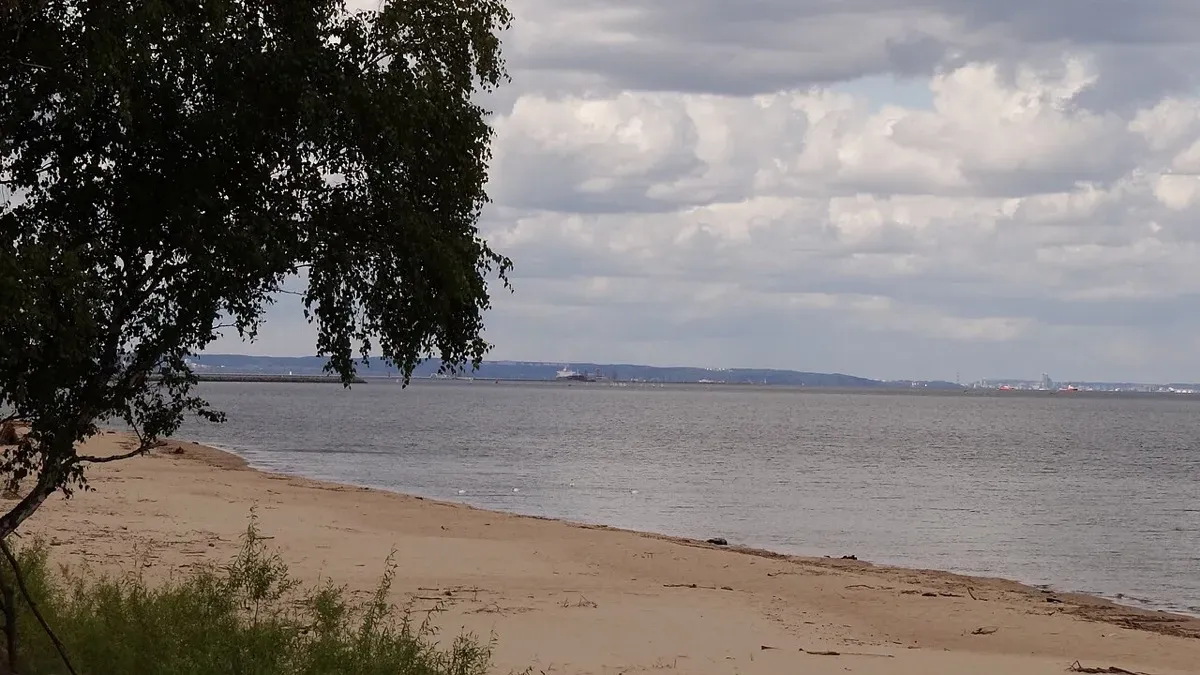
The scale is easy to underestimate. Gdańsk has 17 km of city beaches. On a sunny day 50,000 to 60,000 people can be on them at once, and in the 2024 summer season the city collected nearly 310 tonnes of waste from them. Heavy tractor-pulled beach cleaners can handle that volume, but they are noisy, burn diesel, compact the sand and can damage dune plants and the small animals that live in the strandline.
The product
BeBot is a compact, all-electric beach-cleaning robot made by The Searial Cleaners, a company of Wearth Group. Wearth is an industrial group based in the Ain department of eastern France that builds waterfront and land infrastructure; it says it is present in more than 30 countries and groups 12 companies. The Searial Cleaners is its marine and beach litter business, which also makes the PixieDrone water drone and floating litter traps.
The manufacturer’s specification sheet lists:
- a screening width of 130 cm and a screening depth of 10 cm;
- a cleaning capacity of up to 3,000 m² an hour;
- a 100-litre litter container;
- remote control from up to 150 m away (Gdańsk’s city reports quote 300 m);
- up to 3 hours of battery life and 8 hours for a full charge, with solar panels on the body;
- a top speed of 2.7 km/h, slopes of up to 20 degrees and towing of loads up to 400 kg.
It can also rake seaweed and level sand, and it carries safety LEDs, an emergency stop button and an optional audible warning, so it can work among beachgoers.
How it works
- Drive. An operator walks behind or near the robot and steers it with a remote control.
- Lift. A front blade lifts the top layer of sand, down to about 10 cm.
- Screen. The sand passes over a vibrating screen. Clean sand falls back onto the beach; anything larger than the mesh stays on top.
- Store. Litter is moved into the 100-litre container on the robot.
- Empty. The operator tips the container into a bin for sorting and disposal.
- Recharge. Batteries are charged from the grid overnight, with the body-mounted solar panels topping them up during work.
Timeline
| Date | Milestone |
|---|---|
| 2022 | BeBot deployed at Lake Tahoe, described by its US operator as a first for the US West Coast |
| Before 2025 | Finns beach club introduces BeBot in Bali, described as the first solar electric beach robot there |
| 30 Jul 2025 | Container terminal operator Baltic Hub hands a BeBot (about EUR 60,000) to Gdańsk’s sports centre for Stogi beach, the first in Poland |
| 17 Jun 2026 | Baltic Hub reports further beach support at Stogi, confirming the BeBot as part of its programme |
Impact and numbers
The Gdańsk deployment gives the clearest public figures. In tests, the robot collected about 8.5 kg of waste in 10 minutes, including cigarette butts, glass, plastic pieces and caps. The city estimated that with daily work over half a year, BeBot could collect up to 27.5 tonnes of litter. That would still be well under a tenth of the 310 tonnes collected from Gdańsk’s beaches in a season, which shows its role: a precise tool for the dirtiest spots, not a replacement for the whole cleaning service.
The beach operator plans to use it mainly on intensively used areas such as beach volleyball courts, where trodden-in litter is worst. City officials stressed that it is quiet and emits no exhaust, so it can work while people are on the beach, and the funder’s sustainability lead said it does not disturb the natural structure of the beach.
Outside Europe, the US operator at Lake Tahoe and the Finns beach club in Bali both describe hundreds of kilograms removed. Those quotes come from the manufacturer’s website, so they are best read as customer testimonials, not audited data.
Honest caveats
Battery life is short. Up to 3 hours of work against an 8-hour full charge means one robot covers a limited area each day. Large beaches need several units or a mix with conventional machines.
It sieves everything. Screening the top layer removes litter but also disturbs sand-dwelling invertebrates, seeds and the wrack line that birds feed on. The manufacturer says it protects plant and animal life, but operators still need to keep it away from dunes, nests and protected strandline zones.
Small mesh, small limits. Very small fragments and microplastics pass through the screen with the sand.
Estimates, not measurements. The 27.5-tonne figure for Gdańsk is a projection, and the US and Bali numbers are testimonials. No independent study of BeBot performance was found.
Upstream first. No beach robot reduces the litter people bring. Ashtrays, deposit schemes and enforcement matter more over time.
What’s next
The Gdańsk model, where a local port company pays for a robot that the city’s sports centre runs, is a template other coastal cities can copy. Baltic Hub’s 2026 package for Stogi beach shows that such sponsorship can grow into a wider long-term programme. For The Searial Cleaners, BeBot sits alongside water-based tools, so a city can tackle litter on the sand and in the harbour with one supplier.
Why it matters for Europe and green buyers
For Europe, BeBot fits the EU’s single-use plastics rules and Blue Flag beach standards, which push councils to show that they keep beaches clean without harming the coast. It is a French-made, all-electric machine that a municipal worker can run after short training, at a price, around EUR 60,000 in Gdańsk, that local sponsors can cover. Seaside towns that want to cut diesel use on their beaches have a concrete, low-noise option.
For India, the need is obvious on crowded city beaches such as those in Mumbai, Chennai, Goa and Puri, where volunteers regularly pull tonnes of plastic and cigarette butts out of the sand. A robot like this would not replace large clean-up drives, but it could help keep high-use stretches clean between them. Indian buyers would need to check how the screen copes with wet, heavy sand and monsoon debris, and whether local service and spare parts are available.
Sources & image credits
- The Searial Cleaners, BeBot product page and specifications. https://www.searial-cleaners.com/our-solutions/bebot-the-beach-cleaner/
- The Searial Cleaners, “The Searial Cleaners, a Wearth Group company”. https://www.searial-cleaners.com/the-searial-cleaners-a-wearth-group-company/
- Baltic Hub, “BeBot: Poland’s first autonomous beach-cleaning robot”. https://www.baltichub.com/en/news/bebot-poland-s-first-autonomous-beach-cleaning-robot
- Gdańsk City Hall press office, “BeBot na plaży Stogi” (30 Jul 2025). https://media.gdansk.pl/komunikaty/855802/bebot-na-plazy-stogi-pierwszy-taki-robot-w-polsce-juz-dziala-w-gdansku
- gdansk.pl, “Czesze plażę, szuka śmieci. BeBot już pracuje na Stogach” (30 Jul 2025). https://www.gdansk.pl/wiadomosci/Czesze-plaze-szuka-smieci-BeBot-juz-pracuje-na-Stogach,a,293047
- WhiteMAD, “BeBot: a robot that cleans beaches appeared in Gdańsk”. https://whitemad.pl/en/bebot-a-robot-that-cleans-beaches-appeared-in-gdansk/
- IntermodalNews, “Baltic Hub wzmacnia bezpieczeństwo, atrakcyjność oraz dostępność plaży Stogi” (18 Jun 2026). https://intermodalnews.pl/2026/06/18/baltic-hub-wzmacnia-bezpieczenstwo-atrakcyjnosc-oraz-dostepnosc-plazy-stogi/
- Wikimedia Commons, “Gdańsk Stogi, plaża 05.jpg”. https://commons.wikimedia.org/wiki/File:Gda%C5%84sk_Stogi,_pla%C5%BCa_05.jpg
Images: “Gdańsk Stogi, plaża 05”, Marfryd6360, 21 August 2014, CC BY-SA 3.0, via Wikimedia Commons. Illustrative: shows the beach, not the robot.