
The problem
Most marine litter does not start at sea. It blows off quaysides, washes out of storm drains and floats down rivers into harbours, where wind pushes it into the corners of docks and marinas. Those corners are exactly where large cleaning boats cannot go and where staff with nets on poles spend hours fishing out bottles, crisp packets and polystyrene. Toronto’s port authority puts the problem plainly: researchers estimate that about 10,000 tonnes of waste enter the Great Lakes every year, much of it plastic.
Ports also face a second, quieter problem: floating biomass. Duckweed, algae and invasive water plants clog intakes, block light and use up oxygen as they rot. Removing them by hand is slow, and removing them with diesel boats adds noise and fumes to the water that is being cleaned.
The product
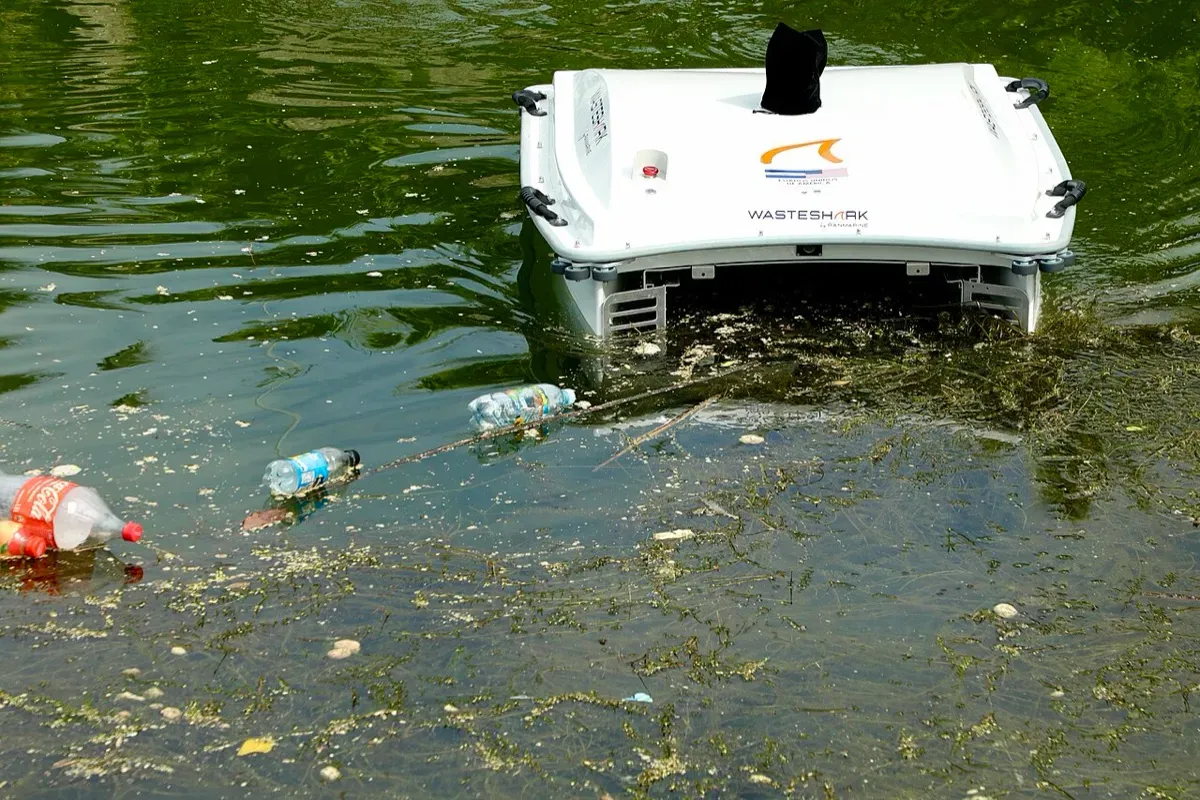
RanMarine Technology, based at Galileistraat 15 in Rotterdam, has been building the WasteShark since 2016. The company describes it as an aquadrone: a twin-hulled, electric surface vessel that drives through the water with an open mouth between its hulls, letting floating debris flow into a basket.
On 2 February 2026 RanMarine launched the new WasteShark+, which it says is built in the Netherlands and designed as a professional tool rather than a gadget. The main changes are aimed at operators:
- a 7-inch 1080p HD remote control with live video up to about 750 metres away;
- 1 kW rim-drive thrusters, which have no exposed propeller hub and are meant to resist tangling in weed and fishing line;
- 48-volt batteries from the Dutch supplier Cleantron, giving up to 8 hours of runtime and about 12 km of travel per charge;
- wet charging, so the drone can be topped up without lifting it out of the water;
- a floating 160-litre basket that can be swapped in seconds, plus a wheeled SharkTrolley for launching.
The WasteShark sits in a wider family. The CyanoShark is set up for algae, the MegaShark is a larger version for open basins, and the OilShark carries absorbent material for small oil sheens.
How it works
- Launch. The drone is wheeled to a slipway or pontoon on its trolley and lowered into the water.
- Drive. An operator steers it with the HD remote, watching the onboard camera, or sends it along a preset route. The rim-drive thrusters push it slowly through debris fields.
- Collect. Floating litter and plant matter flow between the hulls into the basket. Water drains out through the mesh.
- Swap. When the basket is full, it is unclipped and floated off, and an empty one is clipped in.
- Record. Location data shows where litter gathers, which helps ports find the drains, outfalls or events that cause it.
- Recharge. The drone returns to its dock and charges, in some setups while still afloat.
Timeline
| Date | Milestone |
|---|---|
| 2016 | First WasteSharks deployed, according to RanMarine’s fleet counter |
| Summer 2023 | Toronto Port Authority pilots two WasteSharks, named Ebb and Flow by public vote |
| 2 Feb 2026 | WasteShark+ launched, built in the Netherlands, with HD remote, rim drives and Cleantron batteries |
| 14 May 2026 | RanMarine joins Green Marine, the North American environmental certification programme for the maritime industry |
| 26 to 27 Jun 2026 | WasteShark demonstrations in Baku Bay, Azerbaijan |
Impact and numbers
The strongest independent evidence comes from Toronto, because the port publishes its results with the University of Toronto Trash Team. RanMarine’s own case study says three WasteShark deployments matched the full-season output, by weight, of eight fixed floating bins, and that the drones reached harbour zones that had been out of reach. The drones were especially good at larger items such as bottles, bags and food wrappers, and their geo-referenced logs fed the researchers’ work on where the pollution comes from.
The port’s own figures are more sobering. Between May and October 2025 its whole network of traps removed 525 kg of debris and about 147,000 items from the harbour. The two WasteSharks contributed over 5,100 pieces of litter, weighing about 5 kg in total. The port lists the drones’ capacity at up to 180 litres per trip and up to about 500 kg of waste a day, but actual catch depends on how much litter is there and how often the drones go out.
At company level, RanMarine says its fleet works on four continents and has collected millions of litres of waste since 2016. Those numbers come from the company and have not been independently audited.
Honest caveats
It is a surface tool. The WasteShark only catches what floats. Sunken litter, microplastics in the water column and fibres in sediment stay where they are.
Results depend on operations. Toronto’s 5 kg in a season shows that a drone used occasionally in a fairly clean harbour will not move tonnes. The same machine in a weed-choked canal can fill its basket in minutes.
It treats the symptom. Every bottle removed is a bottle that did not reach the sea, but the real fix is upstream: bins that do not overflow, storm drain filters and less single-use packaging. The Toronto programme pairs its drones with drain traps for that reason.
Company data. Fleet-wide totals and many performance claims come from RanMarine’s own marketing. The Toronto data is a useful check, but it is one site.
Wildlife. Slow-moving drones can still disturb nesting birds or catch small animals in weed. Operators need local rules on when and where to run them.
What’s next
RanMarine’s membership of Green Marine in May 2026 points at the North American port market, where environmental certification increasingly rewards measurable litter and water quality work. The Baku Bay demonstrations in June 2026 show interest from cities with polluted urban bays. The company’s next selling point is data: if each drone becomes a moving sensor that maps where litter collects, ports can use it to target the sources rather than just the symptoms.
Why it matters for Europe and green buyers
For Europe, the WasteShark+ is a small, locally built answer to obligations under the Marine Strategy Framework Directive and the push to cut plastic at source. Dutch, Belgian and German ports, city canals and marinas can buy or lease a quiet, zero-emission machine that a single trained person can run, and that produces data for litter reporting. The fact that it is built in the Netherlands with Dutch batteries also helps public buyers who want a short, traceable supply chain.
For India, the relevance is the same problem at a much larger scale: city lakes, temple tanks and harbour fronts choked with plastic and water hyacinth. A drone like this is not a substitute for waste collection on land, but in a lake or harbour with a regular cleaning routine it can do work that today relies on manual labour in difficult conditions. Indian buyers will want to compare it with home-grown cleaning robots on price, service and how it handles heavy weed.
Sources & image credits
- RanMarine, “The WasteShark is here: professional power, precision control” (launch news, 2 Feb 2026). https://www.ranmarine.io/news/the-wasteshark-is-here-professional-power-precision-control/
- RanMarine, WasteShark product page. https://www.ranmarine.io/wasteshark/
- RanMarine, Green Marine membership news (14 May 2026). https://www.ranmarine.io/news/green-marine/
- RanMarine, Baku Bay demonstration news (June 2026). https://www.ranmarine.io/news/bakubay/
- RanMarine, PortsToronto success story. https://www.ranmarine.io/success_story/toronto/
- Toronto Port Authority, Trash Trapping Program page, including 2025 results. https://www.torontoportauthority.com/about-us/environment/trash-trapping-program/
- Toronto Port Authority media, “Trash Trapping Program traps 147,000 pieces of plastic from Lake Ontario in latest cleanup effort”. https://media.torontoportauthority.com/trash-trapping-program-traps-147000-pieces-of-plastic-from-lake-ontario-in-latest-cleanup-effort/
- Wikimedia Commons, “Donativo Drones Acuáticos (53787419333).jpg”. https://commons.wikimedia.org/wiki/File:Donativo_Drones_Acu%C3%A1ticos_(53787419333).jpg
Images: “Donativo Drones Acuáticos”, U.S. Embassy San Salvador, 12 June 2024, public domain (work of the U.S. government), via Wikimedia Commons. Shows an earlier WasteShark model; used for illustration.

.jpg)