
The problem
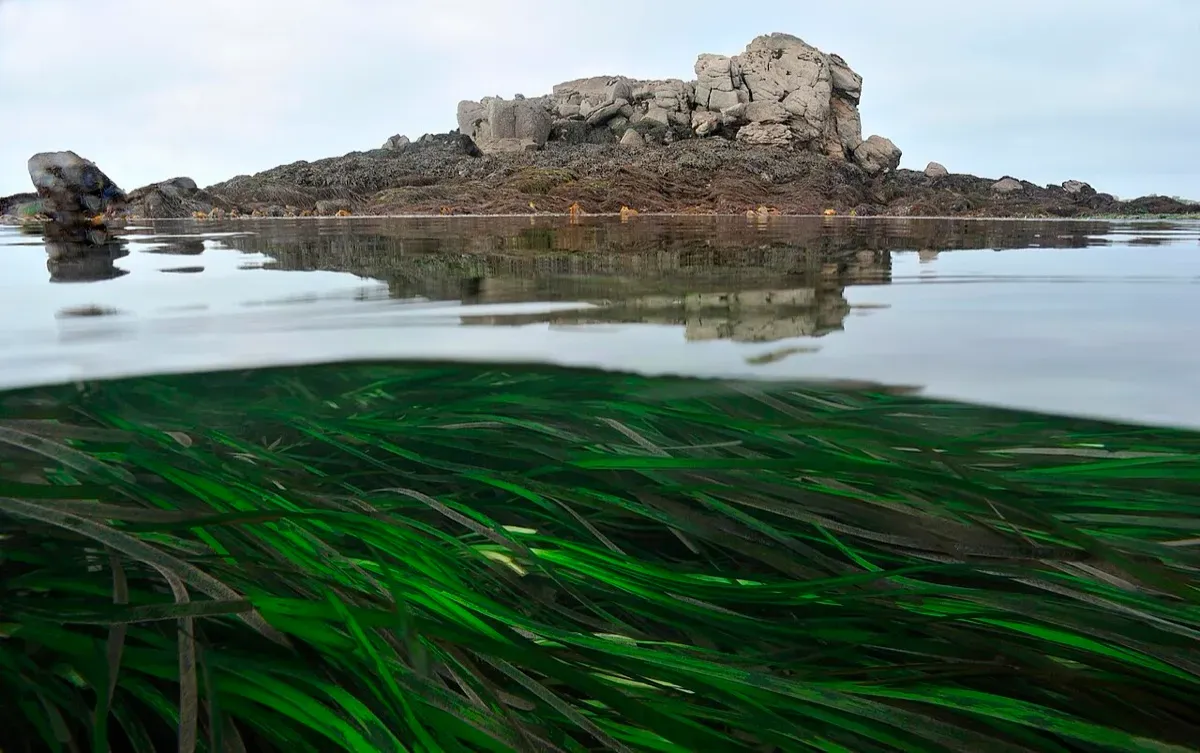
Seagrass meadows are among the most valuable habitats in shallow seas. They shelter young fish, calm waves, hold sediment in place and store carbon in their roots and in the mud below. They have also been lost on a huge scale. In the UK, up to 92% of seagrass may have disappeared, according to restoration groups quoted by the BBC, through pollution, disease, dredging and boat moorings.
Restoring seagrass is possible but slow. Most projects use divers or volunteers who push seeds into the sediment by hand, or plant shoots one by one. A diver can only work for limited periods in cold water, so projects that cover a few hectares take years. To make a real difference, restoration needs to move from square metres to hectares.
The product
Reefgen was started in San Francisco by the technologist Tom Chi and is led by chief executive Chris Oakes. Its first robot idea, Cora, was aimed at corals. The team found seagrass a better first target and built Grasshopper.
The Grasshopper weighs about 23 kg. It sits on the seabed and is guided from a boat above along a transect line. A bag of seeds mixed with mud, holding about 20,000 seeds in 20 litres, feeds the robot. At each step it injects a small amount of seed and mud slurry into the sediment, then hops forward about 30 cm and repeats. The company says it can plant up to about 60 seeds a minute, much faster and more evenly than divers.
How it works
- Collect seeds. Partners harvest seed-bearing shoots from healthy meadows in summer and store the seeds until planting.
- Mix. Seeds are mixed with mud into a slurry and loaded into the 20-litre bag.
- Lower. The robot is lowered from a boat onto the seabed at the restoration site.
- Plant. The pilot drives the robot along a line, and it injects seed slurry at regular spacing as it hops.
- Repeat. The boat moves the line and the robot plants the next strip.
- Monitor. Divers return months later to count shoots and map how much of the plot has grown.
Timeline
| Date | Milestone |
|---|---|
| Jun 2022 | First seagrass planting with Grasshopper at Catalina Island, California, which the company calls a world first |
| Jun 2023 | Grasshopper (nicknamed “Shack”) plants seagrass at Dale, Milford Haven, Wales, with Project Seagrass, WWF and Swansea University |
| 2023 to 2024 | Trials in Bali with the Indonesian marine group LINI |
| Apr 2024 | Second Welsh deployment; partners report about 300% higher planting efficiency |
| Jul 2024 | Work starts in Puget Sound, Washington, continuing to Oct 2025 |
| Oct 2024 | 1,000 seeds planted in 1,000 m² in North Carolina with the UNC Institute of Marine Sciences |
| Jun 2025 | Further LINI trials in Bali, with seed losses to waves |
| 29 Jul 2026 | Preprint reports 18-month results from Wales |
Impact and numbers
The most useful data comes from the Welsh site at Dale. A preprint posted on EcoEvoRxiv on 29 July 2026, written by Richard Unsworth of Swansea University and Project Seagrass with colleagues and Reefgen’s Chris Oakes, reports that the robot planted 25,550 eelgrass seeds over about 200 m² in 31.5 hours of work. After 18 months, at least 102 m² had established seagrass, about 51% of the planted area, with an average density of 56 shoots per square metre, give or take 23.
Those results are promising for a method that has to compete with hand planting, where seed-based projects often see very low survival. The Welsh partners also reported that the robot improved planting efficiency by about 300% compared with their earlier methods.
In the US, CNN reported in December 2024 that Reefgen was working on both coasts. In Puget Sound it worked with the conservation group Seacology around the San Juan Islands, and in North Carolina with university scientists. In Bali, LINI reported in August 2025 that trials had taught important lessons, including losses of seeds to wave action in shallow, exposed sites.
Honest caveats
Not yet peer reviewed. The 51% establishment figure is from a preprint. It may change during review, and it comes from a single site.
Seeds are the bottleneck. The robot plants faster, but seed has to be harvested from healthy meadows, which limits how much can be collected without harming donor beds.
Site conditions decide. Wave exposure, poor water quality, warm water and disease can wipe out new plants. The Bali trials show that the robot cannot fix a bad site.
Carbon claims need care. Seagrass stores carbon, but measuring how much a young meadow adds is hard. Buyers of “blue carbon” credits from robot-planted beds should expect years of monitoring first.
Boat and crew still needed. The robot reduces diving time, but it still needs a boat, a pilot and support staff, so costs per hectare are not yet public.
What’s next
Reefgen’s aim is to move from plots of a few hundred square metres to hectare-scale meadows. Peer review of the Welsh study, and comparable data from the Puget Sound and North Carolina projects, will show whether the results hold up elsewhere. Lower cost per hectare and repeatable survival will decide whether governments and port authorities include robot planting in their restoration plans.
Why it matters for Europe and green buyers
For Europe, the Welsh trials are the headline. The UK, France, Denmark and other coastal states have lost most of their historic eelgrass, and the EU Nature Restoration Law sets targets for restoring marine habitats, including seagrass. A robot that plants faster than divers could help restoration groups and harbour authorities reach those targets, especially in cold northern waters where diving time is short. European buyers should insist on independent, multi-year survival data before scaling up.
For India, seagrass beds in the Gulf of Mannar, Palk Bay, Chilika Lagoon and the Andaman and Nicobar Islands support dugongs, fisheries and coastal livelihoods, and they are under pressure from trawling and sediment. Seed-based planting of tropical seagrass species is still at an early stage, so a robot like Grasshopper would need local trials and local seed sources. It is a technology to watch and test, not yet one to buy at scale.
Sources & image credits
- Reefgen, deployments page. https://www.reefgen.io/deployments
- CNN, Reefgen robots and seagrass restoration (9 Dec 2024). https://www.cnn.com/climate/reefgen-robots-seagrass-ocean-restoration-spc
- Unsworth, Fox, Rees, Oakes and colleagues, robotic eelgrass seeding at Dale, Wales, EcoEvoRxiv preprint 13900 (posted 29 Jul 2026, not peer reviewed). https://ecoevorxiv.org/repository/view/13900/
- BBC News, robot plants seagrass in Pembrokeshire (29 Jun 2023). https://www.bbc.co.uk/news/uk-wales-66050848
- Project Seagrass, Dale restoration project. https://projectseagrass.org/dale/
- LINI, “Planting the future: LINI and Reefgen pioneer robotic seagrass restoration” (12 Aug 2025). https://lini.or.id/planting-the-future-lini-and-reefgen-pioneer-robotic-seagrass-restoration/
- Seacology, Decatur, Sucia and Shaw Islands project. https://www.seacology.org/project/decatur-sucia-and-shaw-islands/
- Wikimedia Commons, “Herbier à zostère (Zostera marina) (Ifremer 00567-67906 - 43877).jpg”. https://commons.wikimedia.org/wiki/File:Herbier_%C3%A0_zost%C3%A8re_(Zostera_marina)_(Ifremer_00567-67906_-_43877).jpg
Images: “Herbier à zostère (Zostera marina)”, Olivier Dugornay (Ifremer), CC BY 4.0, via Wikimedia Commons. Illustrative: shows an eelgrass meadow, not the robot.

_(Ifremer_00567-67906_-_43877).jpg)