The problem
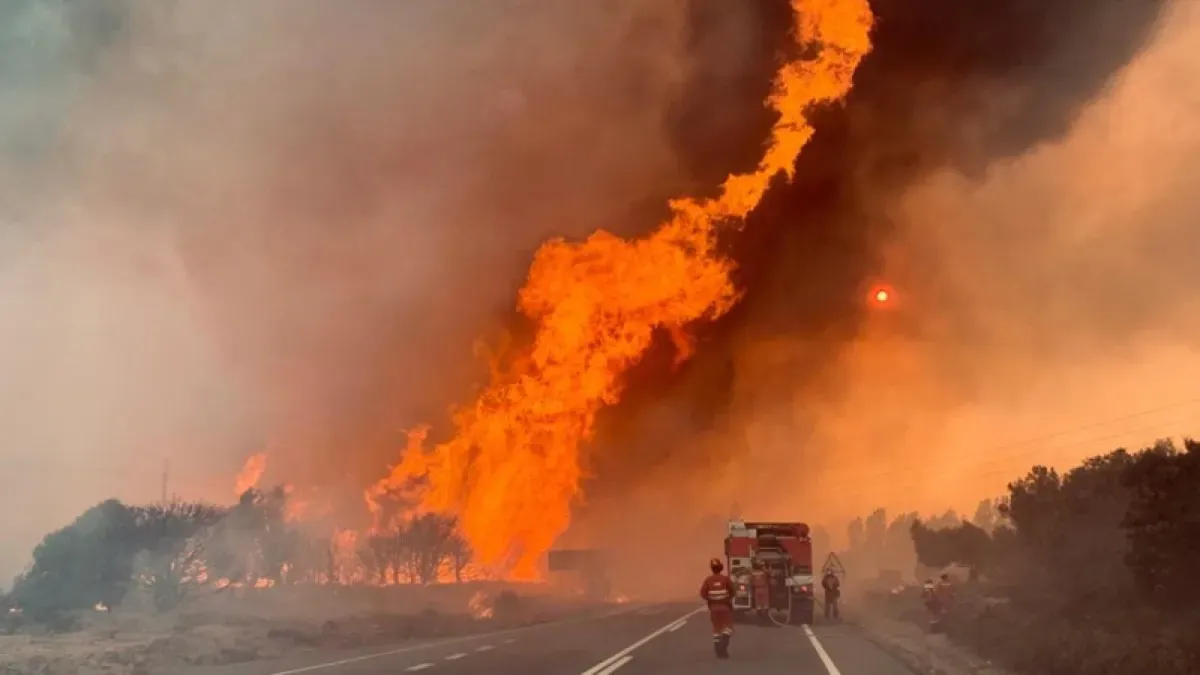
Spain loses large areas of forest to fire almost every summer. In June 2022 the fire in the Sierra de la Culebra in Zamora alone burned about 30,800 hectares. After a fire, hillsides are steep, covered in ash and often far from roads. Replanting them by hand means growing seedlings in nurseries, carrying them up the slopes and planting each one, which is slow and expensive. Waiting for the forest to come back by itself can take decades, and in the meantime soil washes away in autumn storms.
The big question in restoration is therefore how to get the right native seeds into the ground over a large area, quickly and at a low cost, without heavy machinery that damages the soil further.
The product
CO2 Revolution was constituted in February 2018 by Juan Carlos Sesma, an entrepreneur from Navarra. Its product has two parts.
The first is the iSeed, a coated seed of a native species such as oak, holm oak, cork oak, pine or chestnut. Together with IDForest, a forestry research company from Palencia whose founder Jaime Olaizola acts as CO2 Revolution’s external R&D director, the company developed and patented a capsule that contains mycorrhizal fungi to help young roots, clay additives that soak up and hold rainwater, and wildlife deterrents so that birds and rodents do not eat the seed. Seeds are selected and, in some cases, pre-germinated.
The second part is the drone. In 2019 the company described a modified commercial drone fitted with a 3D-printed dispenser. Each flight lasted about eight minutes, covered three to four hectares and could fire up to 9,000 seeds. By 2023 the company said its drones carried a 10 kg tank and could dispense up to about 450,000 seeds a day.
How it works
- Plan. Foresters and the landowner, often a regional government, choose the site and the mix of native species. The company maps the area, often from drone images.
- Prepare. Seeds are collected, treated and encapsulated as iSeeds.
- Fly. A pilot flies the drone over the site along planned lines, firing seeds at set spacing.
- Germinate. With autumn and winter rain, the clays release water to the seed and the fungi help the first roots.
- Check and reseed. Plots are surveyed. In dry years, when germination is poor, sites are reseeded.
Timeline
| Date | Milestone |
|---|---|
| Feb 2018 | CO2 Revolution constituted in Spain |
| 2019 | Alto Tajo project (Alcoroches, Guadalajara) on land burned in 2012; company reports 1.6 million trees sown |
| Jun 2022 | Company offers to help reforest the Sierra de la Culebra after a 30,800 ha fire |
| Sep 2022 | IDForest partner cites an average germination of about 10%, and more than 50% at Borela, Pontevedra |
| May 2023 | Company cites 450,000 seeds a day, 600,000+ trees on about 1,200 ha, and an 80% average germination |
| 2023 | 218,479 trees on 195 ha in Galicia, up 183% on the year before |
| 2024 | Expansion to Latin America, including Colombia and a 500,000-seed project in Honduras |
| May 2024 | University of Granada researchers say drone seeding success in Spain has so far been practically zero |
Impact and numbers
The company’s numbers are large. In 2019 it said its method had about 80% better odds of rooting than unprotected seeds and cost about a tenth of conventional planting. In May 2023 it told Forbes Spain it had grown more than 600,000 trees on about 1,200 hectares and that these would capture around 300,000 tonnes of CO2 over their life, with average germination of 80%.
In Galicia, the regional press reported 218,479 trees on 195 hectares in 2023, mostly in Avión (135,289) and Cercedo-Cotobade (83,190), funded by corporate sponsors buying restoration for their climate programmes. The best documented local result is Borela in Pontevedra, burned in 2006, 2016 and 2017, where the R&D partner reported more than 50% efficiency.
The numbers do not all line up. In September 2022 the same R&D partner said germination “can be around 10% on average”, adding that this was acceptable because a drone costs the same whether it carries one kilo of seeds or ten. A forest needs about 1,100 to 1,500 trees per hectare, so the gap between 10% and 80% is the difference between success and failure.
Honest caveats
Seeds are not trees. “Trees sown” and “trees grown” are often blurred. The 1.6 million figure for Alto Tajo in 2019 refers to seeds fired, not surviving saplings.
Weak peer-reviewed evidence. In 2023, Spanish ecologists led by Jorge Castro published a paper in Restoration Ecology titled “Forest restoration is more than firing seeds from a drone”. They found no peer-reviewed evidence that drone seeding produces lasting tree recruitment at scale, and they warned that hype could divert funds from proven methods.
Field results in Spain. In May 2024, University of Granada researchers working with a restoration company said the success of drone seeding in Spain had so far been “practically null”, and launched a project to find out why.
Drought sensitivity. The company itself says dry years cut germination and require reseeding.
Overlap with other seed-drone firms. This story sits close to other drone seeding companies in this series. CO2 Revolution is included for its Spanish, wildfire-focused model, not because the method is new.
Freshness. The most recent public project figures found date from 2024.
What’s next
The real next step is measurement. If CO2 Revolution and its partners publish long-term survival counts for sites like Borela and the Galician projects, measured by independent foresters, the method can be judged fairly. The company’s move into Latin America shows demand from buyers of nature-based carbon and restoration projects, which makes independent verification more urgent, not less.
Why it matters for Europe and green buyers
For Europe, wildfire recovery is now a yearly cost in Spain, Portugal, Greece and Italy, and the EU Nature Restoration Law will push member states to restore degraded land at scale. Drones carrying native seeds could reach steep, remote burned slopes that crews cannot. But public bodies and companies paying for “trees planted” should ask for survival data at three and five years, not seed counts, and should combine seeding with proven planting where it matters most.
For India, where states run large afforestation drives and seed-ball campaigns on degraded hills, the Spanish experience is a useful warning. Seed drones may be a cheap way to cover ground, but without good seed, the right season, follow-up surveys and protection from grazing, most seeds will not become trees. Indian buyers should insist on the same survival evidence.
Sources & image credits
- El Confidencial, drone reforestation after fires, Alto Tajo project (16 Jun 2019). https://www.elconfidencial.com/tecnologia/2019-06-16/incendio-verano-drones-reforestacion_2072167/
- Forbes España, “Los drones de CO2 Revolution permiten dispensar hasta 450.000 semillas por día” (24 May 2023). https://forbes.es/empresas/284134/los-drones-de-co2-revolution-permiten-dispensar-hasta-450-000-semillas-por-dia-para-reforestar-bosques/
- Forbes España, CO2 Revolution expands to Colombia. https://forbes.es/actualidad/300448/el-proyecto-pionero-made-in-spain-de-co2-revolution-da-el-salto-a-latinoamerica-para-reforestar-en-colombia/
- Zamoranews, CO2 Revolution offers to reforest after the Sierra de la Culebra fire (24 Jun 2022). https://www.zamoranews.com/articulo/provincia/co2-revolution-brinda-reforestar-zamora-incendio-sierra-culebra/20220624143025213465.html
- La Razón (EFE), “Una lluvia de semillas inteligentes reforesta bosques quemados desde drones” (3 Sep 2022). https://www.larazon.es/castilla-y-leon/20220903/xjaeptcgj5exfpoclregqqzrxi.html
- La Voz de Galicia, Galician forests restored with drones and smart seeds (23 Jun 2024). https://www.lavozdegalicia.es/noticia/mercados/2024/06/23/bosques-gallegos-recuperados-drones-semillas-inteligentes/0003_202406SM23P10991.htm
- El Independiente de Granada, project to make drone forest seeding work after failures (7 May 2024). https://www.elindependientedegranada.es/economia/proyecto-pionero-busca-garantizar-exito-siembra-forestal-con-drones-fracasada-ahora
- Castro, J. et al. (2023), “Forest restoration is more than firing seeds from a drone”, Restoration Ecology. https://doi.org/10.1111/rec.13736
- Wikimedia Commons, “Medios de extinción actuando en el incendio de la Sierra de la Culebra.jpg”. https://commons.wikimedia.org/wiki/File:Medios_de_extinci%C3%B3n_actuando_en_el_incendio_de_la_Sierra_de_la_Culebra.jpg
Images: “Medios de extinción actuando en el incendio de la Sierra de la Culebra”, Álvaro Las Heras, 20 June 2022, CC BY-SA 4.0, via Wikimedia Commons. Illustrative: shows the fire, not CO2 Revolution’s drones.