The problem
Every year, more than 8 million tonnes of plastic end up in the oceans, and 60% to 80% of it is thought to come from rivers, according to Plastic Smart Cities (Plastic Smart Cities). Bags, bottles, wrappers and foam break into ever smaller pieces, entangle wildlife and enter food chains.
Catching plastic in rivers is cheaper than chasing it across the sea, but rivers are working waterways. Booms and hard installations that cross a channel can block shipping and fish migration, and they mostly catch what floats at the surface. Much of the plastic in a river is suspended in the water column, where surface skimmers cannot reach it.
The product
The Bubble Barrier has three parts: a bubble screen, a catchment system and an air supply (Waterforum).
- Bubble screen: a perforated tube on the riverbed releases a steady stream of air, creating an upward current that lifts floating and suspended plastic to the surface.
- Diagonal layout: because the tube runs at an angle across the river, the natural flow pushes the lifted plastic sideways toward the bank.
- Catchment: a trap at the riverbank holds the plastic until it is removed.
- Air supply: a compressor on shore, which in Amsterdam runs on renewable energy, keeps the curtain going 24 hours a day.
The barrier covers the full width and depth of the waterway, lets fish and boats pass, and gently aerates the water, which can improve oxygen levels for aquatic life (Dutch Water Sector).
How it works
- Lift: air bubbles rise from the tube and carry plastic toward the surface.
- Steer: the river’s current and the angle of the curtain move the plastic toward one bank.
- Trap: the plastic enters the catchment system and stays there.
- Empty: local partners regularly remove the catch.
- Count: in Amsterdam, a year of catches was counted, analysed and sorted with Waternet and the Plastic Soup Foundation to trace where the waste came from.
Timeline
| Date | Milestone |
|---|---|
| 2017 | Founded; 180 m pilot in the IJssel with Rijkswaterstaat, Deltares and BAM/vdHerik |
| Nov 2019 | First long-term barrier opens in Amsterdam’s Westerdok |
| 4 Jul 2022 | Limes Bubble Barrier opens in the Oude Rijn at Katwijk, the first in a river mouth |
| 2023 | First international and first estuarine barrier piloted in the Ave River, Vila do Conde, Portugal, under the EU-funded MAELSTROM project |
| 2024 | Harlingen barrier installed |
| 2025 | Amsterdam passes one million pieces of plastic caught; MAELSTROM wins a Blue Rivers and Lakes award |
| 2026 | Finalist for the Zayed Sustainability Prize, Water category |
Impact and numbers
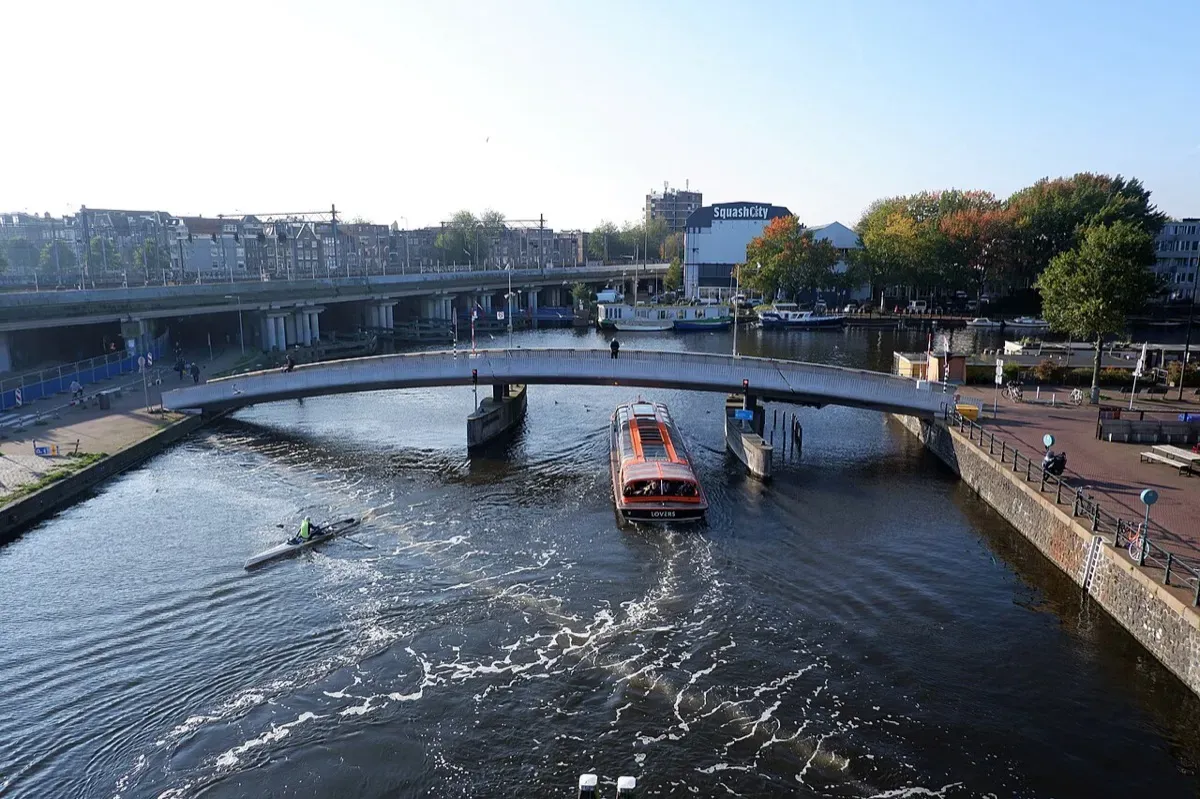
- Amsterdam: the Westerdok barrier catches on average about 15,000 pieces, roughly 80 kg, of waste a month, and passed one million pieces in 2025. It complements daily clean-ups by the water company Waternet, catching plastic that would stay below the surface (Dutch Water Sector).
- Katwijk: more than 1 million pieces of plastic, over 2 tonnes, reach the North Sea through Katwijk each year. Volunteers from Coast Busters, a local anti-plastic foundation, first counted tiny green plastic fragments by hand at the pumping station, which shocked local leaders into action; many municipalities from Woerden to Katwijk joined in. Larger debris is often already fished out upstream at the pumping station, so the barrier there mainly catches the smaller pieces (Omroep West). The barrier was paid for through Coast Busters’ crowdfunding, with money from municipalities, the Rijnland water authority and businesses (Waterforum).
- Portugal: the Vila do Conde estuary pilot was adapted to tidal reversals and caught an estimated 2,700 items, about 17 kg, a month. The municipality intends to keep it running.
- Testing: the first proof of concept was a 10 m barrier in Berlin, followed by tests in the Deltares water laboratory and the 180 m IJssel pilot in November 2017. Before Amsterdam, a pilot showed that 86% of all test materials were caught (Plastic Smart Cities).
- Recognition: in 2026 the enterprise was one of 33 Zayed Sustainability Prize finalists chosen from more than 7,700 entries.
Honest caveats. The amounts caught are small: 80 kg a month in Amsterdam, 17 kg a month in Vila do Conde, against the tonnes of plastic each river carries. The 86% figure comes from a pilot with test materials, not a continuous measure of real-world capture, and the company’s own monthly counts are not independently audited. Running compressors around the clock uses energy, and the system needs regular emptying and maintenance. As the Dutch Water Sector notes, many governments must clean streets but have no mandate to remove waste once it is in a river, so funding is scarce and the enterprise has struggled to find long-term investors. Only four long-term barriers exist after eight years. Most of all, a barrier catches plastic that has already escaped; cutting waste at source matters more.
What’s next
With funding from the Dutch Water Innovation Fund, the company is developing a new installation method to make barriers easier to deploy (HHNK), and it is preparing projects with other European cities and river authorities.
Why it matters for Europe / green buyers
The EU’s Zero Pollution Action Plan aims to cut plastic litter at sea by 50% and microplastics released into the environment by 30% by 2030 (European Commission). The Commission’s own tracking finds microplastics off track (European Commission). Water boards and port cities need measures that work on busy rivers without blocking ships or fish, and the Bubble Barrier is one of few designed to do that.
India’s rivers carry heavy loads of plastic and sewage. The Central Pollution Control Board identified 311 polluted river stretches on 279 rivers in its 2022 assessment (PIB). Indian cities running river clean-ups could test bubble curtains on urban canals and at drain outfalls, catching plastic before it reaches main rivers such as the Yamuna and the Ganga, without blocking boats or fish.
Sources & image credits
- Dutch Water Sector, “From Amsterdam to Portugal: Dutch innovation turns bubbles into clean rivers” (28 Oct 2025): https://www.dutchwatersector.com/news/from-amsterdam-to-portugal-dutch-innovation-turns-bubbles-into-clean-rivers
- Plastic Smart Cities (WWF), “The Great Bubble Barrier”: https://plasticsmartcities.org/the-great-bubble-barrier/
- Hoogheemraadschap Hollands Noorderkwartier, “The Great Bubble Barrier” (17 Mar 2025): https://www.hhnk.nl/the-great-bubble-barrier
- Waterforum, “Bellenscherm in Oude Rijn bij Katwijk stopt plasticvervuiling naar de Noordzee” (5 Jul 2022): https://www.waterforum.net/bellenscherm-in-oude-rijn-bij-katwijk-stopt-plasticvervuiling-naar-de-noordzee/
- European Commission, DG Environment, “Zero Pollution Action Plan”: https://environment.ec.europa.eu/strategy/zero-pollution-action-plan_en
- European Commission, DG Environment, “Zero pollution targets”: https://environment.ec.europa.eu/strategy/zero-pollution-action-plan/zero-pollution-targets_en
- Press Information Bureau, Government of India, “Analysis of water quality of rivers by Central Pollution Control Board” (2023): https://www.pib.gov.in/Pressreleaseshare.aspx?PRID=1941065
- Omroep West, “Luchtbellenmuur in Oude Rijn bij Katwijk voorkomt plastic in Noordzee” (6 Jul 2022): https://www.omroepwest.nl/nieuws/4601158/luchtbellenmuur-in-oude-rijn-bij-katwijk-voorkomt-plastic-in-noordzee
Images:
- “Bubble Barrier Amsterdam” by The Great Bubble Barrier, released under CC BY-SA 4.0 (https://creativecommons.org/licenses/by-sa/4.0), via Wikimedia Commons: https://commons.wikimedia.org/wiki/File:Bubble_Barrier_Amsterdam.jpg