The problem
Land degradation and desertification are spreading across southern Europe, Africa, the Middle East and South Asia. Restoring trees and shrubs on this land is one of the best ways to rebuild soil, hold water and store carbon. But dry seasons kill seedlings in large numbers, and irrigation is often impossible on remote, steep or rocky sites with no water supply.
Direct seeding often fails in such places, so restoration teams plant nursery-grown seedlings instead. Those also die in large numbers in their first year, especially in summer heat, as a 2024 study of mine sites in the western United States noted (Restoration Ecology). Every dead sapling means more money, labour and nursery stock spent replanting.
The product
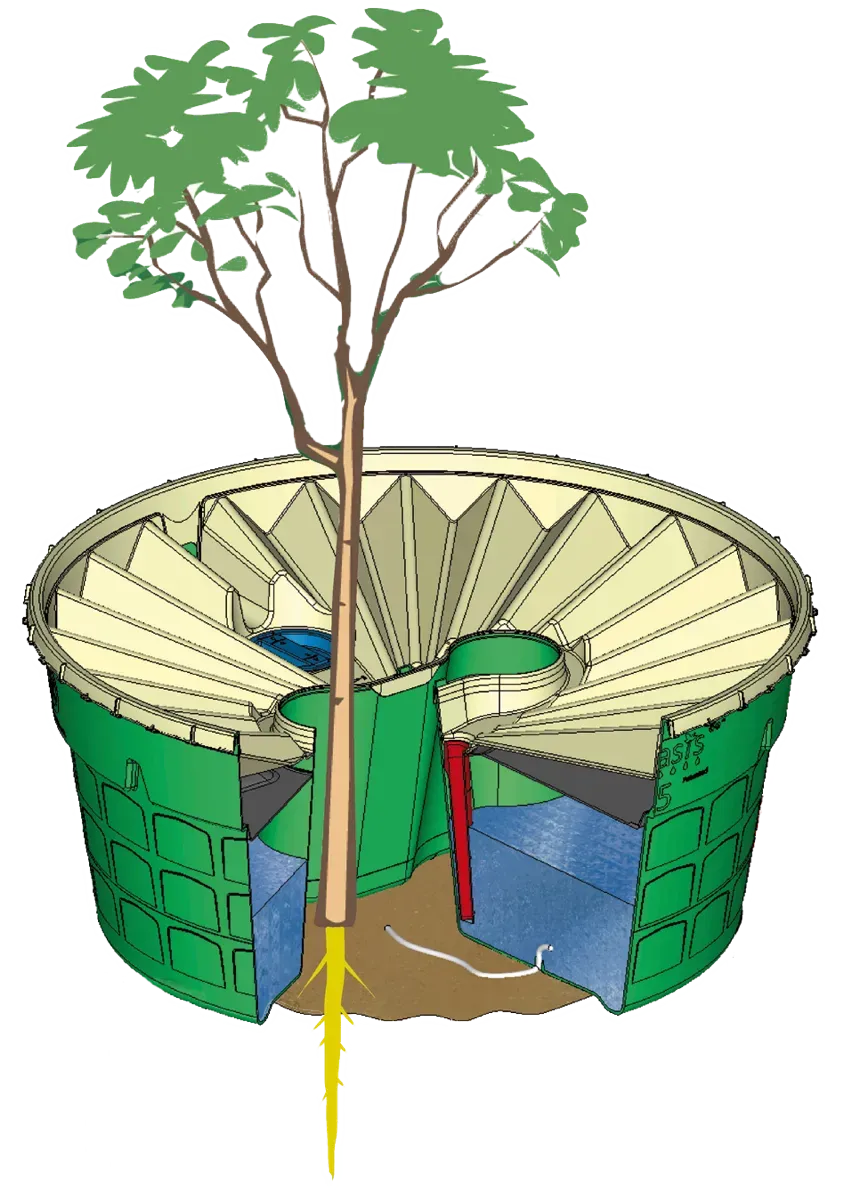
The Waterboxx is a ring-shaped plant cocoon that sits on the soil around a seedling. It collects precipitation and condensation in a polypropylene reservoir and dispenses it slowly onto the soil next to the plant through a wick, while shading the ground and reducing evaporation. Groasis describes it as a planting technology rather than a form of irrigation (Groasis). Key points:
- no energy or piped water is needed after planting;
- reusable: once a tree is established, the box is lifted off and used again, and Groasis says one Waterboxx can plant up to 20 trees, shrubs or vegetables over its life;
- Growboxx, a biodegradable version, is left in place to break down;
- microclimate: the cocoon protects the root zone, and the EU project found it shielded plants from snow, heat, cold and small landslides.
Groasis sums up its claims as the “Triple 90”: 90% cheaper than drip irrigation, 90% less water and survival above 90% (Groasis).
How it works
- Prepare: a planting hole is dug; in the EU project, Dutch firm Aquapro developed a capillary drill for this step.
- Plant: the seedling goes in the centre and the Waterboxx is placed around it.
- Collect: rain and night-time condensation run into the reservoir.
- Release: a wick feeds small amounts of water to the soil each day, encouraging deep roots rather than surface roots.
- Reuse: once the plant’s roots reach deeper moisture, the box is removed and used again elsewhere.
Timeline
| Date | Milestone |
|---|---|
| 2003 | Pieter Hoff founds Groasis to fight deforestation and groundwater depletion |
| 2010s | EU LIFE+ “The Green Deserts” project (LIFE09) tests the Waterboxx across Spain |
| 17 Jun 2015 | Project final conference in Valladolid |
| 2023 | Peer-reviewed Galapagos study shows higher survival for a rare endemic plant |
| 2024 | Restoration Ecology study on US mine waste reports 30% to 65% higher survival for four of five species |
| Mar 2025 | Groasis presents at the Villars Institute Summit |
| Jun 2026 | Waterboxxes arrive in Kenya for a year-long trial with Wageningen University & Research |
Impact and numbers
- Spain: the EU-funded LIFE+ project “The Green Deserts”, coordinated by the University of Valladolid foundation, used 27,501 waterboxxes to grow 59,758 saplings in Castilla y León, Aragón and Catalonia. Survival in the plots ranged from 78% to 98%, against 36% to 62% for controls, provided wildlife looking for water was kept away. The project also found that planting two tall trees in one box caused competition, and that the benefits were greater for hardier species (EU LIFE).
- Galapagos: researchers from the Charles Darwin Foundation and partners tracked 374 plants of the rare Scalesia affinis subspecies, 326 with Groasis and 48 controls, on Santa Cruz Island. Overall survival was low, but plants with the Waterboxx had a three-fold higher predicted survival after 3.7 years (PeerJ via PMC).
- Mine land: on a reclaimed waste rock dump in the US Mountain West, 400 seedlings of five native woody species were planted with and without the device. It kept soil moisture higher for about a month longer, raised survival by 30% to 65% in four species and improved vigour in three (Restoration Ecology).
- Reach: Groasis says more than 2 million trees have been planted with its technology in more than 50 countries, and it aims to help restore 2 billion hectares of degraded land (Groasis).
Honest caveats. The “Triple 90” figures are Groasis’s own marketing claims, and independent studies show smaller, more variable gains; in the Galapagos, most plants died even with the device. The EU project found that on flat land the Waterboxx made reforestation more expensive per hectare than traditional planting, and that it pays off mainly on harsh, steep or rocky sites or for high-value trees. Results depend on good soil preparation, good saplings and managing animals that raid the boxes for water. The reusable box is plastic, so it must be collected and reused as intended; boxes left in the landscape become litter. Groasis is a small private company and does not publish accounts or audited planting data.
What’s next
In Kenya’s semi-arid Makueni County, Wageningen University & Research, Lukenya University and local farmers are comparing the Waterboxx with watering cans and Lukenya’s own ZUDROT method over a year, for tree survival, water use and practicality (WUR). Groasis is also promoting its cocoons for food growing by smallholders in dry regions, under what it calls the Groasis Treesolution, aimed at food security, biodiversity and income for small farmers (Groasis). In September 2026, WUR students were due to join the Kenya fieldwork.
Why it matters for Europe / green buyers
The EU Nature Restoration Regulation, in force since 18 August 2024, requires restoration measures on at least 20% of the EU’s land and sea areas by 2030 (European Commission). Much of the land in southern Spain, Portugal, Italy and Greece that needs new trees is dry and hard to reach. The Spanish LIFE+ results suggest tools like the Waterboxx can cut seedling losses there, especially on slopes where replanting is expensive.
India has committed to restore 26 million hectares of degraded land by 2030 under the Bonn Challenge, and in June 2026 reported 21.76 million hectares already under restoration (IUCN). Much of the remaining work is in hot, dry regions where young trees must survive long seasons without rain. A cheap, reusable way to raise survival without irrigation could make restoration budgets there go further.
Sources & image credits
- Groasis, “Groasis at the Villars Summit 2025” (Mar 2025): https://www.groasis.com/en/press/groasis-at-the-villars-summit-2025
- Groasis, “Waterboxx plant cocoon” product page: https://www.groasis.com/en/products/groasis-waterboxx-plant-cocoon
- European Commission, LIFE Programme, “The Green Deserts: new planting techniques for tree cultivation in desertified environments to face climate change” (LIFE09 ENV/ES/000447): https://webgate.ec.europa.eu/life/publicWebsite/project/LIFE09-ENV-ES-000447/the-green-deserts-new-planting-techniques-for-tree-cultivation-in-desertified-environments-to-face-climate-change
- PeerJ (via PubMed Central), “Enhancing restoration success of rare plants in an arid-tropical climate through water-saving technologies: a case study of Scalesia affinis ssp. brachyloba in the Galapagos Islands” (2023): https://pmc.ncbi.nlm.nih.gov/articles/PMC10710167/
- Restoration Ecology, “The use of Groasis Waterboxx devices to improve mineland reclamation efforts by increasing transplant survival and growth of five native woody species” (2024): https://doi.org/10.1111/rec.14165
- Wageningen University & Research, “The next chapter of the Wageningen Forest” (16 Jul 2026): https://www.wur.nl/en/news/next-chapter-wageningen-forest
- European Commission, DG Environment, “Nature Restoration Law enters into force” (15 Aug 2024): https://environment.ec.europa.eu/news/nature-restoration-law-enters-force-2024-08-15_en
- IUCN, “India brings over 21 million hectares of land under restoration under the Bonn Challenge” (Jun 2026): https://iucn.org/news/202606/india-brings-over-21-million-hectares-land-under-restoration-under-bonn-challenge
Images:
- “Open design of the Groasis Waterboxx functionalities” by Groasis, released under CC BY-SA 4.0 (https://creativecommons.org/licenses/by-sa/4.0), via Wikimedia Commons: https://commons.wikimedia.org/wiki/File:20180411_Open_design_of_the_Groasis_Waterboxx_functionalities_-_you_may_publish_if_you_include_%27Courtesy_Groasis%27.png