
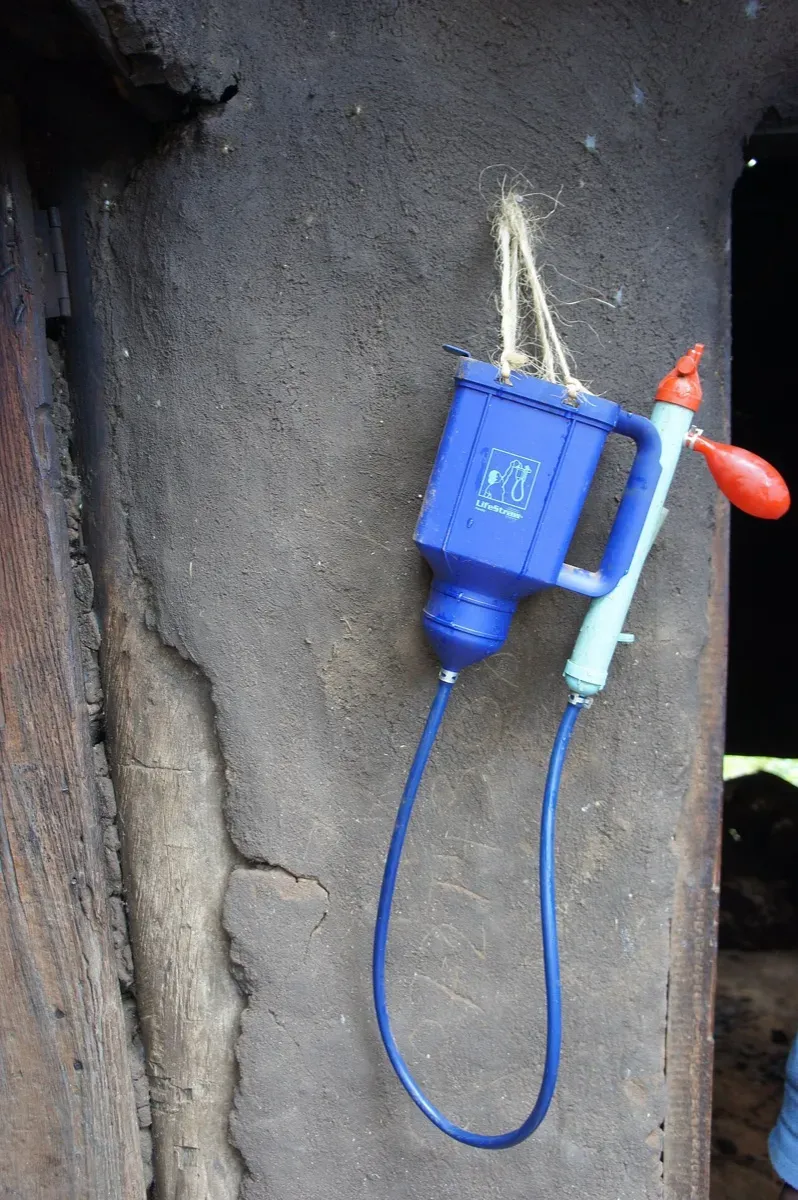
The problem
Safe drinking water is still out of reach for a quarter of humanity. The WHO/UNICEF Joint Monitoring Programme reports that 2.1 billion people lacked safely managed drinking water in 2024, and 106 million still drank directly from rivers, lakes and ponds (JMP 2025). Children are hit hardest: water-borne diarrhoea is a leading cause of illness, and sick children miss school.
Boiling water kills pathogens, but it burns firewood or charcoal, adds to indoor smoke and deforestation, and costs families time and money. Chlorine tablets are cheap but need a steady supply and can be rejected for taste. Piped, treated water is the long-term answer, but it can take decades to reach rural schools.
The product
LifeStraw Community is a stand-alone purifier designed for places where many people drink from one point: schools, clinics and community centres. Users pour untreated water into a 25 litre top tank. It flows by gravity through a cartridge of hollow-fibre ultrafiltration membranes into a 25 litre storage tank with a tap (LifeStraw product guide). The unit purifies up to 100,000 litres before the cartridge is spent, enough for 75 to 100 people for three to five years. It needs no electricity, no chemicals and no replacement filters during that life, and retails for US$399 (LifeStraw).
Schools are a deliberate choice. One unit placed in a classroom or school compound can serve a whole class every day, and teachers or pupils can be trained to refill and look after it. A purifier at school also reaches children whose families cannot afford household treatment. LifeStraw’s local staff return to check that units are working, used and cleaned. By the end of 2025 they had made 35,714 such follow-up visits.
The design has been independently tested. In the first round of the WHO International Scheme to Evaluate Household Water Treatment Technologies, LifeStraw Community earned the top three-star rating, “comprehensive protection”, meaning it met WHO’s highest performance targets for removing bacteria, viruses and protozoa (WHO product report).
How it works
Ultrafiltration is a size filter. The membranes are bundles of thin, hollow fibres whose walls are riddled with pores about 0.02 microns across, roughly one five-thousandth of the width of a human hair. Water molecules pass through, but bacteria, protozoan cysts such as Giardia and Cryptosporidium, and viruses are too big. The only energy needed is the weight of the water in the top tank.
Maintenance is mechanical rather than chemical. When flow slows, the cartridge is flushed to clear particles from the membrane surface and restore flow, as set out in the product guide. The purifier has no activated carbon stage, so it does not remove dissolved chemicals such as arsenic, fluoride or pesticides, and it does not change taste or salinity.
Timeline
| Date | Milestone |
|---|---|
| 2011 | Carbon for Water: nearly 900,000 LifeStraw Family filters distributed in Kenya’s Western Province |
| 2015 | Three-star WHO rating for LifeStraw Community in Round I of the WHO scheme |
| 2017 | Peer-reviewed study questions usage rates in the carbon-financed filter programme |
| End of 2025 | 22,861 Community purifiers in 4,803 schools in Kenya |
| 28 Jan 2026 | 879 purifiers for 282 schools announced in Kisumu County |
| 24 Jun 2026 | Vestergaard and LifeStraw extend partnership to malaria nets and clinic support in western Kenya |
Impact and numbers
- Give Back programme: by the end of 2025, LifeStraw’s programme had reached 14,260,714 children in 4,803 schools with 22,861 Community purifiers, carried out 35,714 follow-up visits and employed more than 40 local staff in western Kenya. One purifier is donated for every 500 products sold (LifeStraw Give Back).
- Kisumu: in January 2026 Kisumu County announced 879 purifiers for 282 schools, delivered through a Gold Standard carbon project (County Government of Kisumu).
- Carbon for Water: the 2011 campaign delivered nearly 900,000 LifeStraw Family filters to households in Western Province, a US$25 million programme using more than 4,000 community health workers (Water Online).
- Wider health: in June 2026 Vestergaard and LifeStraw announced 1,000 PermaNet Dual mosquito nets a year and support for the Emusanda clinic in western Kenya (Vestergaard, 24 June 2026).
Honest caveats. Much of LifeStraw’s work in Kenya is financed by carbon credits, earned on the basis that clean water replaces wood fuel used for boiling. That model has been challenged. A 2017 study in Environmental Health Perspectives found that only 19% of surveyed households reported using their filters two to three years after the Carbon for Water distribution, compared with the 81% usage rate stated in the programme’s own monitoring, and called for independent monitoring of carbon credits (Pickering et al., 2017). That study concerned household Family filters, not the school Community units, but it shows why usage data matter. “Children reached” counts enrolment at equipped schools, not measured health outcomes. The purifier does not remove chemical contaminants, so it is the wrong tool where arsenic or fluoride is the main risk.
What’s next
LifeStraw is linking safe water with wider health support, from mosquito nets to clinic upgrades, and continuing its school programme through follow-up visits that check purifiers are used and maintained. The credibility of carbon-financed water projects will increasingly depend on third-party monitoring, which buyers of such credits should demand.
Why it matters for Europe / green buyers
For European companies, foundations and public buyers, LifeStraw Community is a concrete, independently tested product with a clear unit of impact: one purifier, one classroom, up to 100,000 litres. It is useful for school and clinic programmes, humanitarian response and corporate water stewardship commitments. Buyers of the associated carbon credits, or of products marketed on the back of the give-back model, should ask for independent usage data and avoid relying on “people reached” alone. Within Europe, the same technology has a role in emergency preparedness, for example after floods that contaminate local supplies.
The model could travel to South Asia too, where many rural schools rely on hand pumps or tanker water. There the chemical caveat matters most: arsenic in parts of the Ganges basin and fluoride in groundwater across much of India need treatment that ultrafiltration alone cannot provide, so water testing should come before any purifier is chosen.
Sources & image credits
- World Health Organization, International Scheme to Evaluate Household Water Treatment Technologies, Round I product report, “LifeStraw Community”: https://cdn.who.int/media/docs/default-source/wash-documents/regnet/products/whoscheme_r1_productreport_lifestrawcommunity.pdf
- LifeStraw, “LifeStraw Community” product page: https://lifestraw.com/products/lifestraw-community
- LifeStraw Help Centre, “LifeStraw Community product guide”: https://help.lifestraw.com/en-US/lifestraw-community-%7C-product-guide-3820744
- LifeStraw, “Our Give Back Program”: https://lifestraw.com/pages/our-give-back-program
- County Government of Kisumu, “The 100,000 liter promise: towards safe drinking water for 282 schools in Kisumu”, 28 January 2026: https://www.kisumu.go.ke/the-100000-liter-promise-towards-safe-drinking-water-for-282-schools-in-kisumu/
- Vestergaard, “Vestergaard and LifeStraw boost community health impact in Kenya”, 24 June 2026: https://vestergaard.com/en/news-and-reports/press-releases-statements/vestergaard-and-lifestraw-boost-community-health-impact-in-kenya
- Water Online, “Close To One Million Water Filters Delivered”, 2011: https://www.wateronline.com/doc/close-to-one-million-water-filters-delivered-0001
- Pickering AJ et al., “Climate and Health Co-Benefits in Low-Income Countries: A Case Study of Carbon Financed Water Filters in Kenya and a Call for Independent Monitoring”, Environmental Health Perspectives 125:278 to 283, 2017: https://pmc.ncbi.nlm.nih.gov/articles/PMC5332188/
- WHO/UNICEF Joint Monitoring Programme, “Progress on household drinking water, sanitation and hygiene 2000 to 2024”, 2025: https://data.unicef.org/resources/jmp-report-2025/
Images:
- “Lifestraw Family” by Engineering for Change, licensed CC BY-SA 2.0 (https://creativecommons.org/licenses/by-sa/2.0), via Wikimedia Commons: https://commons.wikimedia.org/wiki/File:Lifestraw_Family_(6437408151).jpg
.jpg)