
The problem
According to the WHO/UNICEF Joint Monitoring Programme, 2.1 billion people still lacked safely managed drinking water in 2024, and 106 million drank untreated water directly from rivers, lakes and ponds (JMP 2025). Many of them live in places where there is water, but it is salty or contaminated: coastal aquifers invaded by seawater, arid regions with brackish boreholes, or towns where wells are polluted.
Conventional desalination is a poor fit. Large plants need a stable grid or diesel generators, skilled operators and big upfront investment. Small solar systems usually rely on batteries, which add cost, wear out within a few years and are a common point of failure in hot climates. The result is that rural communities often depend on water trucks, expensive bottled water or unsafe sources.
The product
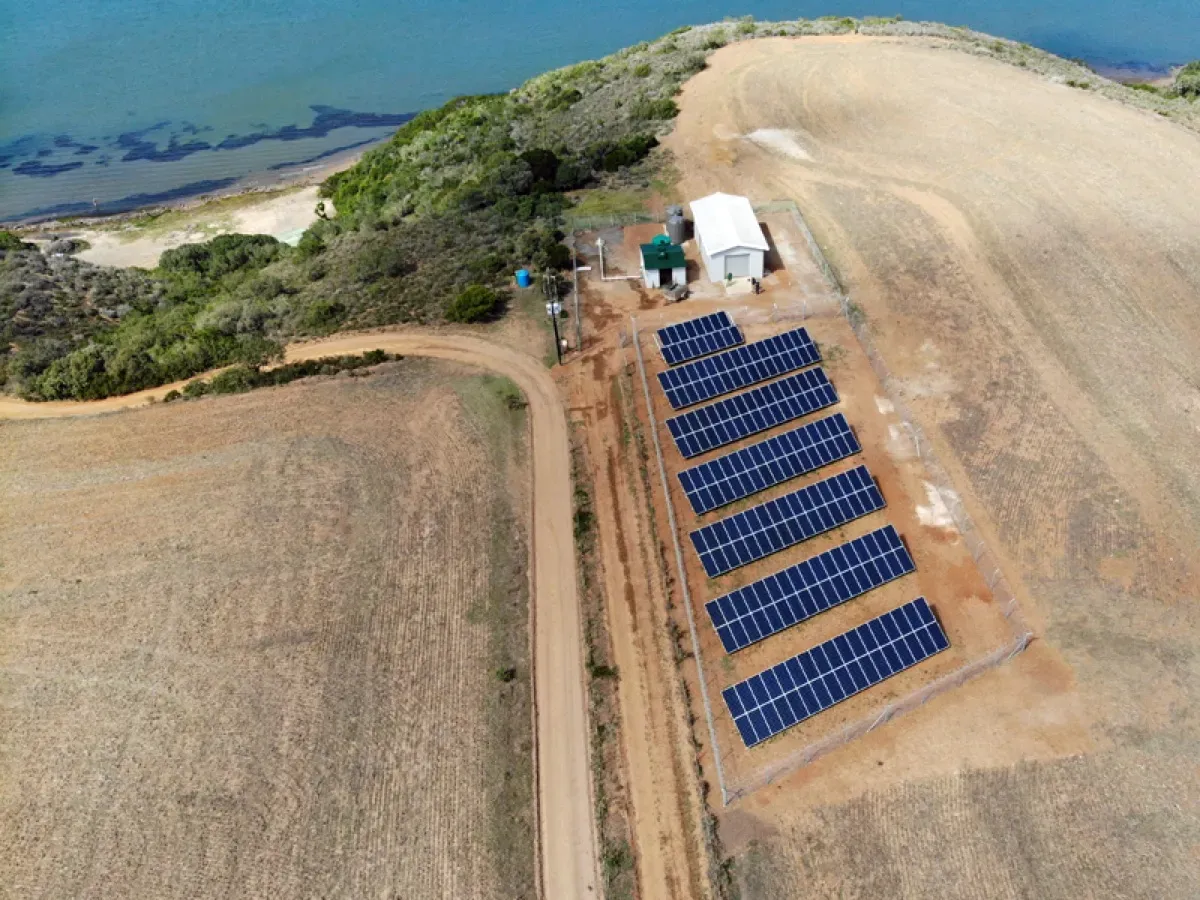
Boreal Light’s WaterKiosk is designed to work where the grid does not reach. Each unit combines a solar array, pumps, pre-treatment and a reverse osmosis desalination stage in a container or on a frame, ready to install beside a borehole or the sea. The company holds a patent on connecting the pumps directly to the solar cells, so the system runs whenever the sun shines and needs no battery bank (Boreal Light).
The founders built their first systems in Somalia around 2017 and 2018. In an interview with Germany Trade & Invest in 2021, Boreal Light said a container costs between €55,000 and €150,000, that a typical unit produces about 10,000 litres a day, and that membranes last four to five years (GTAI Africa Business Guide, 2021). The kiosks are run on the ground by WaterKiosk Africa, which sells water to households, schools and businesses (WaterKiosk Africa).
How it works
Raw water is pumped from a borehole, river or the sea and passes through pre-filters that remove sand and particles. High-pressure pumps then push it through reverse osmosis membranes, which let water molecules through but hold back salt, bacteria and most other contaminants. The clean water is stored in tanks and dispensed at the kiosk; the concentrated brine is discharged or, at some sites, reused.
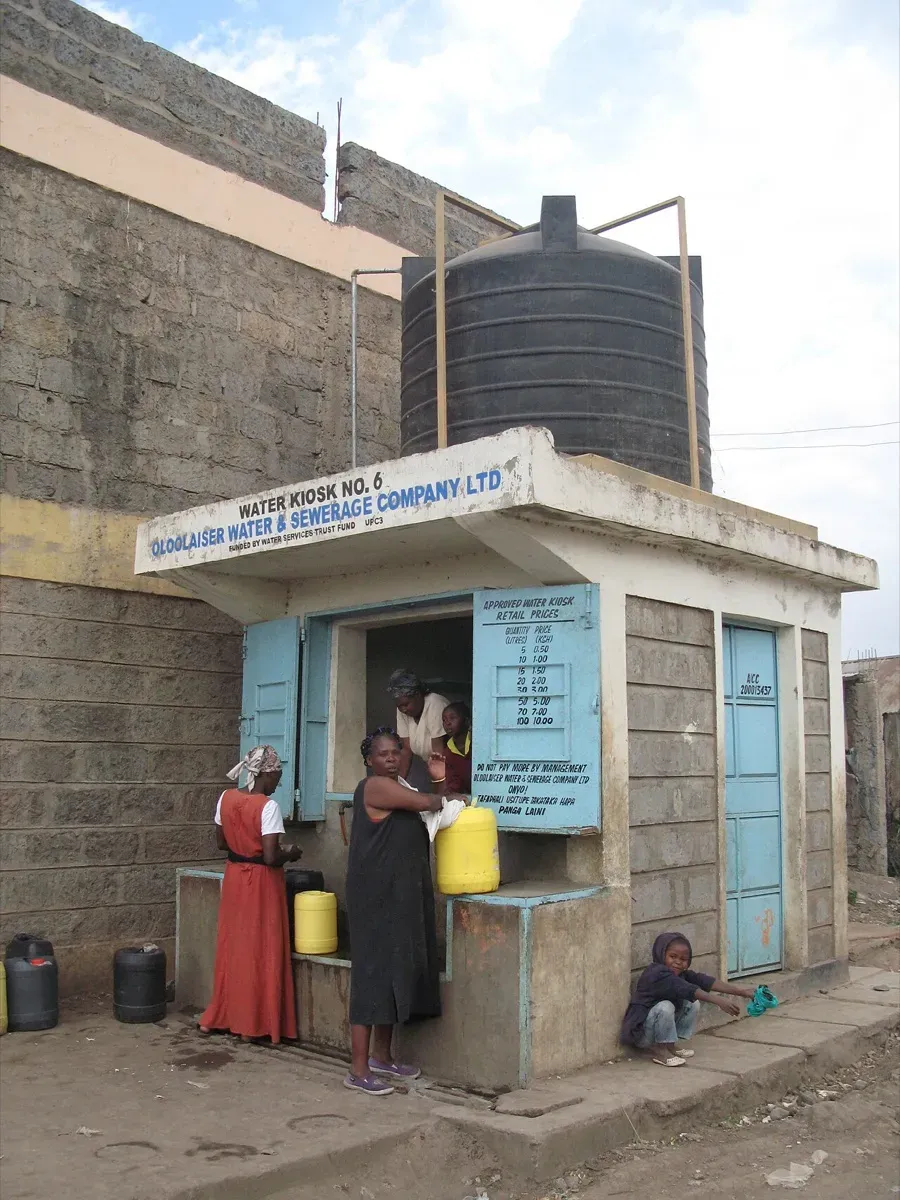
Running without batteries means the plant produces most of its water during sunny hours, then stores water rather than electricity. Water tanks are cheap, last decades and do not degrade in the heat, which makes this approach simpler and cheaper to maintain in remote areas. Kiosk operators sell water in standard 20-litre jerrycans, and revenue pays for maintenance and staff. The arithmetic is simple: a typical 10,000 litre-a-day unit fills 500 jerrycans, which at the social price of ten US cents brings in about US$50 a day, while urban kiosks charging US$1 earn ten times as much per jerrycan. Because there is no fuel bill and no battery to replace, the main recurring costs are staff, membranes and spare parts, which keeps the price of water low and predictable.
Timeline
| Date | Milestone |
|---|---|
| 2014 | Boreal Light founded in Berlin |
| 2017 to 2018 | First systems installed in Somalia |
| 2020 | Recognised with a German award for contributions to the SDGs |
| Feb 2021 | Likoni WaterKiosk, Mombasa: 20,000 litres a day from a 9.8 kW solar array |
| 2022 | Bubisa, Marsabit County: plant producing 100,000 litres a day |
| 2025 | La Guajira, Colombia: 12,000 litres a day under a German government renewable energy programme |
| Mar 2026 | Two units of 2,000 litres an hour funded for municipalities in the Odessa region, Ukraine |
Impact and numbers
- Scale: about 230 systems installed, which the company says serve some 8 million people (AIM2Flourish).
- Cost: production costs of about 50 US cents per 1,000 litres, falling to around 9 cents in large plants.
- Price: about US$0.10 for 20 litres at social kiosks and US$1 in urban areas, against around US$4 for the same volume of bottled water in supermarkets (GTAI).
- Likoni, Mombasa: 20,000 litres a day from a 9.8 kW solar array, opened in February 2021 (Boreal Light, Likoni).
- Bubisa, Marsabit: a 100,000 litre-a-day plant in one of Kenya’s driest counties.
- Colombia: a 12,000 litre-a-day plant in La Guajira, supported by the German Energy Agency’s renewable energy export programme (Boreal Light, Colombia).
- Ukraine: the German Federal Environmental Foundation (DBU) is funding two units of 2,000 litres an hour each for municipalities near Odessa, a project worth €219,391 (DBU).
- Brine reuse: at some sites, brine has been used to farm fish in ponds instead of being dumped.
Honest caveats. The figures of 230 systems and 8 million people come from the company and its case-study partners, not from independent audits, and “people served” can be counted in different ways. Reverse osmosis still produces brine, which must be managed carefully to avoid salting soils or harming coastal ecosystems. Membranes need replacing every few years, and a kiosk only stays open if local management, spare parts and pricing work over the long term. Water kiosks also mean people still carry jerrycans home, which is better than unsafe water but short of a piped connection.
What’s next
Boreal Light is moving beyond Africa, with projects in Colombia and Ukraine showing that the same battery-free design works in very different settings, from desert coasts to war-damaged municipalities. German public programmes, including energy export initiatives and environmental foundations, are helping to fund those first deployments. The next challenge is finance at scale: blending grants, development bank loans and water sales so that hundreds more kiosks can be built without depending on donations.
Why it matters for Europe / green buyers
Boreal Light is a European engineering company exporting a practical answer to one of the world’s most basic problems. For development finance institutions, NGOs, humanitarian agencies and companies with water stewardship commitments in their supply chains, WaterKiosks are a tangible product with clear unit economics: a known cost per container, a known daily output and a price per litre families can afford. The battery-free design cuts lifetime costs and waste. Southern Europe faces its own growing pressure on coastal aquifers and island water supplies, and small solar desalination units of this kind could find a role there too.
Sources & image credits
- Boreal Light, Bubisa WaterKiosk project page (100,000 litres a day): https://www.boreallight.com/projects/template-wsbck
- Boreal Light, “Likoni WaterKiosk”: https://www.boreallight.com/projects/likoni-waterkiosk
- Boreal Light, La Guajira, Colombia project page: https://www.boreallight.com/projects/template-kaa5j-xenb4-hm2md-cdbhy-9gzc6
- Germany Trade & Invest, Africa Business Guide, “Wasserkioske: Sauberes Trinkwasser dank integrierter Solaranlage”, 2021: https://www.africa-business-guide.de/de/praxis/erfahrungen/wasserkioske-sauberes-trinkwasser-dank-integrierter-solaranlage-690702
- AIM2Flourish, “From Solar Power to Clean Drinking Water: A Sustainable Solution”: https://aim2flourish.com/innovations/from-solar-power-to-clean-drinking-water-a-sustainable-solution
- Deutsche Bundesstiftung Umwelt (DBU), “Water treatment systems from Boreal Light GmbH for Ukrainian municipalities in the Odessa region”, 2026: https://www.dbu.de/en/projektbeispiele/water-treatment-systems-from-boreal-light-gmbh-for-ukrainian-municipalities-in-the-odessa-region/
- WaterKiosk Africa: https://waterkiosk.africa/
- WHO/UNICEF Joint Monitoring Programme, “Progress on household drinking water, sanitation and hygiene 2000 to 2024”, 2025: https://data.unicef.org/resources/jmp-report-2025/
Images:
- “Water kiosk at low-income area Bulbul near Nairobi, Kenya” by SuSanA Secretariat, licensed CC BY 2.0 (https://creativecommons.org/licenses/by/2.0), via Wikimedia Commons: https://commons.wikimedia.org/wiki/File:Water_kiosk_at_low-income_area_Bulbul_near_Nairobi,_Kenya_(10543518693).jpg
.jpg)