
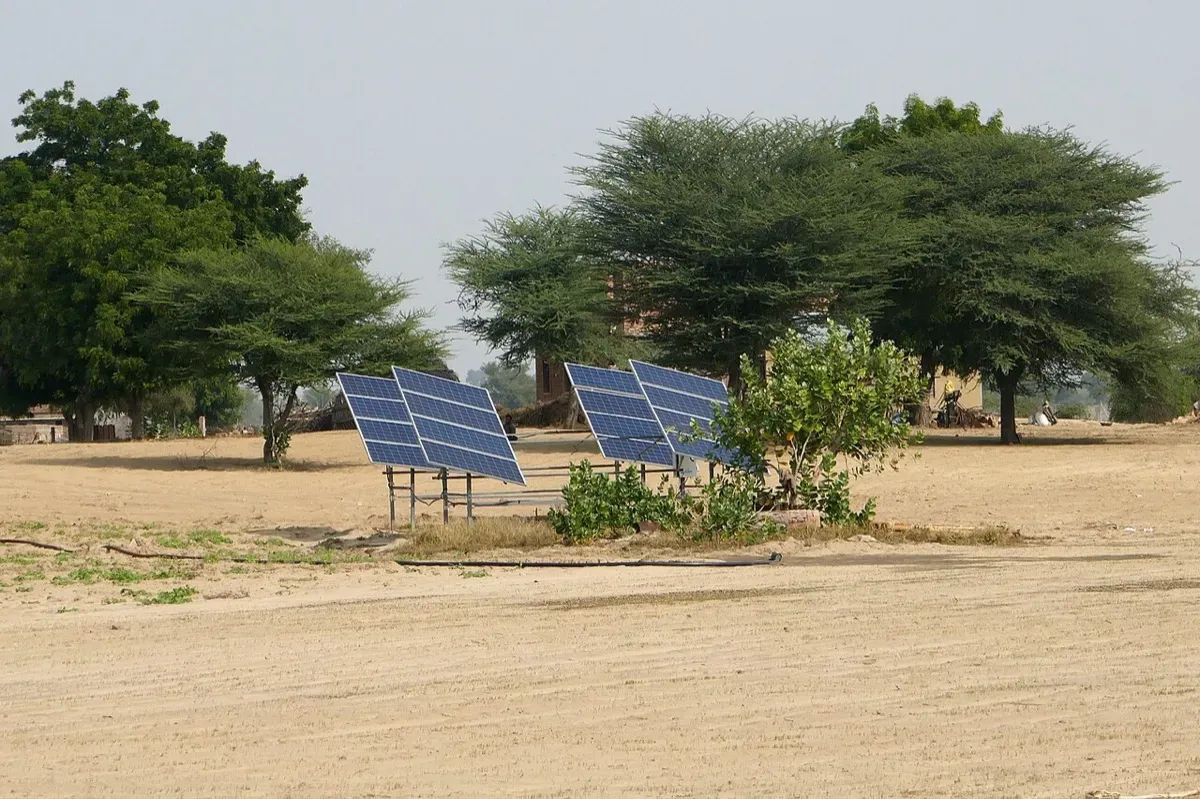
The problem
India is one of the world’s fastest-growing solar markets, but for years most of its panels and nearly all its cells came from China. That exposed developers to price swings, trade disputes and supply shocks, and it meant India captured little of the industrial value of its energy transition.
The government responded with import duties, a production-linked incentive scheme and the Approved List of Models and Manufacturers (ALMM), which requires many projects to use listed domestic modules and, since June 2026, domestic cells. That created a huge market for Indian manufacturers, but also a race to build capacity quickly and move to newer, more efficient technologies.
The product
The ELITE R Series is Waaree’s n-type bifacial module for large solar farms. It uses 132 half-cut n-type cells on large rectangular G12R wafers, packaged between two sheets of glass with an aluminium frame. N-type cells, such as TOPCon, are more efficient than the older p-type PERC cells and degrade more slowly. The modules are rated from 600 to 635 W, with efficiencies from 22.21% to 23.51% (Waaree datasheet). Each module measures 2,382 x 1,134 mm, a format close to the one most large module makers have now adopted, so it fits standard trackers and mounting structures.
The back side has a bifaciality of about 80%, so it also generates power from light reflected off the ground. Waaree says that with a 20% rear-side gain, the 635 W module can produce up to 762 W. The current datasheet offers a 12-year product warranty and a 30-year linear performance warranty, with at least 87.4% of rated output after 30 years.
How it works
- Cells: n-type silicon cells with passivated contacts convert sunlight on both faces into electricity.
- Half-cut design: each cell is cut in two, which lowers current and resistive losses and improves shade tolerance.
- Dual glass: glass on both sides lets light reach the rear and protects cells against moisture and mechanical stress.
- Strength: the frame and glass are tested to 5,400 Pa of snow load and 2,400 Pa of wind load.
- System: modules are wired in strings of up to 1,500 V and usually mounted on single-axis trackers in utility-scale plants to boost rear-side gain.
Timeline
| Date | Milestone |
|---|---|
| 1990 | Waaree founded in Mumbai |
| Oct 2024 | ELITE R BiN-21 datasheet issued; Waaree lists on the BSE and NSE |
| Jun 2025 | US Customs opens an evasion investigation (EAPA 8163) |
| Apr 2026 | FY26 results: 12.6 GW produced; construction starts on a 10 GW ingot and wafer plant in Nagpur |
| Jun 2026 | ALMM List-II, requiring domestic cells, takes effect for many projects |
| 23 Jun 2026 | US Customs finds evasion on certain historical imports |
| Sep 2026 | Mercom reports India’s module capacity at 261.7 GW |
Impact and numbers
- Production: Waaree produced a record 12.6 GW of modules in FY26, including 4.2 GW in the fourth quarter (Waaree).
- Finances: FY26 revenue rose 83.72% to ₹26,536.77 crore, and profit after tax roughly doubled to ₹3,884.15 crore.
- Backward integration: Waaree commissioned another 3 GW of modules at Samakhiali, Gujarat, bought a strategic stake in Oman’s polysilicon maker United Solar Holding, and began building a 10 GW ingot and wafer plant in Nagpur with an investment of ₹6,200 crore.
- US presence: its US subsidiary has 3 GW of module capacity in the United States.
- National context: India’s module capacity reached 261.7 GW in June 2026, against 36.6 GW of cells, and TOPCon makes up 80% of ALMM-listed module capacity (pv magazine).
Honest caveats. On 23 June 2026, US Customs and Border Protection found that Waaree had evaded antidumping and countervailing duties on solar cells from Vietnam and Malaysia, citing a “four year history of reporting the wrong country of origin”. It will assess duties of up to 271.28% on the affected imports, though it declined to apply adverse inferences (pv magazine). Waaree says the finding covers only certain historical imports, does not affect its ongoing operations, and that it is evaluating review options (pv magazine India). Waaree’s cell capacity is still far smaller than its module capacity, so it still relies partly on bought-in cells. India’s industry also depends heavily on one export market: the US took 92% of India’s solar exports in the first half of 2026. With module capacity far ahead of cell supply and domestic demand, India faces a risk of overcapacity and price pressure. Mercom’s chief executive Raj Prabhu says domestic cell shortages have become “the biggest near-term challenge” for India’s solar market, pushing up prices for compliant modules and slowing project activity, and that many module makers are struggling to keep production going.
What’s next
Waaree calls its next phase “Waaree 2.0”: moving upstream into ingots, wafers and polysilicon, expanding cell capacity and growing in batteries, inverters and other energy businesses. For FY27, it projects operating EBITDA of ₹7,000 to ₹7,700 crore. The outcome of any appeal of the US Customs decision, and new US trade cases against Indian solar products, will shape its export business.
Why it matters for Europe / green buyers
For European developers and buyers trying to reduce reliance on Chinese supply chains, Indian manufacturers like Waaree are becoming an alternative source of high-efficiency n-type modules, especially as Waaree integrates back to wafers and polysilicon. European buyers should still check supply-chain traceability and trade compliance carefully, as the US case shows. Europe can also learn from India’s approach: a mix of domestic content rules, auctions and incentives that built hundreds of gigawatts of module capacity in a few years.
For India, Waaree is a flagship of the national manufacturing push. Its move into wafers and polysilicon is crucial if the country is to make the whole solar value chain at home, not just assemble imported parts.
Sources & image credits
- Waaree Energies, FY26 results press release, 29 April 2026: https://www.waaree.com/upload/media/press_release_april_29_1777531272.pdf
- Waaree, “ELITE R Series BiN-21” module datasheet: https://www.waaree.com/upload/media/elite_r_series_bin_21_1782115130.pdf
- pv magazine, “Waaree determined to have evaded AD/CVD orders on solar imports, finds U.S. Customs”, 26 June 2026: https://www.pv-magazine.com/2026/06/26/waaree-determined-to-have-evaded-ad-cvd-orders-on-solar-imports-finds-u-s-customs/
- US Customs and Border Protection, “EAPA Cons. Case 8163: Solar Cells (Notice of Determination as to Evasion, June 23, 2026)”: https://www.cbp.gov/document/publications/eapa-cons-case-8163-solar-cells-notice-determination-evasion-june-23-2026
- pv magazine India, “Waaree says U.S. Customs finding limited to certain historical imports, no impact on ongoing operations”, 29 June 2026: https://www.pv-magazine-india.com/2026/06/29/waaree-says-u-s-customs-finding-limited-to-historical-imports-no-impact-on-ongoing-operations/
- pv magazine, “India adds 50.6 GW of solar module and 9.7 GW of cell manufacturing capacity in 1H 2026, says Mercom”, 25 September 2026: https://www.pv-magazine.com/2026/09/25/india-added-50-6-gw-of-solar-module-and-9-7-gw-of-cell-manufacturing-capacity-in-1h-2026-says-mercom/
- Waaree, “Waaree Energies Limited doubles EBITDA and PAT in FY26, achieves highest ever production and accelerates Waaree 2.0 transition”: https://www.waaree.com/usa/en/press-release/waaree-energies-limited-doubles-ebitda-s-pat-in-fy26,-achieves-highest-ever-production-and-accelerates-waaree-2.0-transition
Images:
- “Panneaux solaires dans le désert du Thar (Rajasthan)” by Ji-Elle, licensed under CC BY-SA 4.0 (https://creativecommons.org/licenses/by-sa/4.0), via Wikimedia Commons: https://commons.wikimedia.org/wiki/File:Panneaux_solaires_dans_le_d%C3%A9sert_du_Thar_(Rajasthan).jpg


.jpg)