The problem
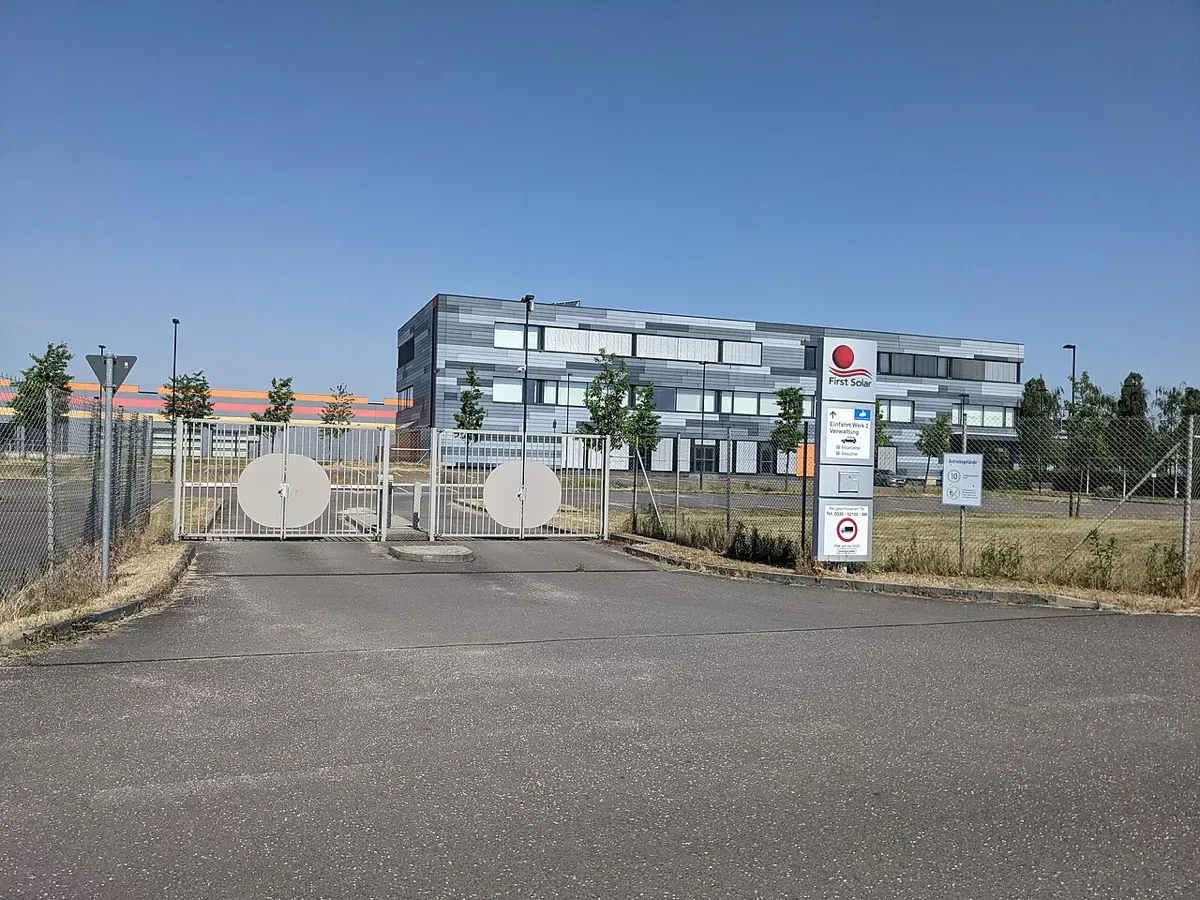
Europe’s solar boom runs mostly on imported panels. Chinese manufacturers dominate every step from polysilicon to modules, and prices have fallen so low that many European factories have closed. Meyer Burger, which made heterojunction modules in Germany, saw its German subsidiaries file for insolvency in 2025 (pv magazine).
That leaves Europe exposed on energy security and supply chains, with limited traceability for buyers worried about carbon footprints and forced labour. The EU wants home-grown manufacturing, but needs factories large and advanced enough to compete. The Net-Zero Industry Act sets a goal for Europe to make 40% of its own clean-tech needs by 2030, but for solar modules the EU is still far from that level.
The product
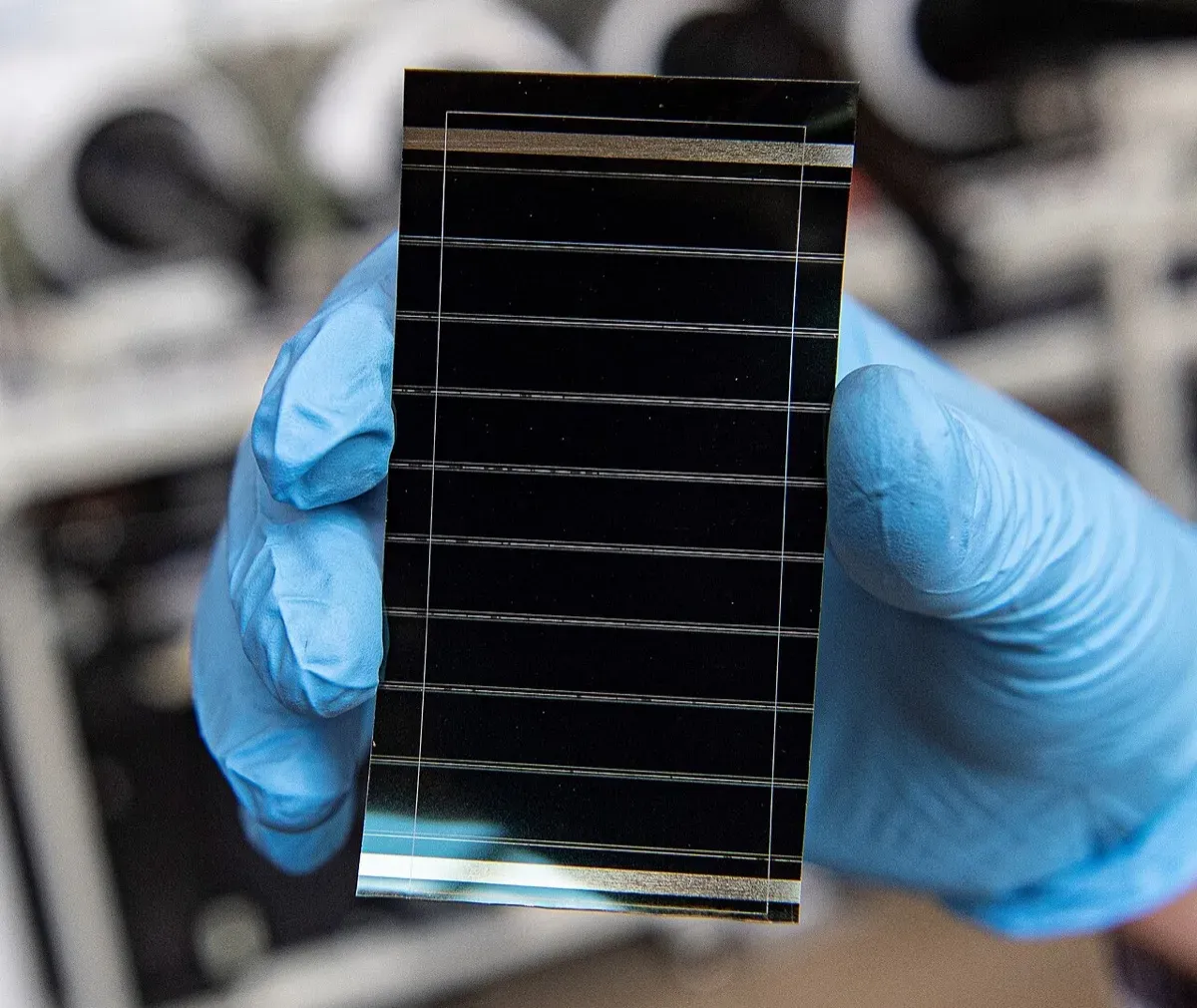
The B60 is a glass-glass bifacial module with 120 half-cut heterojunction cells on large G12 wafers. Heterojunction cells combine a crystalline silicon wafer with ultra-thin amorphous silicon layers, which gives very good surface passivation, high efficiency and a low temperature coefficient (minus 0.24% per °C). With 95% bifaciality, the back side produces almost as much power from reflected light as the front does from direct light. The module measures 2,172 x 1,303 mm and is rated at 640 to 680 W (3SUN datasheet).
3SUN describes the B60 as lead-free and fluorine-free and “Made in Europe”, with cells and modules produced in Catania. It carries a 15-year product warranty and a 30-year linear performance warranty, with degradation of 1% in the first year and 0.25% a year after that.
How it works
- Wafers in: n-type monocrystalline silicon wafers are textured and cleaned.
- Thin layers: amorphous silicon and transparent conductive oxide layers are deposited on both sides at below 200 °C, in about six process steps compared with about fourteen for TOPCon.
- Metallisation: fine silver-containing contacts are printed at low temperature.
- Cutting and stringing: cells are cut in half and connected to reduce resistive losses.
- Lamination: cells are sealed between two glass sheets to make a durable bifacial module.
- Upgrade path: the TANGO project plans to add a perovskite layer on top of the HJT cell to make tandem cells.
Timeline
| Date | Milestone |
|---|---|
| 2010 | 3SUN starts as a thin-film joint venture of Enel, Sharp and STMicroelectronics in Catania |
| Jul 2022 | EU Innovation Fund grants about €118 million to the TANGO 3 GW gigafactory project |
| Mar 2024 | €560 million financing from the EIB and Italian banks led by UniCredit, backed by SACE |
| Jan 2025 | 3SUN and CEA reach 30.8% efficiency on a perovskite-HJT tandem cell |
| 15 May 2025 | EU Executive Vice-President Stéphane Séjourné visits; three lines running, 1.8 GW per year potential |
| Mar 2026 | All equipment commissioned, but not yet operating at full capacity |
| 2026 | 500 to 600 MW of module sales expected |
| 2027 | Target of about 1.2 GW |
Impact and numbers
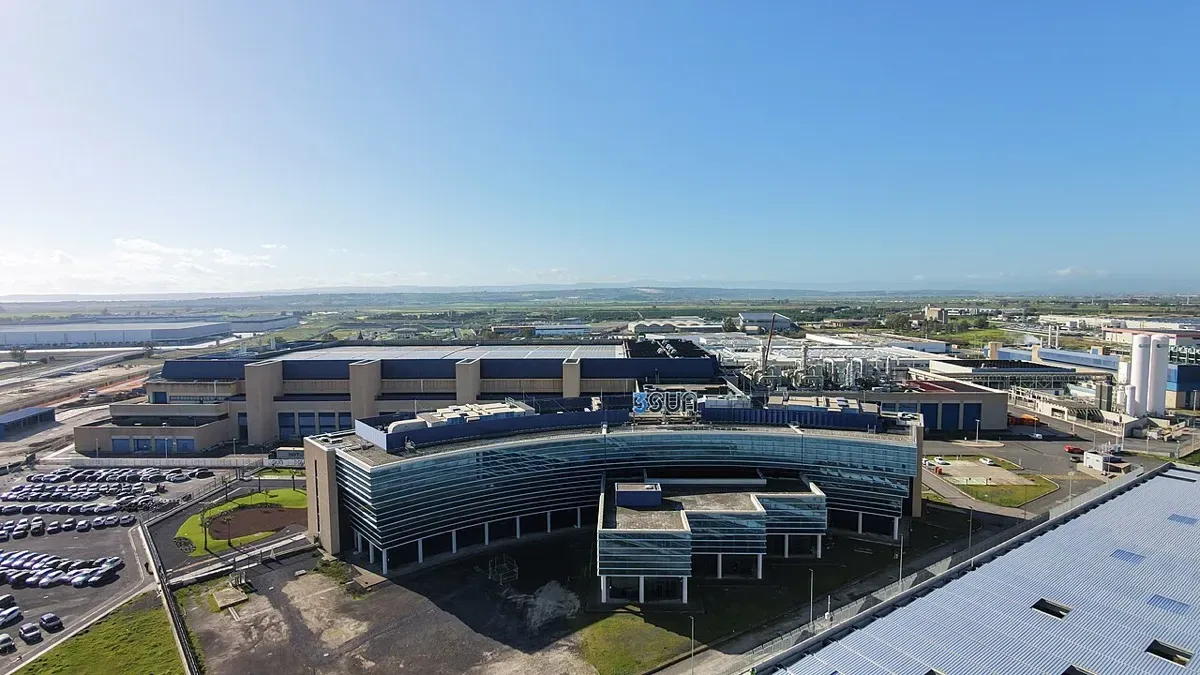
- Scale: once at full capacity, 3SUN expects to make about 15 times more than the original 200 MW factory, up to 3 GW a year (EIB).
- Daily capacity: the plant can produce about 800,000 cells and 14,000 modules a day (TaiyangNews). Enel’s target at full output is about 15,000 modules a day.
- Jobs and region: the gigafactory is in the Etna Valley, a semiconductor cluster in a region of southern Italy with high unemployment, and employs about 600 people, half of them hired in 2023 and 2024. Enel says expansion will bring about 1,000 direct jobs and the same number of related jobs in the local economy (Enel).
- Research: with CEA-INES in France, 3SUN reached 30.8% efficiency on a 9 cm² perovskite-on-HJT tandem cell (3SUN).
- Policy support: Italy’s Transizione 5.0 tax credit gives bigger incentives to companies that install high-efficiency modules made in the EU, which the government presents as support for 3SUN.
Honest caveats. The factory is far below its design output. Despite 1.8 GW of potential in 2025 and 3 GW of nameplate, 3SUN expects to sell only 500 to 600 MW in 2026 and about 1.2 GW in 2027 (Qualenergia). In the first half of 2025 it produced about 70,000 modules, around 40 MW. European modules cost more than Chinese imports, so demand depends heavily on public incentives such as Transizione 5.0 and on buyers willing to pay for traceability. The project has received roughly €200 million in public money, and the Meyer Burger insolvency shows how quickly European solar manufacturers can fail. The 30.8% tandem result is a small laboratory cell, not a commercial product. Finally, HJT cells use more silver than some competing technologies, a cost and supply risk.
What’s next
3SUN is ramping up toward higher output, launching a larger-format B66 module and working with CEA-INES to industrialise tandem cells on a pilot line. The second phase of TANGO foresees converting HJT production to perovskite-silicon tandem technology. Whether 3SUN reaches its 3 GW target depends on European rules that favour local, low-carbon modules, such as the Net-Zero Industry Act’s resilience criteria in public tenders and auctions.
Why it matters for Europe / green buyers
3SUN is the test case for the EU’s plan to rebuild solar manufacturing. If an EU-funded, utility-backed gigafactory cannot fill its lines, Europe’s goal of making a meaningful share of its own clean-tech equipment will be hard to reach. For European buyers, the B60 offers a high-efficiency, fully traceable module with an EU supply chain, useful for public tenders, corporate buyers with supply-chain due diligence rules and projects seeking resilience criteria.
For India, 3SUN is a useful comparison: India’s module capacity has grown to well over 200 GW with strong policy support, while Europe is struggling to run even a single 3 GW plant at full output. HJT and tandem development in Catania could also open technology partnerships with Indian cell makers.
Sources & image credits
- European Commission, “The TANGO story: Towards the largest solar factory in Europe”, 11 July 2022: https://climate.ec.europa.eu/news-other-reads/news/tango-story-towards-largest-solar-factory-europe-2022-07-11_en
- European Investment Bank, “3SUN PV Gigafactory” project summary sheet, 2024: https://www.eib.org/en/projects/all/20220497
- 3SUN, “Executive Vice President of the European Commission, Stéphane Séjourné, visits 3SUN Gigafactory”, May 2025: https://www.3sun.com/en/search-news/news/2025/05/stephane-sejourne-visits-3sun-gigafactory
- TaiyangNews, “3SUN Scales HJT Manufacturing To GW-Level In Europe”, 24 March 2026: https://taiyangnews.info/technology/3sun-scales-hjt-manufacturing-to-gw-level-in-europe
- Qualenergia, “3Sun: Nel 2027 puntiamo a produrre 1,2 GW”, May 2026: https://www.qualenergia.it/pro/articoli-pro/3sun-2026-produrremo-500-600-mw-2027-puntiamo-12-gw/
- 3SUN, “B60” module datasheet: https://www.3sun.com/content/dam/threesun/documents/technical/3SUN_B60-ENG.pdf
- 3SUN, “CEA and 3SUN break a new record for photovoltaic cell efficiency”, January 2025: https://www.3sun.com/en/search-press-releases/press/2025/01/cea-3sun-new-record-photovoltaic-cell-efficiency
- pv magazine, “Meyer Burger’s German subsidiaries file for insolvency”, 2 June 2025: https://www.pv-magazine.com/2025/06/02/meyer-burgers-german-subsidiaries-file-for-insolvency/
- Enel Group, “3SUN Gigafactory”: https://www.enel.com/company/3sun-gigafactory
Images:
- “3SUN Gigafactory Catania aerial view” by Ottaluc, licensed under CC BY-SA 4.0 (https://creativecommons.org/licenses/by-sa/4.0), via Wikimedia Commons: https://commons.wikimedia.org/wiki/File:3SUN-Gigafactory-Catania-aerial-view.jpg