The problem
Standard silicon solar cells are cheap and reliable, but their practical efficiency ceiling is about 25 to 27% for commercial panels. Since panels are only part of the cost of a solar farm, a more efficient panel reduces the cost of land, mounting structures, cables and labour for every kilowatt-hour.
Europe has a second problem: almost all solar panels are made in China, and most European module factories have closed. Competing on price with standard silicon is extremely difficult, so European makers need a technology edge.
The product
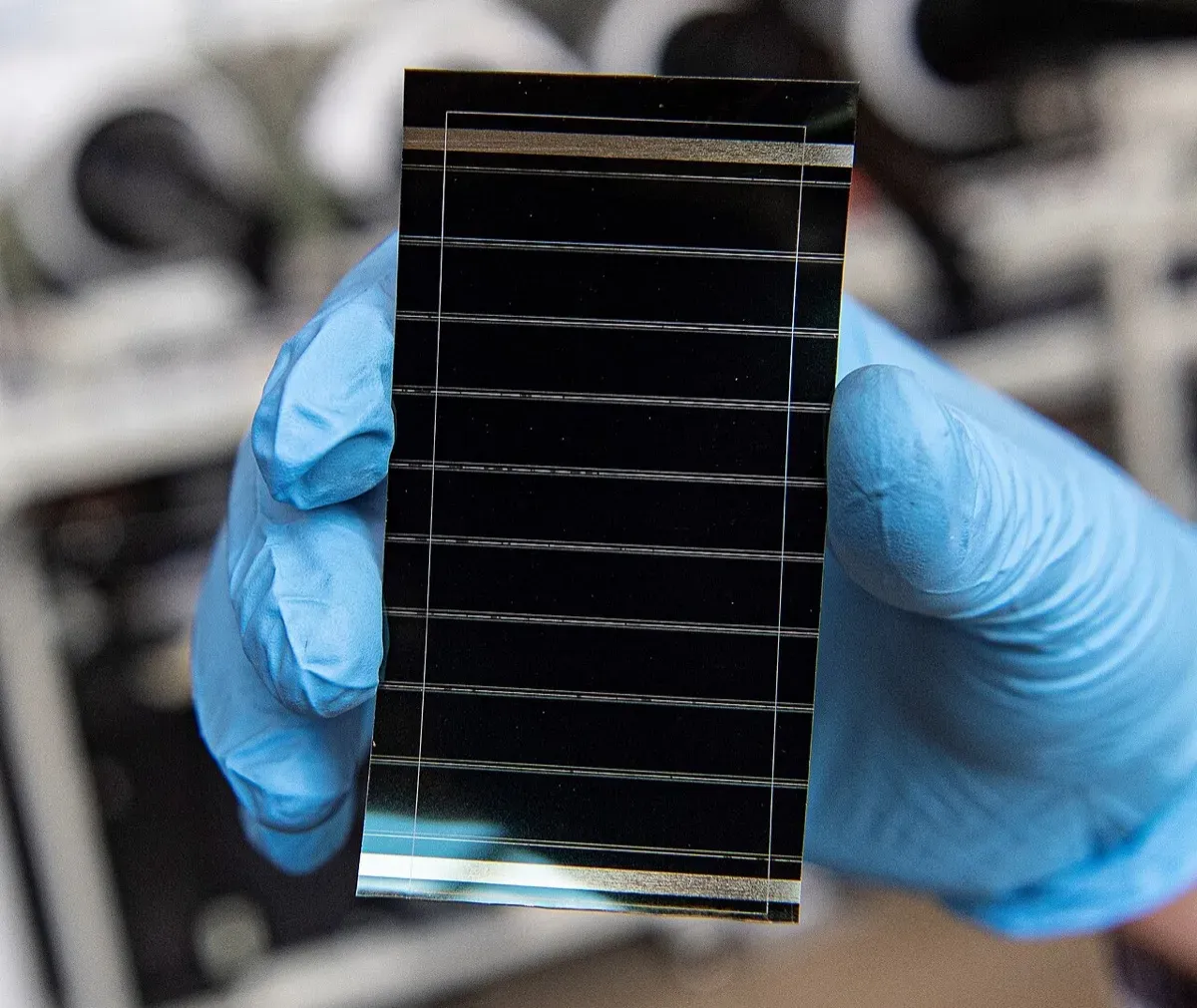
Oxford PV’s answer is the tandem cell. A silicon heterojunction cell forms the bottom layer. A thin film of perovskite, a crystal material that is very good at absorbing blue and green light, is deposited directly on top. The perovskite captures the high-energy part of the spectrum, while red and infrared light passes through to the silicon. Together they can beat the limit of silicon alone (pv Europe).
The cells are assembled into standard bifacial glass-glass modules that look almost identical to normal panels. In September 2024, Oxford PV announced its first commercial sale: 72-cell modules with 24.5% efficiency, shipped to a US utility-scale customer. The company said they produce up to 20% more energy than a standard silicon module of the same size (pv magazine).
How it works
- Silicon base: silicon wafers are textured, cleaned and coated with very thin amorphous silicon layers to make heterojunction bottom cells.
- Perovskite top: a perovskite thin film is deposited on the silicon at low temperature, because perovskite cannot survive the heat of normal silicon processing.
- Two absorbers, one cell: the top layer converts high-energy light; the bottom layer converts the light that passes through.
- Standard assembly: cells are connected with conductive adhesive and laminated between two sheets of glass.
- Licensing: the same patents are licensed to large manufacturers, so the technology can scale beyond Oxford PV’s own pilot line.
Timeline
| Date | Milestone |
|---|---|
| 2010 | Oxford PV founded as a University of Oxford spin-out |
| 2016 | Buys the former Bosch Solar and Johanna Solar factory in Brandenburg an der Havel |
| Jun 2024 | Record 26.9% efficient tandem module |
| 5 Sep 2024 | First commercial shipment of tandem modules, to a US customer |
| Apr 2025 | Exclusive licence for mainland China with Trina Solar |
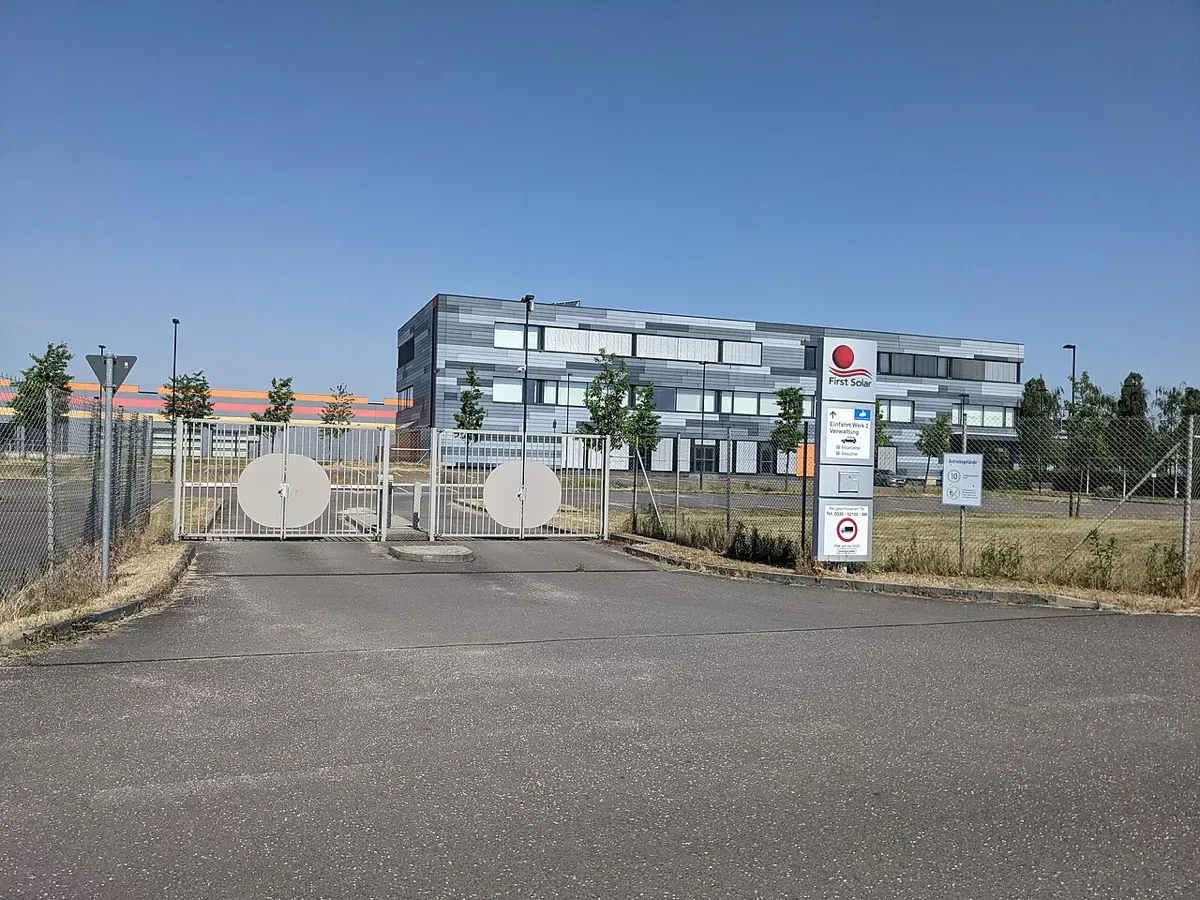
| 24 Feb 2026 | Non-exclusive US patent licence with First Solar |
| 18 Jun 2026 | Shingled tandem prototypes with Fraunhofer ISE reach 25.6% |
| 2026 | Centaur 3 launch planned: 550 W, 26%, 15-year warranty |
| 2027 | Planned mass production; 27% efficiency and 20-year lifetime target |
Impact and numbers
- Efficiency: current commercial modules are around 25% efficient, compared with roughly 22 to 23% for typical mainstream silicon panels. CEO David Ward targets one percentage point of improvement a year (pv magazine).
- Factory: the Brandenburg site has a heterojunction bottom-cell nameplate capacity of about 100 MW, while the integrated tandem line is in the tens of megawatts.
- Shingled design: with Fraunhofer ISE in Freiburg, Oxford PV built shingled tandem prototypes reaching 25.6%: a 491 W rooftop module of 1.92 m² and a 546 W bifacial module of 2.13 m² (Fraunhofer ISE).
- Reach through licences: Trina Solar can make and sublicense Oxford PV technology in China, and First Solar can use it in the US (Oxford PV).
- Cost logic: Ward says the perovskite materials are cheap and need no unusually expensive process steps, so most of the cost of a tandem cell is still the silicon bottom cell. The company’s longer-term ambition is 35% module efficiency by 2035 and a levelised cost of energy about 20% below silicon-only panels.
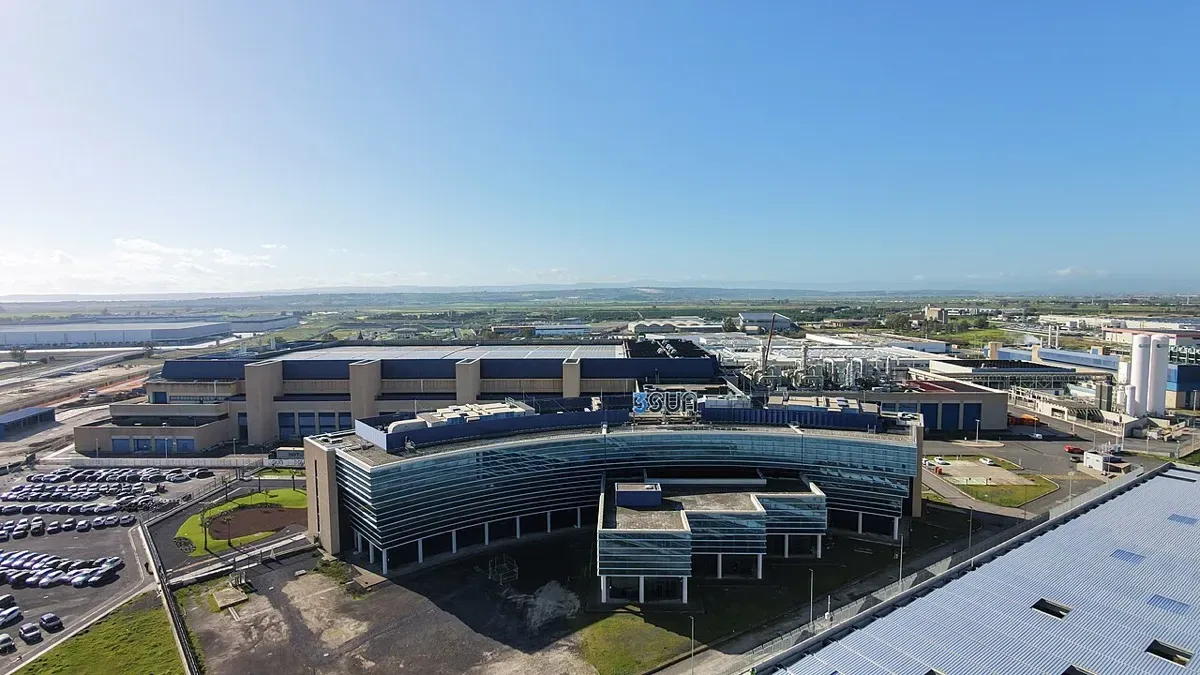
- Saving a site: the Brandenburg plant survived the collapse of Bosch Solar and Johanna Solar, and the local mayor credits Oxford PV with saving it.
Honest caveats. Durability is the big open question. Perovskites degrade with heat, moisture and light, and Oxford PV’s own roadmap only reaches a 20-year lifetime in 2027, well short of the 25 to 30 years buyers expect from silicon. Volumes are tiny: a line in the tens of megawatts is a rounding error in a market of hundreds of gigawatts a year. The perovskite layer contains a small amount of lead, which must be safely encapsulated and recovered at end of life. Most future production is likely to happen in China and the US through licences, not in Europe; Oxford PV is looking at the Middle East, the US and Europe for its next factory. Finally, there is little independent long-term field data yet, though the company expects more test-field results this year.
What’s next
Oxford PV plans to launch Centaur 3 in 2026 and to reach mass production in 2027. It is looking for sites for several more factories, with manufacturing at a new site targeted for late 2027 or early 2028. Its specialty line is also developing lightweight modules for high-altitude aircraft and other uses where power per kilogram matters. Licensing activity should grow too: Ward expects more deals to become public in 2026.
Why it matters for Europe / green buyers
Oxford PV is one of the few European solar companies with genuine technology leadership, and it has turned a closed Bosch site into the first commercial tandem factory. For European buyers, a 25% module means more power from the same roof or field, which matters where space is scarce, such as on factories, warehouses and urban buildings. The key question for EU policy is whether Europe will host the gigawatt-scale tandem factories, or whether, as with silicon, European inventions will mainly be produced in Asia and the US.
For India, which is quickly building its own module and cell industry, tandem technology is the next step after TOPCon. Licensing models like Oxford PV’s could let Indian manufacturers access perovskite technology without starting from zero.
Sources & image credits
- pv magazine, “Oxford PV starts commercial distribution of perovskite solar modules”, 5 September 2024: https://www.pv-magazine.com/2024/09/05/oxford-pv-starts-commercial-distribution-of-perovskite-solar-modules/
- PV Tech, “Oxford PV ships first commercial perovskite tandem modules”, September 2024: https://www.pv-tech.org/oxford-pv-ships-first-commercial-perovskite-tandem-modules/
- pv magazine, “Oxford PV targets 20-year lifetime for perovskite-silicon tandem modules by 2028” (updated 19 January 2026), 16 January 2026: https://www.pv-magazine.com/2026/01/16/oxford-pv-targets-20-year-lifetime-for-perovskite-silicon-tandem-modules-by-2028/
- pv Europe, “Oxford PV: Inside the Brandenburg factory where perovskite went commercial”, 10 January 2026: https://www.pveurope.eu/solar-modules/oxford-pv-inside-brandenburg-factory-where-perovskite-went-commercial
- Fraunhofer ISE, “Perovskite-silicon solar cells meet matrix shingled interconnection”, June 2026: https://www.ise.fraunhofer.de/en/press-media/press-releases/2026/perovskite-silicon-solar-cells-meet-matrix-shingled-interconnection.html
- pv magazine, “Oxford PV achieves 25.6% efficiency for perovskite-silicon tandem module based on shingled design”, 18 June 2026: https://www.pv-magazine.com/2026/06/18/oxford-pv-achieves-25-6-efficiency-for-perovskite-silicon-tandem-module-based-on-shingled-design/
- Oxford PV, “First Solar, Oxford PV enter into patent licensing agreement for US markets”, February 2026: https://www.oxfordpv.com/press-releases/first-solar-oxford-pv-enter-into-patent-licensing-agreement-for-us-markets
- pv magazine, “Oxford PV, Trina Solar enter patent licensing agreement for perovskite-silicon tandem solar”, 9 April 2025: https://www.pv-magazine.com/2025/04/09/oxford-pv-trina-solar-enter-patent-licensing-agreement-for-perovskite-silicon-tandem-solar/
Images:
- “Perovskite solar cell” by Dennis Schroeder / National Renewable Energy Laboratory, public domain (US government work), via Wikimedia Commons: https://commons.wikimedia.org/wiki/File:Perovskite_solar_cell.jpg