The problem
Rooftop solar has grown fast in Europe, but standard panels weigh around 10 to 12 kg per m² plus their mounting frames. Many warehouses, sports halls and farm buildings have lightweight roofs that cannot carry that load. Facades, curved surfaces, towers and tanks are also mostly unused, because rigid glass panels are hard to fix to them.
There is also a materials question. Silicon panels need energy-intensive glass and aluminium, and some thin-film technologies use lead or cadmium. Buyers who care about embodied carbon and end-of-life waste want solar products with a lighter footprint.
The product
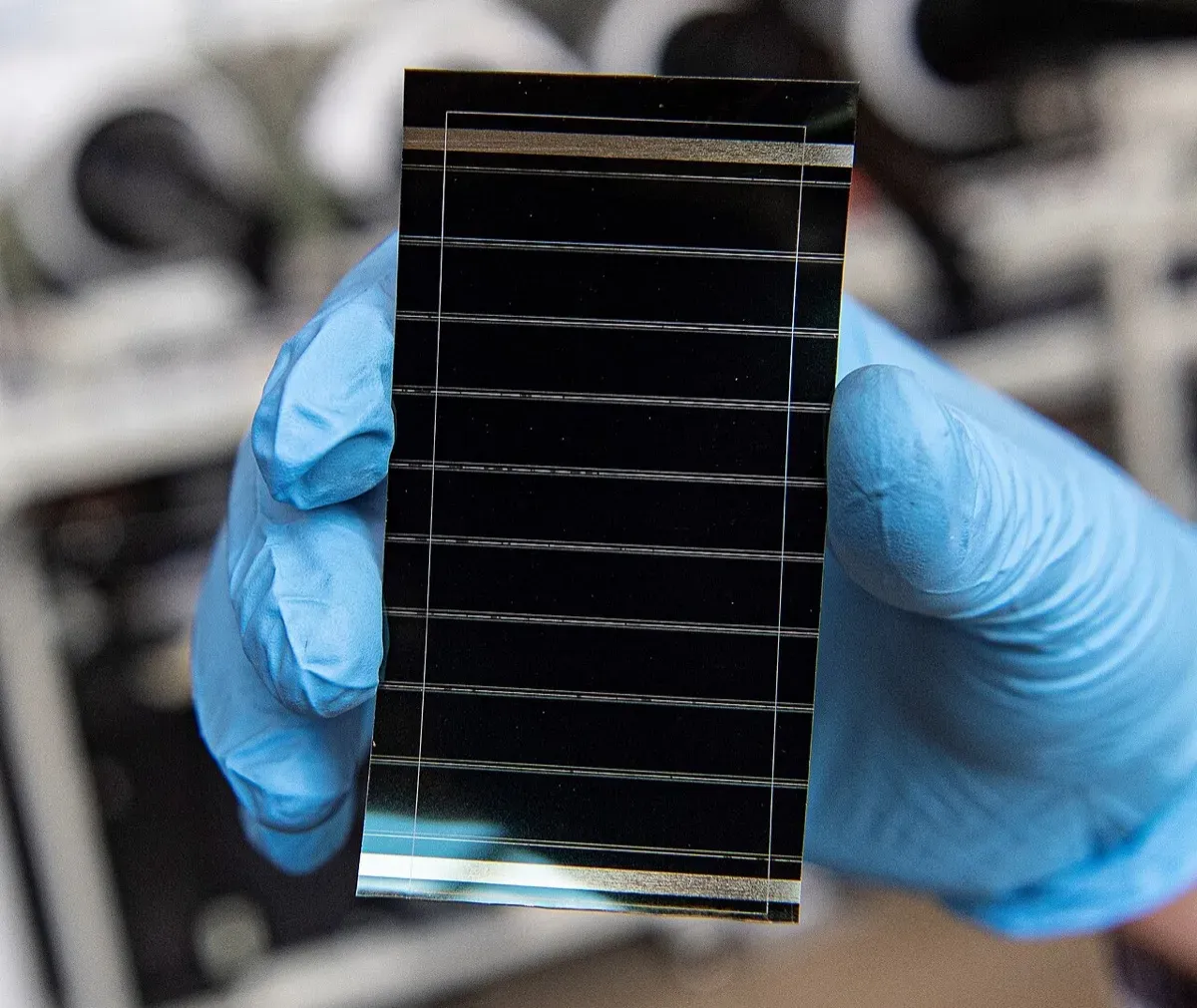
HeliaSol is a thin, flexible solar film based on organic molecules (small carbon-based molecules, not silicon). Each film contains organic triple-junction cells, which stack three thin absorber layers to capture more of the light spectrum. The film is protected by polymer front and back sheets and has a self-adhesive acrylic foam tape on the back, so installers simply peel and stick it onto glass, metal, steel or concrete. There is no mounting structure and no need to drill through the roof (Heliatek datasheet).
The 436-2000 film produces 50 or 55 W at standard test conditions. Its temperature coefficient is 0.00% per °C up to 65 °C, so unlike silicon it does not lose power when it gets hot. It is certified to IEC 61215 and IEC 61730, has a UL 61730 listing, and comes with a 5-year product warranty and a 20-year performance warranty.
Weight matters as much as power here. A HeliaSol film weighs about 1.6 kg in total, so one person can carry and install several at a time, and the extra load on a roof or wall is tiny. Because the film is dark, matt and flexible, architects can also treat it as part of the building skin rather than an add-on. The films are delivered rolled, twelve to a box, which cuts transport volume compared with glass panels.
How it works
- Organic absorbers: layers of small organic molecules absorb sunlight and release electrons.
- Triple junction: three sub-cells, each tuned to different wavelengths, are stacked and connected in series.
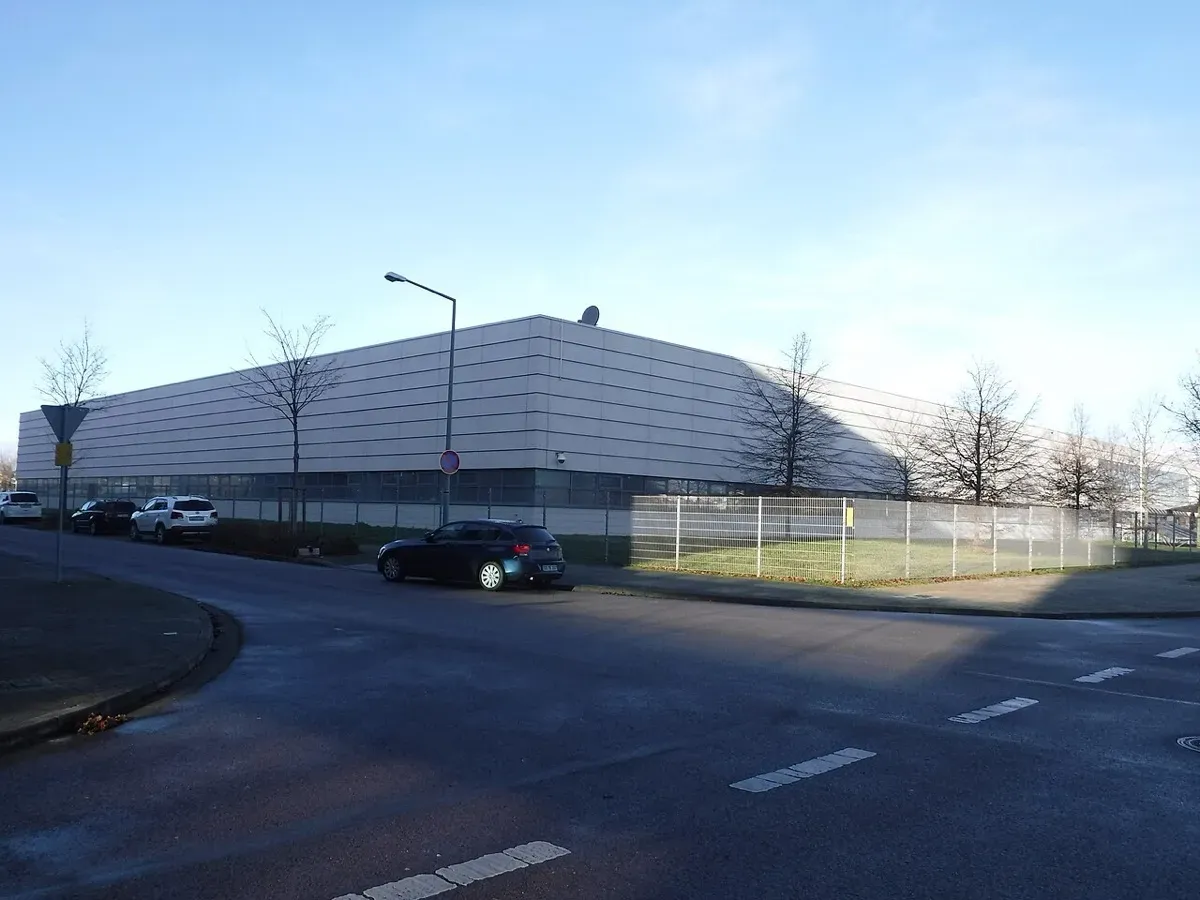
- Roll-to-roll production: the layers are vapour-deposited onto plastic film in a continuous roll process at mild temperatures in Dresden.
- Encapsulation: polymer films with UV and weather protection seal the cells.
- Installation: the film is glued onto the surface and connected through a junction box on the front, then to a normal inverter.
Timeline
| Date | Milestone |
|---|---|
| 2006 to 2007 | Heliatek founded as a TU Dresden and University of Ulm spin-off |
| Sep 2016 | €80 million financing round, including European Investment Bank support, to build large-scale production |
| Aug 2019 | Roll-to-roll series production inaugurated in Dresden |
| Apr 2024 | HeliaSol 436-2000 certified to IEC 61215 and IEC 61730 by TÜV |
| Mar 2025 | UL certification for the US market |
| 25 Feb 2026 | Installation of about 22 kWp on BMW’s Dingolfing plant towers announced |
| 21 Jul 2026 | TU Dresden’s TUDAG sells its stake in a new financing round |
Impact and numbers
- Carbon: TÜV Rheinland certified HeliaSol’s life-cycle footprint at 14.52 kg CO2e per m². Heliatek says that equals 3 to 15 g CO2e per kWh depending on sunshine, and claims a footprint up to six times lower than conventional silicon modules (Heliatek).
- Payback: energy payback is 2 to 7 months worldwide, and carbon payback 1 to 5 months at many locations, according to the company.
- Materials: no lead, cadmium, rare earths or scarce raw materials. At end of life, the film is classed as solid recovered fuel with a calorific value of 22 MJ per kg.
- BMW Dingolfing: 414 films covering about 330 m² on three concrete towers deliver about 22 kWp, used directly in the plant. BMW calls it a practical test of the technology in its industrialisation phase (Saxony Trade & Invest).
- Weight: under 2 kg per m², which opens roofs that cannot carry standard panels.
Honest caveats. At 7 to 8% aperture efficiency, HeliaSol produces only about a third of the power per m² of a mainstream silicon panel, so it suits surfaces that would otherwise stay empty, not open fields. Heliatek is still a small company losing a lot of money: its 2024 accounts show revenue of about €714,000 and a net loss of about €46 million (North Data). It depends on investors, and TU Dresden’s investment company sold its stake in a 2026 financing round. The warranties are shorter than for glass panels: 5 years on the product and 20 years on performance. The carbon figures come from the company’s own certified LCA, and incineration as fuel is energy recovery rather than true recycling.
What’s next
Heliatek is focusing on facades, lightweight industrial roofs and building-integrated solar through partners, including roofing system makers. The UL listing opens the North American market, and the 2026 financing round should fund the next stage of commercialisation. The key test is whether projects like BMW’s move from pilot to repeat orders at industrial scale. Raising efficiency and extending warranties closer to those of glass panels will also be essential to win mainstream buyers.
Why it matters for Europe / green buyers
HeliaSol is designed, developed and manufactured in Germany, from an EU-backed factory in Saxony, at a time when almost all solar hardware comes from Asia. For European building owners, it turns facades, towers and weak roofs into energy surfaces without structural upgrades, which supports the EU’s push for solar on buildings. Its low embodied carbon and lack of toxic heavy metals also help buyers who report Scope 3 emissions or pursue green building certification.
In India, where many factory sheds and warehouses have light metal roofs and summer temperatures cut silicon output, a lightweight film with zero temperature loss up to 65 °C is interesting, though the higher cost per watt and Heliatek’s limited presence remain hurdles.
Sources & image credits
- Heliatek, “HeliaSol” product page: https://www.heliatek.com/en/products/heliasol/
- Heliatek, “Technical datasheet: HeliaSol 436-2000-CFF”: https://www.heliatek.com/fileadmin/user_upload/pdf_documents/Datasheet_HeliaSol_436-2000_Website_EN.pdf
- Heliatek, “Sustainability”: https://www.heliatek.com/en/technology/sustainability/
- Heliatek, “Eye catching installation of Heliatek PV solar films at BMW plant in Dingolfing”, 25 February 2026: https://www.heliatek.com/en/media/news/detail/eye-catching-installation-of-heliatek-pv-solar-films-at-bmw-plant-in-dingolfing/
- Saxony Trade & Invest, “PV solar films from Saxony provide electricity for the BMW plant in Dingolfing”, 2026: https://business-saxony.com/en/news-events/news/news-detail/n1921-pv-solar-films-from-saxony-provide-electricity-for-the-bmw-plant-in-dingolfing
- TUDAG, “TUDAG beendet Beteiligung an Heliatek”, 21 July 2026: https://tudag.de/entrepreneurship/tudag-beendet-beteiligung-an-heliatek/
- North Data, “Heliatek GmbH, Dresden, HRB 24834” (2024 annual accounts): https://www.northdata.de/Heliatek%20GmbH,%20Dresden/HRB%2024834
- European Investment Bank, “Heliatek raises EUR 80 million to finance large manufacturing expansion and support worldwide market development”, September 2016: https://www.eib.org/en/press/all/2016-213-heliatek-raises-eur80-million-to-finance-large-manufacturing-expansion-and-support-worldwide-market-development
Images:
- “Heliatek Dresden” by Derbrauni, licensed under CC BY-SA 4.0 (https://creativecommons.org/licenses/by-sa/4.0), via Wikimedia Commons: https://commons.wikimedia.org/wiki/File:Heliatek_Dresden.jpg