The problem
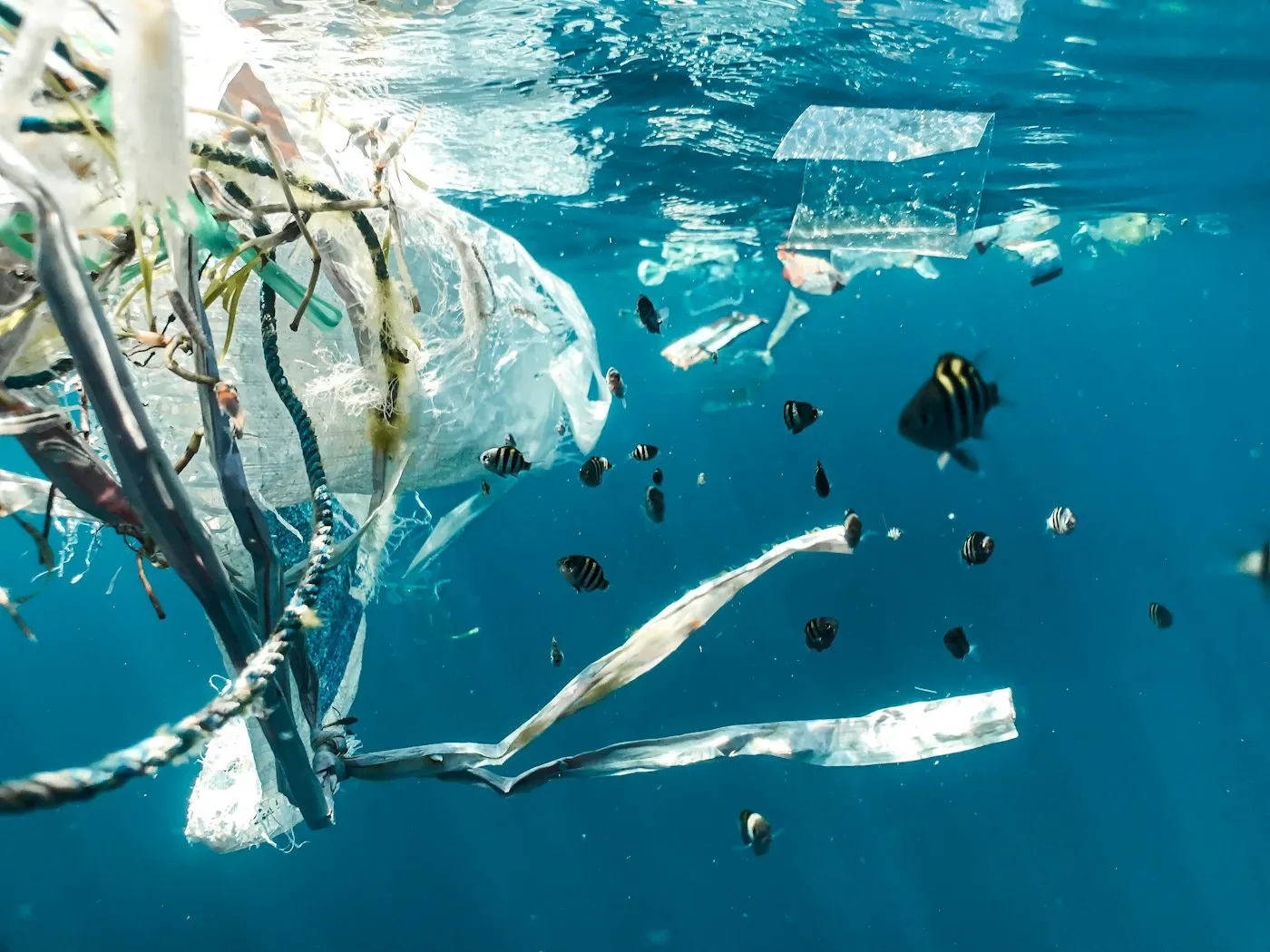
Ports and marinas are where land meets sea. Litter from streets, rivers and boats ends up in their calm water: bottles, wrappers, cigarette butts, foam, fishing line and tiny fragments of plastic. Because wind and currents drive floating debris in predictable directions, it piles up in the same corners again and again. Manual skimming with nets is slow and misses small pieces, and many marinas have no regular cleanup at all.
The EU’s Zero Pollution Action Plan aims to cut plastic litter at sea by 50% and microplastics released into the environment by 30% by 2030 (European Commission). Most of that must come from prevention, but sheltered waters are also the cheapest place to catch litter before it reaches the open sea.
The product
The Seabin began as a surfers’ idea: if there are bins on land, why not in the water? Turton and Ceglinski built prototypes in Mallorca and launched an Indiegogo campaign in late 2015 that raised more than US$260,000 (Waste Dive, 22 December 2015; Tourism Australia). In March 2016 they signed an exclusive industrial partnership with Poralu Marine, with La Grande Motte in the south of France as the first French port for research and development.
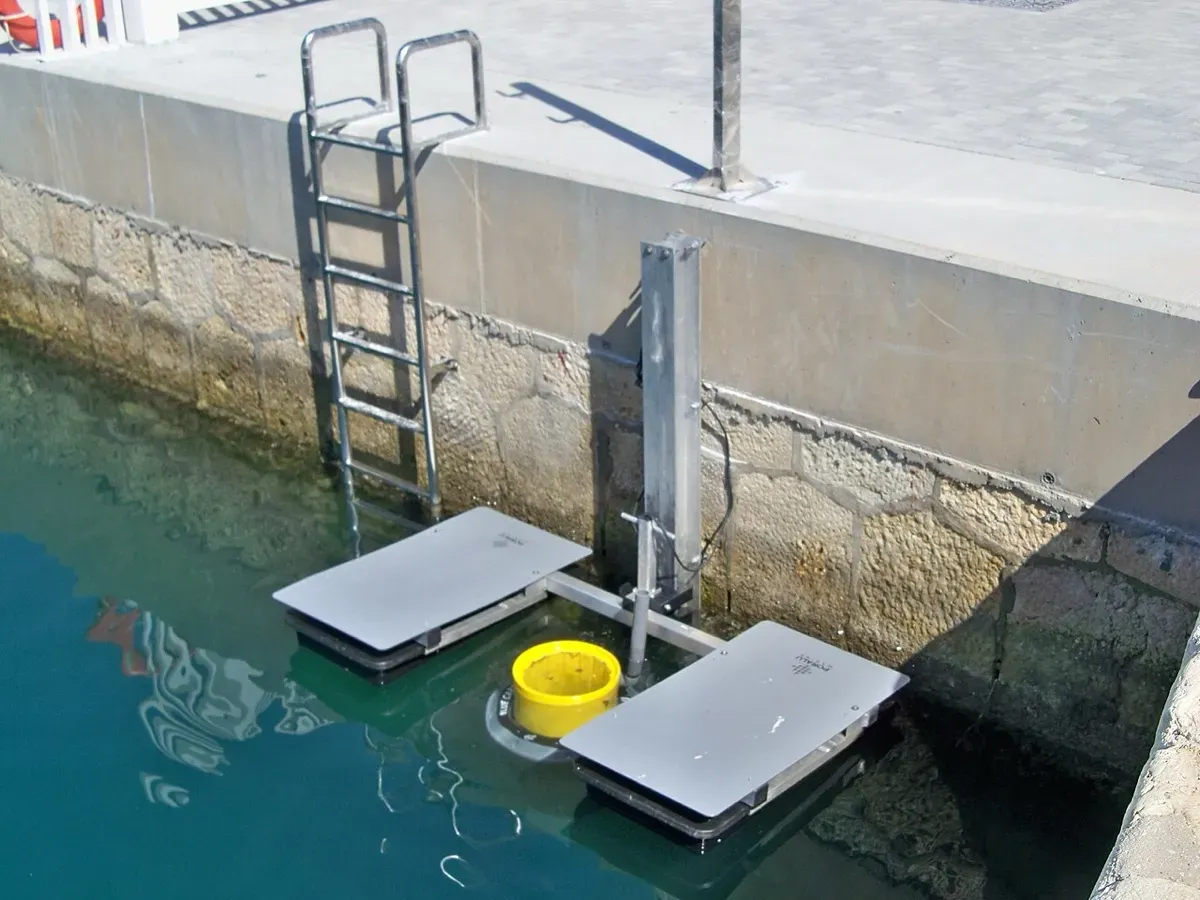
The resulting Seabin V5 is a rotomoulded tube attached to a floating dock. At METS in November 2017, it won the DAME Design Award for port and shipyard equipment. Boat Industry reported that it is made in France, captures debris larger than 2 mm, and was priced at €3,300 excluding VAT, with an operating cost of about €0.90 a day (Boat Industry).
How it works
The Seabin sits with its rim at the waterline. A submersible pump on the dock, rated at 25,000 litres per hour, draws water down into the bin, pulling in floating debris from the surface around it. Water flows through a catch bag and back into the harbour, while the litter stays behind. Optional oil-absorbent pads inside the bin soak up surface fuel and oil films.
According to specifications reported in 2019, the unit weighs about 55 kg, measures roughly 500 x 500 x 1,800 mm, is made of high-density polyethylene, runs on 110 or 220 volts and holds up to 20 kg of debris in its catch bag. Marina staff empty the bag and sort the catch. The same report said each bin could collect almost 4 kg of floating debris a day, or about 1.4 tonnes a year, depending on weather and location (AZoCleantech). Where mains power is awkward, the pump can also run from a solar panel, small wind turbine or water turbine, according to Boat Industry. Placement matters: the bin works best where wind and currents bring litter to it.
Timeline
| Date | Milestone |
|---|---|
| 2015 | Prototypes built in Mallorca; Indiegogo raises more than US$260,000 |
| March 2016 | Exclusive partnership with Poralu Marine; La Grande Motte becomes French R&D port |
| November 2017 | Seabin V5 wins a DAME Design Award at METS, Amsterdam |
| April 2018 | First V5 deliveries; about 150 units presold in Europe |
| 2019 | More than 700 units installed worldwide |
| 2020 | Seabin starts long-term monitoring in Sydney Harbour |
| 2026 | 21 active Seabins in Sydney feed a live public data dashboard |
Impact and numbers
- European roll-out: about 150 units presold across more than 50 European sites, including Paris, Marseille and Venice, before first deliveries in April 2018. Paris installed units for the opening of its Paris Plages summer beach, and Marseille fitted them in the Vieux Port. Poralu targeted 400 more sales in the second year, and said marina managers were surprised both by how much the bins caught and by how much macro and micro plastic was in their water (Argus du Bateau, 11 July 2018).
- Monitoring: in Sydney Harbour, Seabin reports 43.4 billion litres of water filtered, 33.0 million items captured and 18.9 million microplastics, all catalogued by type (Seabin).
- What gets caught: the dashboard lists millions of plastic pellets, foam fragments and microfibres, the small debris that manual skimming misses.
- Global footprint (2019): more than 700 active Seabins and close to 115,000 kg of waste officially recorded, with a programme to track and certify that captured plastic is recycled (AZoCleantech).
- Accountability: Seabin audits branded items in the catch and shares the data with partners for sustainability reporting and to support new legislation.
Honest caveats. Seabins work at the scale of a marina corner, not an ocean. Published capacity figures vary widely, from a maximum of about 500 kg a year cited at the 2017 launch to about 1.4 tonnes a year in a 2019 profile, and actual catch depends heavily on placement and weather. Units need electricity, regular emptying and maintenance, and operators should check catches for small marine life as well as litter. Most impact numbers are self-reported.
What’s next
Seabin has shifted from selling hardware to running a “nature-data intelligence platform”. Companies such as JCDecaux, Yamaha Motors Australia and Multiplex sponsor units in Sydney, and the data on items and brands captured feeds partners’ ESG reporting and policy discussions on plastic packaging. The aim is to use cleanup data as evidence for prevention, linking specific products and brands to the litter found in the water.
Why it matters for Europe / green buyers
Although the founders are Australian, the Seabin V5 is a European product in many ways: developed in Mallorca, engineered and made in France by Poralu, and first deployed at scale in French, Italian and Spanish ports. For European marinas and port authorities, it is an off-the-shelf tool that supports Zero Pollution goals, engages visitors and produces data on local litter.
Buyers should treat it as part of a broader port waste strategy, together with waste reception facilities for boats, storm drain filters and prevention campaigns. The most valuable output may not be the kilograms collected but the evidence on what kinds of plastic, and which brands, end up in the water.
Sources & image credits
- Waste Dive, “Surfers launch Seabin Project to protect waters from trash, oil”, 22 December 2015: https://www.wastedive.com/news/surfers-launch-seabin-project-to-protect-waters-from-trash-oil/411210/
- Tourism Australia Business Events, “Australian invention Seabin tackles ocean pollution”: https://businessevents.australia.com/en/news/australian-invention-seabin-tackles-ocean-pollution.html
- Boat Industry, “Seabin, the marine waste collector Made In France, awarded at METS”, 21 November 2017: https://www.boatindustry.com/news/27053/seabin-the-marine-waste-collector-made-in-france-awarded-at-mets
- L’Argus du Bateau, “Poralu Marine et Seabin dans les ports d’Europe”, 11 July 2018: https://www.argusdubateau.fr/actualite/poralu-marine-et-seabin-dans-les-ports-d-europe
- AZoCleantech, “Using the V5 Seabin to Reduce Marine Pollution”, 2019: https://www.azocleantech.com/article.aspx?ArticleID=914
- Seabin, Nature-Data Intelligence Platform and live Sydney Harbour dashboard, accessed October 2026: https://seabin.io/
- European Commission, Zero Pollution Action Plan: https://environment.ec.europa.eu/strategy/zero-pollution-action-plan_en
Images:
- “Seabin in the Port of Málaga” by Daniel Capilla, licensed CC BY-SA 4.0 (https://creativecommons.org/licenses/by-sa/4.0), via Wikimedia Commons: https://commons.wikimedia.org/wiki/File:Seabin_in_the_Port_of_M%C3%A1laga.jpg