The problem
Ocean waves are a concentrated, relatively steady renewable resource. They often peak in winter, when solar output is low, and they continue for hours or days after the wind that created them has died down. That makes wave power a natural partner for offshore wind in Europe’s future grid.
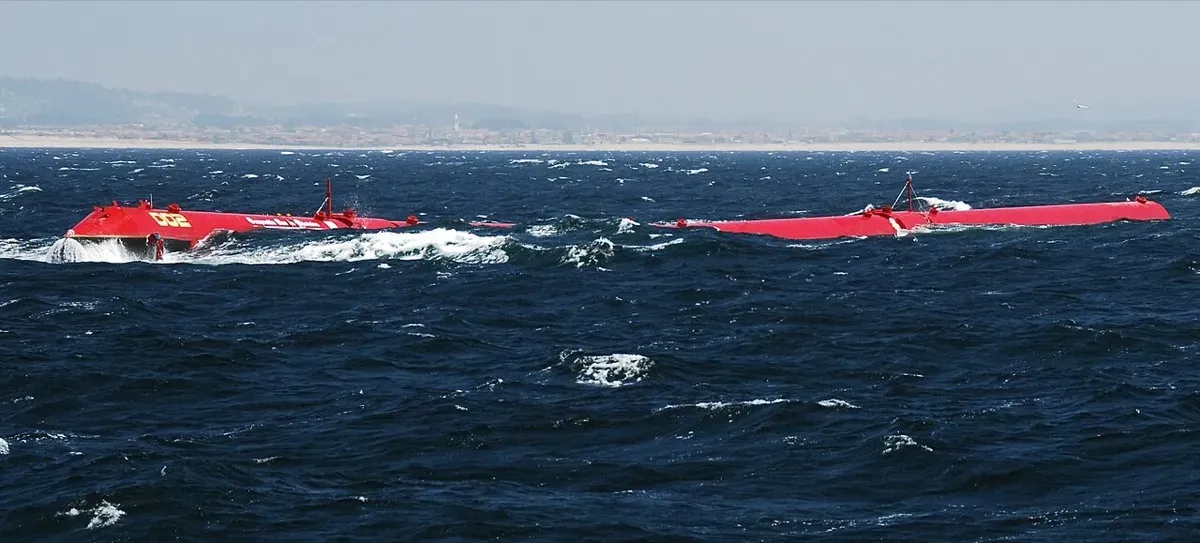
The history of the sector, though, is full of devices that were too fragile, too heavy or too expensive. Two problems have dominated: surviving extreme storms, and capturing enough energy in the moderate waves that occur most of the time. Aguçadoura itself is a reminder: the world’s first multi-unit wave farm opened there in September 2008 with three Pelamis machines totalling 2.25 MW, and shut down two months later (Wikipedia). A machine built strong enough for a 100-year storm tends to be heavy and costly, while a machine optimised for everyday seas risks being destroyed. The EU still aims for at least 1 GW of ocean energy by 2030 and 40 GW by 2050 (European Commission, 2020), so solving both problems at once matters.
The product
CorPower C4 is the company’s first commercial-scale wave energy converter, unveiled in Stockholm on 15 June 2022. It is a buoyant composite hull on the sea surface, connected by a tensioned mooring line to an anchor on the seabed. As waves lift and drop the buoy, a power take-off inside converts the motion into electricity. At 300 kW, CorPower calls it the world’s most compact wave energy system relative to its power output (CorPower Ocean, 15 June 2022).
The company says C4 can generate up to five times more annual energy per tonne of device than previous state of the art, and that CorPack wave farms could produce up to three times as much power per unit of ocean area as a typical offshore wind farm. Its long-term target is a cost of around €30/MWh at gigawatt-scale deployment.
How it works
The heart analogy is literal. C4’s Pretension Cylinder is inspired by the heart’s ability to store pressure for the return stroke: it uses pneumatic pretension to pull the buoy downward, keeping it centred and ready for storms (CorPower Ocean technology). The WaveSpring phase control then makes the buoy oscillate in phase with incoming waves. CorPower measured up to 3 m of machinery motion in waves only 1 m high when tuned.
In storms the system does the opposite. The detuned “survival mode” is the device’s natural state, so the buoy barely reacts even when waves submerge the hull. During storm Domingos on 4 November 2023, waves reached up to 18.5 m, which the Hydrographic Institute of Portugal reported as a record for the region, while machinery motion stayed within a few decimetres (CorPower Ocean, 27 February 2024). CorPower compares this to the way wind turbines pitch their blades to shed load.
The device is held at the Aguçadoura site by CorPower’s UMACK anchor, installed in sand at 45 m depth. A remotely released quick connector lets the buoy surface and be towed back to Viana do Castelo for maintenance. After its first 2,000 hours of operation, CorPower used the data to upgrade the system, including higher peak power capacity and more advanced control methods, before redeployment (CorPower Ocean, 2 July 2024). Lessons from this first deployment period have also been published for peer scrutiny at the European Wave and Tidal Energy Conference.
Timeline
| Date | Milestone |
|---|---|
| 2012 | CorPower Ocean founded in Stockholm |
| 15 June 2022 | C4 and CorPack clusters unveiled |
| August 2023 | C4 towed out and connected at Aguçadoura under the HiWave-5 project |
| Autumn 2023 | Survives storms Babet, Aline and Domingos, with waves up to 18.5 m |
| 27 February 2024 | First operational phase results published; device towed to Viana do Castelo for maintenance |
| 2 July 2024 | On-land inspection and upgrades near completion, based on the first 2,000 hours of operating data |
| 2025 | EU Innovation Fund awards €40 million to the VianaWave pre-commercial park; C5 manufacturing begins |
| 25 May 2026 | Annual report confirms Stage 5 verification and commercialisation targeted for 2027 |
Impact and numbers
- Survivability: four major storms weathered, with power export restarting after each.
- Power: peak export of 592 kW recorded at the onshore substation meter, roughly twice the device’s 300 kW rating, during a commissioning phase with limited motion envelopes.
- Model accuracy: the digital twin of the power conversion chain matched measurements with a typical goodness of fit of 96 to 99%, and the buoy slightly outperformed predictions.
- Funding: a €53 million B-round, €17.5 million from the European Innovation Council and €30 million Horizon Europe funding for the Power Farm EU consortium, plus new investors Acario Innovation, the investment arm of Tokyo Gas, and GTT Strategic Ventures (Annual report 2025).
Honest caveats. C4 is a single demonstration unit, and CorPower has not yet published annual energy yield, capacity factor or an independent power performance assessment under IEC standards, which is the next step in its programme. The cost target of €30/MWh assumes gigawatt-scale build-out that does not yet exist. The 592 kW figure is a peak, not average output. Most data come from the company and its project partners.
What’s next
CorPower is building industrialised C5 machines and plans VianaWave, a pre-commercial wave park off Viana do Castelo backed by the EU Innovation Fund, as the bridge to utility-scale farms. It is also partnering on hybrid projects that share infrastructure with offshore wind, such as Project Saoirse with Simply Blue Group off the west coast of Ireland. The company says Atlantic European countries could in future meet 20% of their energy needs from waves.
Why it matters for Europe / green buyers
CorPower is a Swedish company testing in Portugal with a European supply chain, part of a new industrial sector that could add predictable, winter-heavy renewable output to Europe’s grid and complement offshore wind. Public funders, from the EU Innovation Fund to the European Innovation Council, are betting on it.
For utilities, offshore wind developers and corporate buyers of clean power, the questions to track are clear: independently certified power curves, availability over full years, maintenance costs and the cost of energy from the first multi-unit park. If C5 and VianaWave deliver, wave energy could move from a promising experiment to a bankable technology.
Sources & image credits
- CorPower Ocean, “CorPower Ocean unveils commercial scale products to unleash utility scale wave farms”, 15 June 2022: https://corpowerocean.com/corpower-ocean-unveils-commercial-scale-products-to-unleash-utility-scale-wave-farms/
- CorPower Ocean, “CorPower Ocean announces wave energy breakthrough”, 27 February 2024: https://corpowerocean.com/corpower-ocean-announces-wave-energy-breakthrough/
- CorPower Ocean, “CorPower Ocean completing C4 inspection and upgrades”, 2 July 2024: https://corpowerocean.com/corpower-ocean-completing-inspection-upgrades/
- CorPower Ocean, “CorPower Ocean annual report 2025”, 25 May 2026: https://corpowerocean.com/corpower-ocean-annual-report-2025/
- “Results and Lessons Learned from CorPower Ocean’s Full Scale C4 Wave Energy Converter First Ocean Deployment Period”, Proceedings of the European Wave and Tidal Energy Conference (EWTEC): https://submissions.ewtec.org/proc-ewtec/article/view/958
- European Commission, “An EU Strategy to harness the potential of offshore renewable energy for a climate neutral future”, COM(2020) 741: https://eur-lex.europa.eu/legal-content/EN/TXT/?uri=CELEX%3A52020DC0741
- CorPower Ocean, “Technology”: https://corpowerocean.com/technology/
- Wikipedia, “Aguçadoura Wave Farm”: https://en.wikipedia.org/wiki/Agu%C3%A7adoura_Wave_Farm
Images:
- “Pelamis machine installed at the Agucadoura Wave Park” by S. Portland, public domain, via Wikimedia Commons: https://commons.wikimedia.org/wiki/File:Pelamis_machine_installed_at_the_Agucadoura_Wave_Park.JPG