The problem
Geothermal energy provides firm, low-carbon electricity with capacity factors above 75%, according to the IEA, yet it still meets less than 1% of global energy demand (IEA). One reason is that many reservoirs are not hot enough for conventional flash steam plants, which need high-temperature, high-pressure fluid.
Flash plants also release some geothermal gases, including carbon dioxide and hydrogen sulphide, and they can lose water to the atmosphere through cooling towers. In arid regions and fragile ecosystems, that is a problem. Developers want plants that work at moderate temperatures, reinject all of the fluid, and can be built in modules as a field is proved.
The product
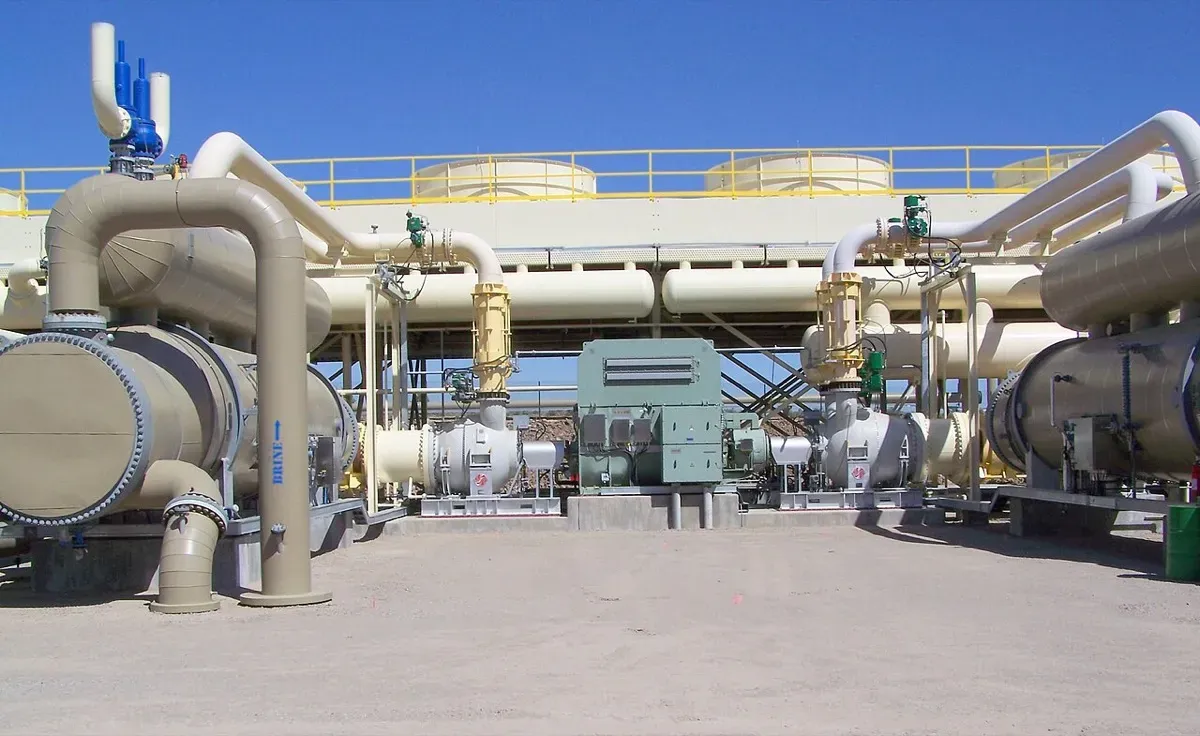
The Ormat Energy Converter is a binary power plant. Hot brine or steam from the wells passes through a heat exchanger and vaporises a separate organic working fluid, which drives a turbine and then condenses in an air-cooled or water-cooled condenser. The geothermal fluid stays in a closed loop and goes back underground, so the plant has near-zero emissions and very low water use when air-cooled (Ormat).
Ormat designs, manufactures and installs the turbines, heat exchangers and controls itself, which is unusual in the industry. The technology began as a way to power remote equipment far from any grid: many of the 120 small Ormat units installed in 1975 to run safety valves and control systems on the Trans-Alaska pipeline are, according to the company, still operating today. Today it offers standard modular OECs, combined-cycle plants that use a steam turbine at the top and a binary bottoming cycle, and plants that integrate with solar and storage.
In June 2026 the company introduced the Ormega100, which it describes as the largest binary unit in the industry: a single 100 MW unit designed to cut cost per megawatt for large fields and for enhanced geothermal systems (EGS). Ormat also announced EGS pilots with SLB, starting at its Desert Peak field in Nevada, with drilling scheduled for the fourth quarter of 2026, and with Sage Geosystems (Ormat, 8 June 2026).
How it works
- Produce: wells bring hot brine, or a mix of steam and brine, to the surface.
- Vaporise: in the vaporiser, the geothermal heat boils an organic fluid such as pentane, which has a much lower boiling point than water.
- Generate: the vapour drives an Ormat turbine connected to a generator.
- Condense: air-cooled condensers turn the vapour back into liquid, which is pumped back to the vaporiser.
- Reinject: the cooled brine, and any non-condensable gases, are returned to the reservoir, sustaining pressure and keeping emissions close to zero.
Timeline
| Date | Milestone |
|---|---|
| 1965 | Ormat founded in Yavne, Israel, by Lucien and Dita Bronicki |
| 1966 | First 600 W solar-powered ORC unit installed in Mali |
| 1975 | 120 Ormat units power stations on the Trans-Alaska pipeline |
| 1986 | Ormesa I, 30 MW, in California’s Imperial Valley |
| 2004 | Ormat Technologies lists on the New York Stock Exchange |
| 2006 | Ormat enters Turkey with its first plant there, DORA 1 |
| 2013 | Ngatamariki, New Zealand, 100 MW |
| 2018 | Sarulla, Indonesia, 330 MW; Olkaria III, Kenya, reaches 150 MW |
| Nov 2020 | Puna, Hawaii, restarts after the 2018 lava flow |
| Jun 2026 | Ormega100 unveiled; EGS pilots with SLB and Sage |
| Jul 2026 | 10 MW geothermal plant in Dominica |
Impact and numbers
- Turkey: over 900 MW in more than 40 plants supplied by Ormat, more than half of the country’s geothermal capacity (Ormat history).
- Kenya: the Olkaria III complex grew from 8 MW in 2000 to 150 MW in 2018 (Ormat, 2018).
- Indonesia and New Zealand: Sarulla (330 MW) and Ngatamariki (100 MW) are among the largest binary or combined-cycle plants in the world.
- Islands: Platanares in Honduras (35 MW), Bouillante in Guadeloupe, and a 10 MW plant in Dominica that came online in July 2026 bring firm power to places that once relied on diesel.
- Finances: Q2 2026 revenue of US$258.8 million, with full-year 2026 guidance of US$1.15 to 1.2 billion (Ormat Q2 2026).
Honest caveats. Ormat’s equipment is proven, but geothermal fields themselves carry risk: reservoirs can cool or lose pressure over time if they are over-produced, and drilling is expensive. Natural hazards matter too: the Puna plant in Hawaii was shut by the Kilauea lava flow in May 2018 and only resumed operation in November 2020 (Ormat, 2020). Some geothermal brines in Turkey are rich in CO2, and plants there can emit more than the “near-zero” figure that applies to binary plants elsewhere unless gases are reinjected. The Ormega100 is newly announced and not yet in commercial operation, and the EGS pilots are at an early stage. Ormat’s portfolio also includes solar and battery storage, so not every megawatt it reports is geothermal.
What’s next
Ormat is positioning itself for the rising demand for firm clean power from data centres and utilities. Its strategy combines expanding its own geothermal fleet, selling equipment to third parties, and moving into enhanced geothermal through partnerships, using the Ormega100 to lower costs at scale. The SLB pilot at Desert Peak will be one of the first tests of EGS at an existing commercial geothermal field.
Why it matters for Europe / green buyers
Turkey has become Europe’s largest geothermal power market by installed capacity, and Ormat’s technology is the backbone of that growth. For European utilities exploring medium-temperature resources in Hungary, Croatia, Germany or the Upper Rhine, Ormat is one of a small number of suppliers, alongside Turboden and Exergy, with decades of binary plant experience. Buyers should evaluate brine chemistry, gas content and reinjection plans, which matter more to life-cycle emissions than the turbine itself.
India has not yet built a commercial geothermal power plant. ONGC’s pilot at Puga in Ladakh, where temperatures of 135°C have been measured at shallow depth, is exactly the type of medium-temperature resource that binary plants like Ormat’s are designed for. The IEA counts India, along with China and the US, among the countries holding three-quarters of the market potential for next-generation geothermal.
Sources & image credits
- Ormat Technologies, “History”: https://www.ormat.com/en/company/welcome/history/
- Ormat Technologies, “Geothermal power”: https://www.ormat.com/en/renewables/geothermal/main/
- Ormat Technologies, “Ormat Technologies reports second quarter 2026 financial results”, August 2026: https://investor.ormat.com/news-events/news/news-details/2026/Ormat-Technologies-Reports-Second-Quarter-2026-Financial-Results/default.aspx
- Ormat Technologies, “Ormat Technologies accelerates enhanced geothermal system (EGS) deployments and introduces Ormega100 unit”, 8 June 2026: https://investor.ormat.com/news-events/news/news-details/2026/Ormat-Technologies-Accelerates-Enhanced-Geothermal-System-EGS-Deployments-and-Introduces-Ormega100-Unit-to-Commercialize-and-Scale-the-Largest-Binary-Unit-in-the-Industry/default.aspx
- Ormat Technologies, “Ormat’s Olkaria III Plant 1 expansion reaches commercial operation, increasing complex capacity to 150 MW”, 2018: https://investor.ormat.com/news-events/news/news-details/2018/Ormats-Olkaria-III-Plant-1-Expansion-Reaches-Commercial-Operation-Increasing-Complex-Capacity-to-150-MW/default.aspx
- Ormat Technologies, “Ormat resumes operation of Puna power plant”, November 2020: https://investor.ormat.com/news-events/news/news-details/2020/Ormat-Resumes-Operation-of-Puna-Power-Plant/default.aspx
- International Energy Agency, “The Future of Geothermal Energy: Executive summary”, December 2024: https://www.iea.org/reports/the-future-of-geothermal-energy/executive-summary
Images:
- “Geothermal Binary Power Plant Steamboat Springs NV” by Rjglewis, licensed CC BY-SA 3.0 (https://creativecommons.org/licenses/by-sa/3.0), via Wikimedia Commons: https://commons.wikimedia.org/wiki/File:Geothermal_Binary_Power_Plant_Steamboat_Springs_NV.jpg