The problem
Heating buildings is one of Europe’s largest uses of energy and one of its largest sources of gas demand. Air-source heat pumps are now the default replacement for gas boilers, but they work hardest when outdoor air is coldest, just when demand peaks. The ground is different: a few metres down, its temperature barely changes during the year, and at 100 to 200 metres, a borehole sees a stable temperature all winter.
That stable source is why “shallow geothermal” matters. The IEA’s 2024 geothermal report covers heat from the ground alongside geothermal power (IEA). The challenge is cost: drilling a borehole adds thousands of euros to an installation, so the heat pump itself must be efficient enough to pay that back.
The product
The S1256 is a ground-source heat pump designed for houses. It combines an inverter-driven compressor, which adjusts speed to match demand, with a 180-litre water heater that delivers up to 300 litres of hot water at usable temperature and meets the XL tap profile (NIBE).
At launch, NIBE called it its most energy-efficient ground-source heat pump ever (NIBE press release, 10 October 2023). Its product sheet lists SCOP values up to 6.22 for the 4 to 18 kW model in a cold climate at 35°C flow temperature, and a COP of about 5.05 to 5.10 at 0°C brine and 35°C flow (NIBE product sheet). It is rated A+++ for space heating and A+ for water heating.
The unit measures 600 × 620 × 1,800 mm and weighs about 231 to 250 kg. It can supply water up to 70°C (65°C from the compressor alone), which suits older homes with radiators as well as underfloor heating. Sound power is 36 to 47 dB(A). The refrigerant is R454B, with 1.15 to 1.75 kg per unit, equivalent to 0.54 to 0.82 tonnes of CO2. Owners can control it with the myUplink app, and Smart Price Adaption shifts operation to cheaper electricity hours. An optional PCS 44 accessory provides passive cooling in summer by circulating cool ground fluid through the house.
How it works
- Collect: a sealed plastic pipe loop is placed in a vertical borehole in rock, in a horizontal trench in soil, or on a lake bed. Antifreeze fluid in the loop picks up heat from the ground at a few degrees above zero.
- Lift: in the heat pump, that heat evaporates the refrigerant, and an inverter compressor raises its pressure and temperature.
- Deliver: the hot refrigerant gives up its heat to the radiator or underfloor circuit and to the water heater.
- Repeat: the cooled fluid returns to the ground loop. Boreholes are spaced at least 15 metres apart so they do not steal heat from each other.
- Cool in summer: with the passive cooling accessory, the same loop can carry heat from the house back into the ground.
Timeline
| Date | Milestone |
|---|---|
| 1952 | NIBE founded in Markaryd, Sweden |
| 10 Oct 2023 | S1256 launched as NIBE’s most efficient ground-source heat pump |
| Nov 2025 | Swedish geothermal country update: about 690,000 ground-source systems |
| Mar 2026 | European Heat Pump Association reports a 10% rise in 2025 sales |
| 2026 | NIBE Q2 report: net sales up 7.6% to SEK 10,849 million |
Impact and numbers
- Sweden: about 690,000 ground-source heat pump systems, installed in roughly one in four single-family homes, deliver about 28.4 TWh of heat a year, of which about 21 TWh is renewable heat from the ground. Installed capacity is about 8.1 GWth, with 15,000 to 24,000 new systems a year and an average borehole depth of about 200 metres (EGC 2025 Sweden country update).
- House values: the same report cites studies finding Swedish homes with a ground-source heat pump valued about €12,500 higher, and about €20,000 in Stockholm.
- Upgrades: many early systems with COPs around 3 are now being replaced by units at COP 4 to 5, cutting electricity use without new drilling.
- Europe: 2.62 million heat pumps sold across 16 countries in 2025, up 10%, with about 28 million installed in Europe; Swedish sales rose 12% and UK ground and water source sales by 32% (EHPA).
- The company: NIBE reported Q2 2026 net sales of SEK 10,849 million, up 7.6%, with an operating margin of 11.4% (NIBE interim report).
Honest caveats. SCOP figures are laboratory values under standard conditions; real performance depends on borehole design, flow temperature and installation quality, and higher radiator temperatures reduce efficiency. The upfront cost of drilling is high, and in Sweden the ROT tax deduction for labour was cut from 50% to 30%, which affects payback. R454B has a far lower global warming potential than older refrigerants, but it is still a fluorinated gas, while some competitors use natural refrigerants such as propane. Heat pumps reduce emissions most where electricity is low-carbon, as in Sweden; on coal-heavy grids the benefit is smaller. Dense borehole fields can cool the ground over time if they are not designed properly.
What’s next
NIBE is betting that ground-source heat pumps will grow beyond the Nordics as gas becomes more expensive and as EU rules push buildings towards zero emissions. Replacement of older ground-source units with high-efficiency inverter models like the S1256 is a large market in Sweden alone. The EU-funded GoGeothermal project finds that Sweden leads Europe with a market now driven mainly by replacements, PV coupling and smart controls, while in countries such as Spain complex permitting and water-authority procedures remain practical barriers (GoGeothermal, December 2025).
Why it matters for Europe / green buyers
For European homeowners, a ground-source heat pump is one of the most efficient ways to replace a gas or oil boiler, especially in cold climates and larger homes. The S1256’s integrated water heater, smart price control and optional passive cooling make it a complete system in one cabinet. Buyers should ask installers for borehole depth calculations, expected SCOP at their actual flow temperature and local subsidy rules.
In India, most demand is for cooling rather than heating. Ground-source systems can provide efficient cooling as well, and they have been tested in commercial buildings, but the main market for products like the S1256 remains Europe’s colder regions.
Sources & image credits
- NIBE, “NIBE S1256” product page: https://www.nibe.eu/en-eu/products/heat-pumps/ground-source-heat-pumps/s1256
- NIBE Energy Systems via Mynewsdesk, “NIBEs mest energieffektiva bergvärmepump någonsin”, 10 October 2023: https://www.mynewsdesk.com/se/nibe-energy-systems/pressreleases/nibes-mest-energieffektiva-bergvaermepump-naagonsin-3274208
- NIBE, “Produktblad bergvärmepumpar S1256” (product sheet, PDF): https://assetstore.nibe.se/hcms/v2.4/entity/document/899106/storage/ODk5MTA2LzAvbWFzdGVy/download/Produktblad_Bergv%C3%A4rmepumpar_S1256_739026-3.pdf
- European Geothermal Congress 2025, “Geothermal energy use, country update for Sweden”, November 2025: https://europeangeothermalcongress.eu/wp-content/uploads/2025/11/31-SWEDEN-EGC-2025-country-update.pdf
- European Heat Pump Association, “Pump it up: why heat pump sales rose in 2025”, March 2026: https://ehpa.org/wp-content/uploads/2026/04/20260325_Pump-it-up-why-heat-pump-sales-rose-in-2025_EHPA.pdf
- NIBE Industrier via Inderes, “Interim report 2, 2026”: https://www.inderes.se/en/releases/nibe-industrier-ab-publ-interim-report-2-2026
- GoGeothermal, “D2.1 Ground Source Heat Pumps in Europe” (updated version), December 2025: https://gogeothermal.eu/wp-content/uploads/2025/12/D2.1-updated-version-Ground-Source-Heat-Pumps-in-Europe.pdf
- International Energy Agency, “The Future of Geothermal Energy: Executive summary”, December 2024: https://www.iea.org/reports/the-future-of-geothermal-energy/executive-summary
Images:
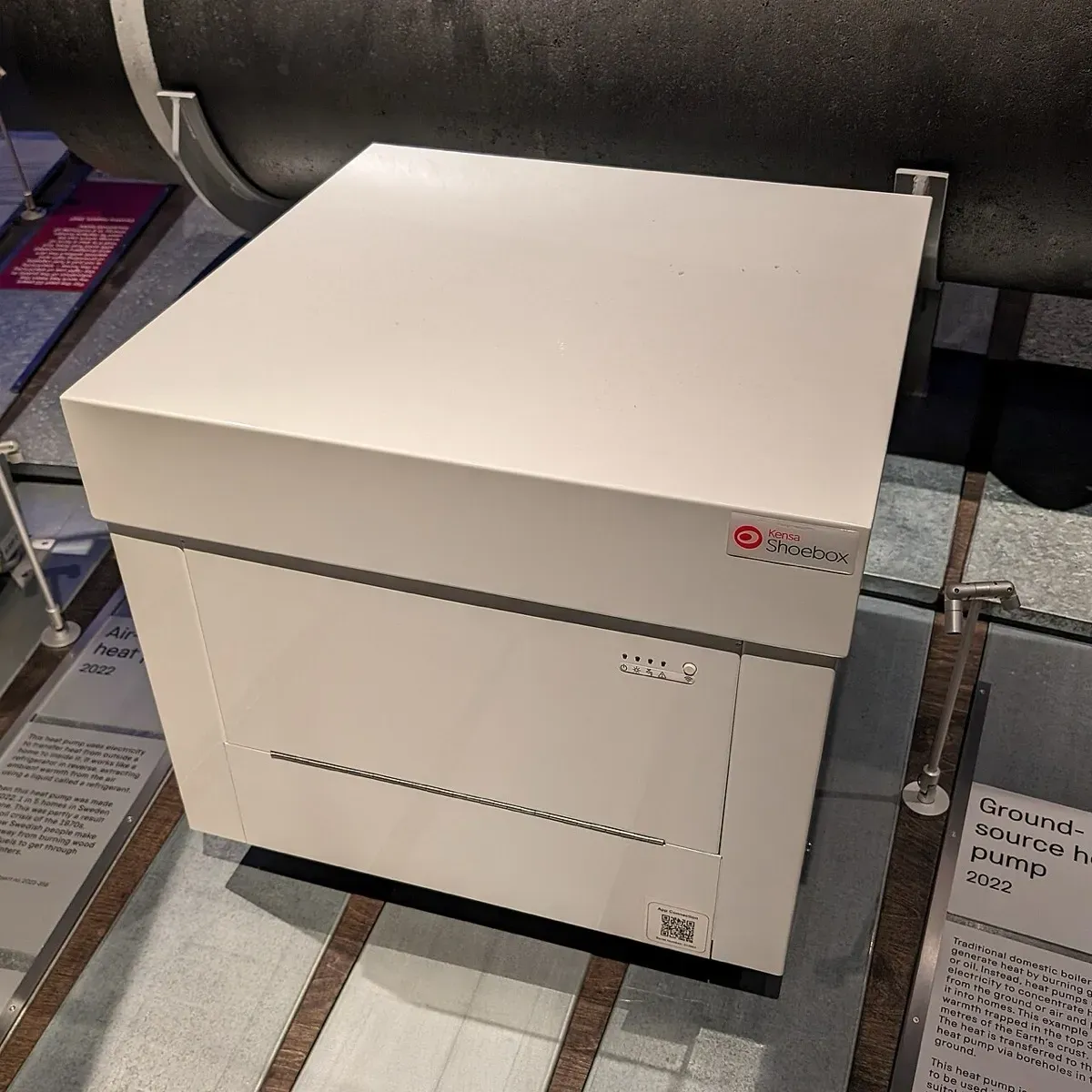
- “Kensa Shoebox ground source heat pump - Science Museum, London” by The wub, licensed CC BY-SA 4.0 (https://creativecommons.org/licenses/by-sa/4.0), via Wikimedia Commons: https://commons.wikimedia.org/wiki/File:Kensa_Shoebox_ground_source_heat_pump_-_Science_Museum,_London.jpg