The problem
Geothermal energy meets less than 1% of global energy demand today, according to the International Energy Agency, even though it runs around the clock with capacity factors above 75%, compared with under 30% for wind and under 15% for solar (IEA). The IEA says next-generation geothermal could meet up to 15% of global electricity demand growth to 2050, with up to 800 GW installed.
The catch is geology. Conventional plants need a hydrothermal reservoir: hot water already moving through cracks in rock. Where that is missing, developers either fracture the rock (enhanced geothermal systems) or give up. Fracturing raises concerns about induced earthquakes, and water can be lost underground. Southern Germany has hot rock, but Geretsried itself was the site of a failed conventional well in 2013 that found heat but not enough water.
The product
The Eavor-Loop does not need water in the rock. It is effectively a giant underground radiator: two vertical wells several kilometres apart, joined at depth by many parallel horizontal laterals. Water, sealed inside the steel and rock wellbore, picks up heat as it flows through the laterals and comes back to the surface hot, where it can drive a turbine or feed a district heating network (Eavor).
At Geretsried, the first loop has six lateral pairs. Each pair is about 16 km of continuous wellbore, with a total measured depth of more than 8 km. To join wells drilled from opposite ends, Eavor developed Eavor-Link, an active magnetic ranging system; the company says it hit every intersection on the first attempt. Rock-Pipe, a sealant pumped through the laterals, lines the open hole and keeps leak-off to between 0.5% and 2% (Eavor technical update, May 2026).
The original plan was four loops of 12 pairs each, for a total of about 8.2 MWe of electricity and 64 MWth of heat. Chubu Electric Power, a shareholder alongside Eavor and OMV, describes loops about 5,000 m deep and called December 2025 the start of partial commercial operation; Eavor’s CEO Mark Fitzgerald called it the world’s first electricity from closed-loop multilateral wells (Chubu Electric Power).
How it works
- Drill: two vertical motherbores are drilled several kilometres deep and turned horizontal.
- Connect: pairs of laterals are drilled from each side and steered to meet using magnetic ranging, forming continuous loops.
- Seal: Rock-Pipe sealant lines the open hole so the loop holds its water.
- Circulate: cold water sinks down the inlet well and hot water rises in the outlet well. The difference in density creates a thermosiphon, so the loop can circulate without a pump once it is running. At Geretsried, a 3 kg/s pump started the flow in under 30 minutes and was then switched off.
- Use the heat: at the surface, a Turboden ORC turbine converts heat to electricity, and the leftover heat can feed district heating.
Timeline
| Date | Milestone |
|---|---|
| 2013 | A conventional geothermal well at Geretsried finds heat but too little water |
| Jul 2023 | Eavor begins drilling at Geretsried |
| 4 Dec 2025 | First electricity delivered to the German grid |
| May 2026 | Technical update: six pairs completed, four producing |
| Jun 2026 | Second loop timeline under review; Eavor seeking partners |
Impact and numbers
- Heat: about 8.5 MWth from the first loop, with more than 2 MWth per working lateral pair at start-up, which Eavor expects to decline towards about 1.3 MWth per pair after five years (Eavor blog).
- Electricity: ORC conversion efficiency of about 4.3% at an average 11.8 MWth input, giving roughly 0.5 MWe of net electricity (Canary Media).
- Drilling: with partner SLB, the team cut drilling time by about 70% and ranging time by more than 70% on the last lateral pairs (Drilling Contractor); Eavor targets about three weeks per lateral pair in future.
- Black start: because of the thermosiphon, the plant can restart without grid power.
Honest caveats. Geretsried has not gone to plan. Poor cement around the motherbores allowed hydraulic communication between two rigs, so work had to continue with one rig at a time, roughly doubling time and cost. The first loop stopped at six pairs instead of 12. Drill cuttings entered five of the six pairs; three were flushed, leaving four pairs working. Electrical output of about 0.5 MWe is small against the original 8.2 MWe target for the whole site, and the ORC efficiency is low because the water returns at moderate temperature. Eavor’s target of electricity below US$75/MWh “anywhere” is unproven, and the timeline for the second loop is being revised while the company seeks partners. The plant is still a demonstration of the concept, not proof of its economics.
What’s next
Eavor has published its lessons openly and is shifting towards a licensing model, in which it supplies technology and know-how to developers and drillers. It argues that future loops can be cheaper with better cementing, one-trip drilling and faster laterals, and it describes a 15 km deep design that could deliver about 20 MWe per loop. Its investors include bp, OMV, Chubu Electric Power, Temasek, the Microsoft Climate Innovation Fund and the Canada Growth Fund, giving it backing to keep going. For Geretsried, the priority is connecting the heat to local district heating, where low-temperature output is valuable even when it is a poor fit for electricity.
Why it matters for Europe / green buyers
For Europe, closed-loop geothermal offers a source of firm, local heat that does not depend on gas imports, water-rich reservoirs or fracturing. Cities in Bavaria, the Netherlands and the Paris basin already run geothermal district heating, and closed loops could extend that to places with hot rock but no aquifer. The IEA notes that up to 80% of investment in a geothermal project draws on skills that overlap with oil and gas, so European drillers can retrain. Municipal utilities should see Geretsried as a promising but early option, best pursued through pilots and shared-risk funding.
In India, ONGC is drilling a geothermal pilot at Puga in Ladakh. Wells reached 1,000 m in 2026 and a 1 MWe pilot is expected in 2026 to 2027. Closed-loop designs could suit Himalayan sites where hot rock is plentiful but drilling water and permits are scarce.
Sources & image credits
- Eavor Technologies, “Eavor Technologies achieves first electricity production at Geretsried site”, 4 December 2025: https://eavor.com/press-releases/eavor-technologies-achieves-first-electricity-production-at-geretsried-site/
- Eavor Technologies, “Technical update from Geretsried: what we built, what we learned and what comes next”, May 2026: https://eavor.com/blog/technical-update-from-geretsried-what-we-built-what-we-learned-and-what-comes-next/
- Eavor Technologies, “Technical update: building on Geretsried” (PDF), 29 May 2026: https://eavor.de/wp-content/uploads/2026/05/Eavor-technical-update-building-on-Geretsried-260529.pdf
- Canary Media, “Eavor’s novel geothermal project”, 18 June 2026: https://www.canarymedia.com/articles/geothermal/eavor-novel-geothermal-project
- Chubu Electric Power, press release on first electricity at the Eavor-Loop in Geretsried, December 2025: https://www.chuden.co.jp/english/corporate/releases/pressreleases/1217165_5163.html
- Drilling Contractor, “Eavor-Loop project in Germany illustrates feasibility, scalability of geothermal anywhere”: https://drillingcontractor.org/eavor-loop-project-in-germany-illustrates-feasibility-scalability-of-geothermal-anywhere-77995
- International Energy Agency, “The Future of Geothermal Energy: Executive summary”, December 2024: https://www.iea.org/reports/the-future-of-geothermal-energy/executive-summary
Images:
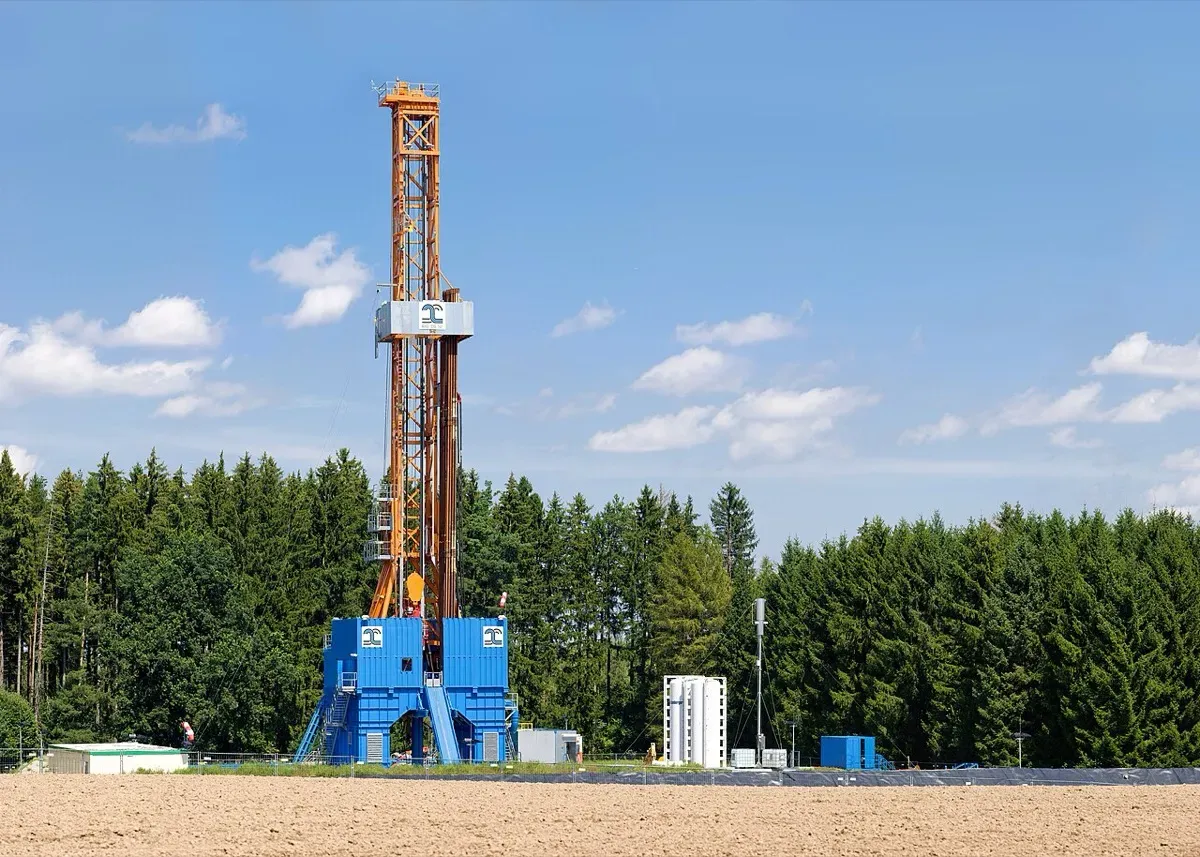
- “Geothermie Bohrturm” by Richard Bartz, licensed CC BY-SA 2.5 (https://creativecommons.org/licenses/by-sa/2.5), via Wikimedia Commons: https://commons.wikimedia.org/wiki/File:Geothermie_Bohrturm.jpg