The problem
PFAS, the per- and polyfluoroalkyl substances used in coatings, foams and textiles, do not break down in nature. They are known as “forever chemicals” and are linked to harm to health and the environment. Europe is tightening limits on PFAS in drinking water, but many treatment plants were never designed to remove them.
The usual tools have drawbacks. Activated carbon and ion exchange resins fill up and must be replaced often. Reverse osmosis removes almost everything, including useful minerals, and uses a lot of energy. Conventional treatment also struggles with tiny pathogens. In November 2010, about 27,000 people in Östersund, around 45% of the town, fell ill with cryptosporidiosis, a parasitic infection spread through the public water supply.
The product
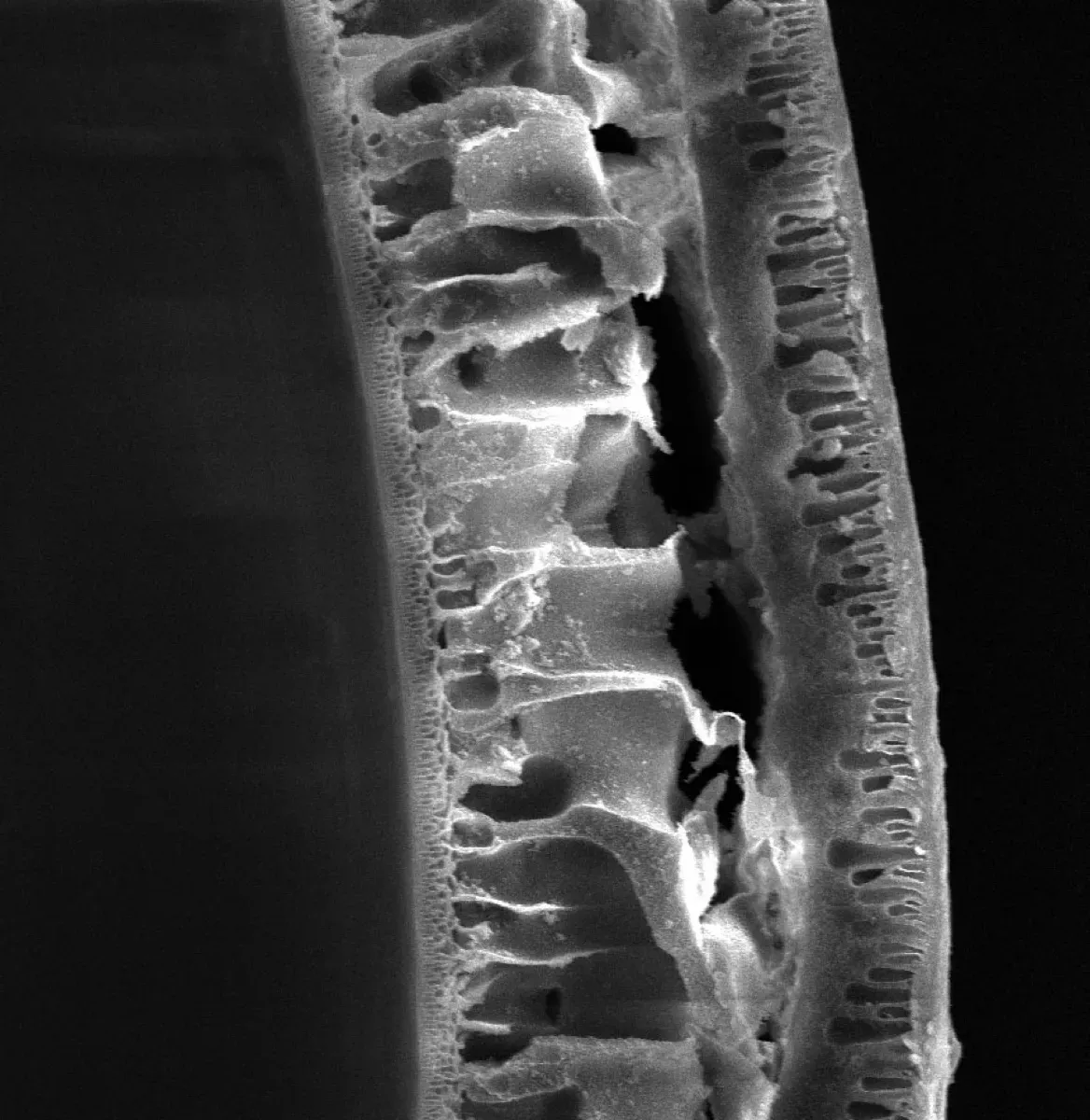
NX Filtration makes hollow fiber membranes: thin, straw-like fibres with a selective inner layer whose pores are on the nanometre scale. Water is pushed through the fibre walls at low pressure. The nanofiltration layer holds back organic micropollutants, colour, hardness, PFAS and pathogens, while letting essential minerals pass.
The company says its HFNF combines the benefits of ultrafiltration and reverse osmosis in a single step, at low energy and without pre-treatment chemicals. Fibres are bundled into modules, which system builders (OEMs) install in treatment plants. NX also sells ultrafiltration and microfiltration modules.
How it works
- Feed. Raw lake, river or treated wastewater enters the module.
- Filter. Water passes through the nano-porous wall of each hollow fibre.
- Reject. PFAS, pesticides, drug residues, colour and pathogens are held back.
- Keep minerals. Useful minerals pass through into the clean water.
- Flush. The concentrate, about 15% of the flow in Bengaluru’s plant, is removed.
- Polish. Carbon or resins can be added after, and last longer because the membrane does most of the work.
Timeline
| Date | Milestone |
|---|---|
| Nov 2010 | Cryptosporidium outbreak affects about 27,000 people in Östersund |
| Oct 2022 | KWR full-scale tests confirm about 95% average PFAS retention |
| Apr 2025 | Capital Markets Day sets target of about 50% average annual revenue growth |
| 29 Apr 2026 | Swiss Lake Neuchâtel PFAS and TFA project announced |
| 16 Jun 2026 | Largest order in company history, for the Minnesgärde plant in Östersund |
| 26 Aug 2026 | H1 2026 results: revenue €7.8 million, record order book |
| End 2026 | First Lake Neuchâtel results expected |
Impact and numbers
The strongest evidence comes from KWR, the independent Dutch water research institute. In long-term, full-scale tests on surface water from the Lekkanaal and on treated municipal effluent, NX’s dNF membranes retained on average 94.7% of PFAS20, the group on the EU monitoring list, and 94.6% of PFAS4, the group Sweden uses in its legislation. KWR found the dNF40 membrane removed about 99% of individual PFAS compounds and the looser dNF80 about 81%.
Commercially, the breakthrough is Östersund. NX Filtration will supply HFNF membranes to the new Minnesgärde drinking water plant, through a consortium led by Swedish integrator Purac, with capacity to supply about 55,000 people. NX says it will be the world’s largest HFNF drinking water plant, part of a broader Scandinavian shift towards multi-barrier systems prepared for microbes, PFAS and climate change. NX also says the membranes work without continuous dosing of flocculants, coagulants or other chemicals.
In the first half of 2026, revenue rose 19% to €7.8 million, order intake rose 61%, the gross margin was 59% and the order book was five times larger than a year earlier. The company had €18.4 million in cash, 156 staff and a new factory in Hengelo. Its partner network keeps widening: in H1 2026 it won first HFNF orders with Applied Membranes in North America and a repeat project with SV Eau in France.
In Switzerland, NX membranes are being tested on water taken directly from Lake Neuchâtel, as a pre-treatment ahead of carbon and resins, in a project coordinated by RWB Groupe with the City of Lausanne and the Eawag research institute. NX says the membranes already removed organic matter well, which should help the downstream carbon and resin last longer.
Honest caveats
Still loss-making. Normalised EBITDA was minus €6.7 million in H1 2026, and break-even is a target, not yet a result.
PFAS is not destroyed. Membranes concentrate PFAS into a reject stream, which still has to be treated or disposed of safely.
Results pending. The Lake Neuchâtel PFAS and TFA trial has not published removal figures, and TFA, a very small PFAS, is particularly hard to remove.
Company sources. Most performance claims come from NX Filtration itself; the KWR results are independent but date from 2022.
Uses beyond water. NX also supplies beverage producers and industrial customers, which is useful but less directly tied to public health.
What’s next
NX Filtration is focusing on four markets: drinking water from surface water, wastewater reuse, industrial micropollutant removal and beverage clarification. It reiterates a target of about 50% average annual revenue growth and EBITDA break-even as it scales.
Why it matters for Europe and green buyers
For Europe, NX Filtration is a home-grown answer to one of the continent’s biggest water challenges. As PFAS limits tighten, utilities need barriers that remove forever chemicals without heavy chemical or energy use, and the Östersund plant will show whether HFNF works at municipal scale.
For India, NX supplies hollow fiber nanofiltration modules to Thermax for projects across the country, and its membranes run Bengaluru’s first full-scale municipal water recycling plant based on HFNF, operated with the city’s water board. That plant turns treated sewage into water for cooling, construction and irrigation at about 85% recovery, easing pressure on groundwater. For the world, low-energy nano-membranes could make safe water and water reuse cheaper wherever rivers carry modern pollutants.
Sources & image credits
- NX Filtration, “Independent Dutch water research institute KWR demonstrates NX Filtration’s membranes retention of PFAS”, 18 Oct 2022. https://nxfiltration.com/knowledge-base/publications/independent-dutch-water-research-institute-kwr-demonstrates-nx-filtrations-membranes-retention-of-pfas/
- NX Filtration, “Advancing PFAS and TFA removal from surface water in Lake Neuchâtel with HFNF technology”, 29 Apr 2026. https://nxfiltration.com/knowledge-base/publications/advancing-pfas-and-tfa-removal-from-surface-water-in-lake-neuchatel-with-hfnf-technology/
- NX Filtration, “NX Filtration achieves major milestone with securing largest order in its history”, 16 Jun 2026. https://nxfiltration.com/knowledge-base/publications/nx-filtration-achieves-major-milestone-with-securing-largest-order-in-its-history/
- NX Filtration, “NX Filtration reports strong H1 2026 with record order intake and order book”, 26 Aug 2026. https://nxfiltration.com/investors/investor-news/nx-filtration-reports-strong-h1-2026-with-record-order-intake-and-order-book-and-major-commercial-milestones/
- Widerström et al., “Large Outbreak of Cryptosporidium hominis Infection Transmitted through the Public Water Supply, Sweden”, Emerging Infectious Diseases, 2014. https://pmc.ncbi.nlm.nih.gov/articles/PMC3966397/
- NX Filtration, “NX Filtration receives orders from Thermax for various nanofiltration and ultrafiltration water projects in India”. https://nxfiltration.com/knowledge-base/publications/nx-filtration-receives-orders-from-thermax-for-various-nanofiltration-and-ultrafiltration-water-projects-in-india/
- NX Filtration, “Bengaluru to get first full-scale hollow fiber nanofiltration water recycling plant”. https://nxfiltration.com/knowledge-base/publications/bengaluru-to-get-first-full-scale-direct-nanofiltration-water-recycling-plant/
- Wikimedia Commons, “Polysulfone Hollow Fiber Membrane Cross-Section”. https://commons.wikimedia.org/wiki/File:Polysulfone_Hollow_Fiber_Membrane_Cross-Section.jpg
Images: “Polysulfone Hollow Fiber Membrane Cross-Section”, RobertsBiology, 2019, CC BY-SA 4.0, via Wikimedia Commons. Illustrative; not an NX Filtration product.