
The problem
Because nanofibres have a huge surface area for their weight, a thin nanofibre layer can catch fine particles while letting air or liquid pass easily. That makes them ideal for HEPA and engine air filters, water filtration, battery separators, fuel cell membranes, wound dressings and waterproof-breathable clothing.
But they are hard to make at scale. The usual method, electrospinning, forces a polymer solution through a fine needle in a strong electric field. It works in the lab, but the European Patent Office notes that needle-based systems suffer from clogging and unstable flow when scaled up, and process only small volumes at a time.
The product
Nanospider is a needle-free electrospinning technology. Instead of a needle, a thin wire electrode is coated with a film of polymer solution along its whole length. When high voltage is applied, many Taylor cones form naturally along the wire and launch stable, simultaneous jets of polymer that dry into nanofibres and land on a moving substrate.
The EPO says this allows continuous production of uniform nanofibre layers at widths of up to two metres, with higher volumes and stability than conventional systems. The spinning solution is dosed from a closed system, which Elmarco says is essential for consistent quality during long production runs.
Elmarco sells three tiers: laboratory units for research, semi-industrial machines for low-volume, high-value products, and full industrial lines. Its INFINITY technology targets defect-free materials for liquid filtration, HEPA filtration and battery separators, while its universal line serves air filtration, performance apparel and healthcare. Industrial lines can combine up to four electrospinning units.
Quality comes from control. Elmarco says operators tune the conductivity, temperature and surface tension of the polymer solution, the temperature and humidity of the room, the electrical resistance of the backing material, and the voltage and electrode distance of the machine itself. The machines are mechanically simple, built from materials compatible with most polymer solutions, and can be run by one or two people depending on size. Each industrial line is tailor-made: Elmarco first develops the polymer solution on laboratory equipment, tests it against the customer’s specification, designs the line, tests the solution at industrial scale, then installs the line on site and trains the operators.
How it works
- Formulate. Elmarco and the customer develop a polymer solution for the product.
- Coat. A head spreads the solution along a thin wire electrode.
- Charge. High voltage creates many jets along the wire at once.
- Spin. The jets stretch and dry into nanofibres in flight.
- Collect. Fibres settle as a uniform web on a moving backing material.
- Scale. Results from lab machines transfer directly to industrial lines.
Timeline
| Date | Milestone |
|---|---|
| 2003 to 2004 | Professor Oldřich Jirsák’s team at the Technical University of Liberec develops needle-free electrospinning |
| 2004 | Elmarco licenses the invention and presents a prototype |
| 2006 | First industrial Nanospider production line |
| 2010 | Elmarco introduces its own proprietary technology platform, refined ever since |
| 2020 | Pandemic demand lifts revenue by more than 80% to over CZK 355 million |
| 2024 | Elmarco donates an industrial Nanospider line to a Liberec technical school |
| 2 Jul 2026 | Elmarco team competes as a European Inventor Award finalist in Berlin |
Impact and numbers
Elmarco’s significance is that it moved nanofibres from the laboratory to the factory. The EPO credits Jan Čmelík and the Elmarco team with making high-performance nanofibre production achievable at industrial scale. In air filtration, the EPO says nanofibre layers improve particle capture while keeping pressure drop lower, which means fans need less energy to push air through. Surface-modified nanofibres can be tuned to be water-loving, water-repelling or oil-repelling for liquid filtration.
The pandemic showed the demand. Forbes Czech reported that Elmarco’s revenue rose by more than 80% in 2020 to over CZK 355 million, helped by sales of industrial lines installed in Turkey, Russia and the Czech Republic, with orders expected from air and liquid filtration, functional clothing and healthcare customers. The company then employed 69 people.
At Techtextil 2026, Elmarco presented its NS 3S500U machine, which bridges research and pilot production, and ECO membranes that aim to deliver high filtration performance while using less material.
“Scaling it to a stable, industrial production process is a very different challenge; it took years of development, iterations and learning,” Čmelík told the EPO. He joined Elmarco in 2004 and has contributed several refinements to the core process, and the EPO says protecting that technology has been central to company strategy as applications multiply. “Innovation takes time,” he added. “Breakthroughs come from persistence.”
Honest caveats
Machines, not products. Elmarco sells equipment. Whether the result is a cleaner air filter or a fashion fabric depends on the buyer, and many uses have no green benefit.
Solvents. Electrospinning dissolves polymers, often in organic solvents, which must be handled and recovered safely.
Nanomaterial safety. Fine fibres raise questions about worker exposure during production, which must be managed.
Thin financial data. Elmarco is private; the latest revenue figure found dates from 2020, and it did not win the 2026 award, which went to French inventor Franck Zal.
Russia sales. The 2020 revenue included lines installed in Russia, before the 2022 invasion of Ukraine.
What’s next
Elmarco is pushing its ECO membranes for sustainable filtration and building local skills: it donated an industrial Nanospider line to the Secondary Technical School in Liberec in 2024 so students can learn nanofibre production.
Why it matters for Europe and green buyers
For Europe, Elmarco is a rare case of a university nanotech invention becoming a world-leading industrial machine made in a European region, Liberec, that calls itself the cradle of nanotechnology. Its lines support European filter, battery and medical textile makers.
For India, with severe urban air pollution and fast-growing battery manufacturing, scalable nanofibre production could make better filters and separators affordable locally. For the world, efficient filtration with lower pressure drop means cleaner air and water for less energy.
Sources & image credits
- European Patent Office, “Scaling nanofibres for cleaner air and advanced materials: Czech engineers selected as finalists for the European Inventor Award 2026”, May 2026. https://www.epo.org/en/news-events/press-centre/press-release/2026/1362418
- Elmarco, “Czech manufacturer of nanofiber technologies” (About). https://www.elmarco.com/about
- Elmarco, “Patented needle-free Nanospider technology”. https://www.elmarco.com/nanospider
- Elmarco, “Elmarco at Techtextil 2026: NS 3S500U Exhibition Premiere”, 2026. https://www.elmarco.com/blog/techtextil-2026-2
- FineEngineering Magazine, “Interview with Elmarco”. https://fineeng.eu/interview-with-elmarco/
- Forbes Česko, “Pandemie pomohla. Výroba nanovláken zvedla firmě tržby o osmdesát procent”, 2021. https://forbes.cz/__trashed-2/
- Elmarco, “Support for Education in the Liberec Region”. https://www.elmarco.com/blog/education-support
- Wikimedia Commons, “PVDF nanovlákna”. https://commons.wikimedia.org/wiki/File:PVDF_nanovl%C3%A1kna.jpg
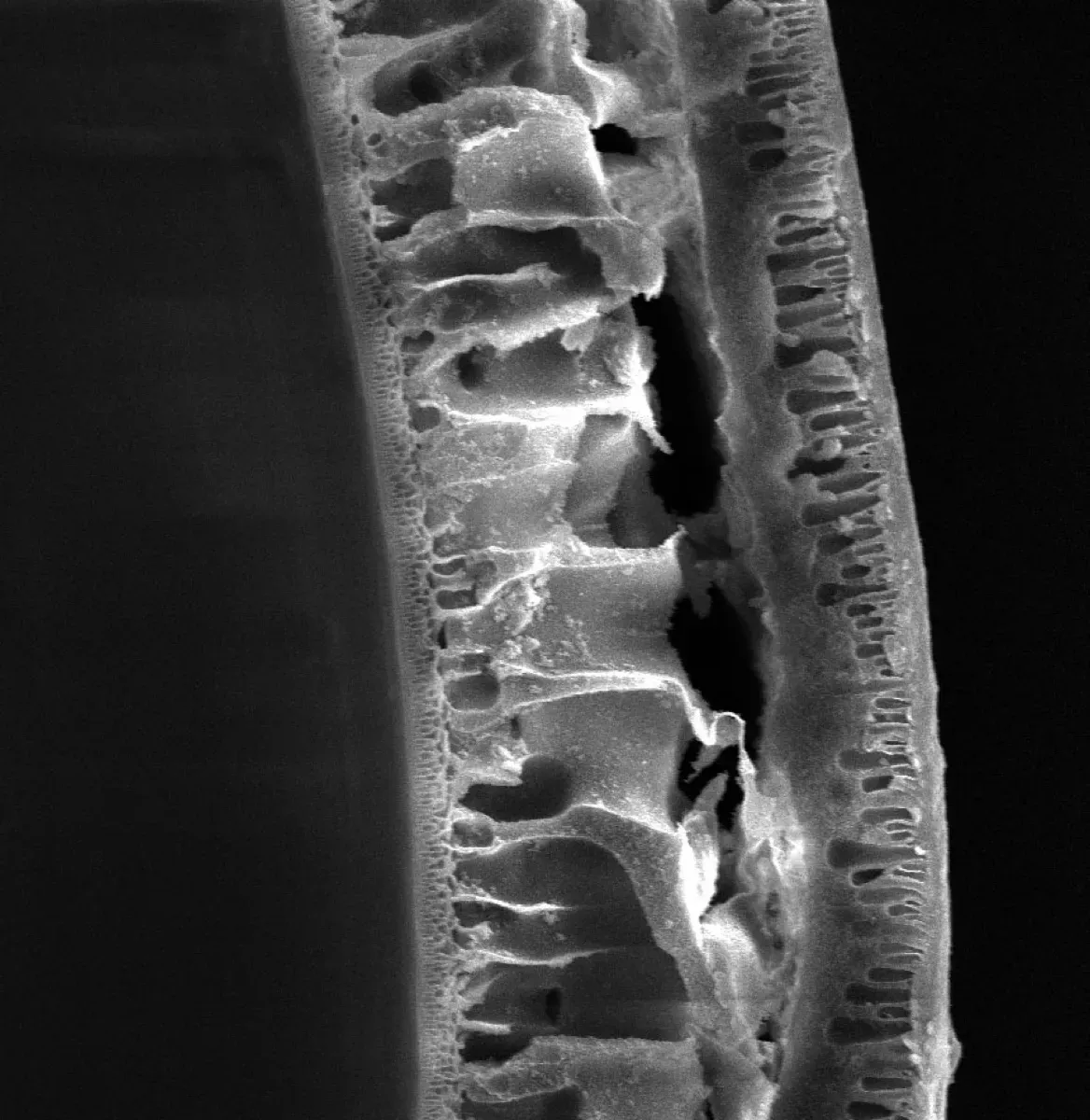
Images: “PVDF nanovlákna”, Jiri chvojka, 2011, CC BY-SA 3.0, via Wikimedia Commons. Illustrative; electrospun nanofibres, not confirmed as Nanospider output.