The problem
Some plastic items are almost impossible to recycle: very thin films, multilayer packs, tea bags and anything soiled with food. Carbiolice cites the figure that 91% of plastic waste ends up incinerated, landfilled, buried or dispersed in nature. For such items, compostable plastic makes sense, because it can go into the food waste bin with its contents.
The catch is that polylactic acid (PLA), the most common bioplastic, usually needs the heat of an industrial composter to break down properly. In a garden heap, or a municipal plant running cooler, PLA can linger and contaminate the compost. That undermines the word “compostable” on the pack.
The product
CARBIOS Active is an enzyme, formulated and encapsulated so it survives the heat of plastic processing, supplied as a masterbatch: small pellets that converters blend into a PLA-rich compound. Carbiolice says it is added at up to 5% in standard processes such as extrusion, injection moulding, calendering and thermoforming. It remains inactive throughout the product’s life, and no effect on shelf life or mechanical properties was observed.
The product launched on 27 November 2020 as Evanesto, with TÜV AUSTRIA “OK compost HOME” certification for films with high PLA content. In September 2021 the certification was extended to rigid PLA packaging. After CARBIOS bought out the SPI fund’s stake in June 2021, Carbiolice became a wholly owned subsidiary and the product was renamed CARBIOS Active. The enzyme is produced by Carbiolice’s partner Novonesis, the Danish enzyme group, and formulated by Carbiolice.
How it works
- Encapsulate. The enzyme is protected so it can withstand processing temperatures.
- Blend. Converters add the masterbatch to PLA-rich compounds at up to 5%.
- Disperse. The enzyme spreads through the material instead of sitting on the surface.
- Wait. It stays dormant while the pack is used.
- Activate. Compost humidity, temperature and pH switch it on, and it cuts PLA chains into small fragments.
- Digest. Compost microbes turn the fragments into water, CO2 and biomass.
Timeline
| Date | Milestone |
|---|---|
| 2016 | Carbiolice created by CARBIOS, the SPI fund managed by Bpifrance and Limagrain Ingredients |
| 27 Nov 2020 | Evanesto launched with “OK compost HOME” certification for PLA-rich films |
| 4 Jun 2021 | CARBIOS acquires the SPI fund’s entire stake in Carbiolice |
| Sep 2021 | Certification extended to rigid PLA packaging |
| 11 Feb 2025 | EU Packaging and Packaging Waste Regulation (EU) 2025/40 enters into force |
| 1 Jun 2026 | Benoît Grenot becomes CARBIOS CEO, succeeding Vincent Kamel |
| 12 Aug 2026 | PPWR applies across the EU |
| 24 Sep 2026 | CARBIOS reports H1 2026 results |
| 12 Feb 2028 | PPWR deadline for compostable tea and coffee bags, soft single-serve units and fruit labels |
Impact and numbers
The company’s test summaries give the clearest picture. A 25 micron film of 33% PLA with 5% CARBIOS Active met the four criteria of French home composting standard NF T51-800 at the OWS laboratory, disintegrating in 70 days and fully biodegrading in 120 days. In internal tests, a 60 micron film of 95% PLA disintegrated in two weeks, and a 700 micron sheet in six weeks. Watercress germination and biomass in compost containing the material reached the 90% the standards require, and tests at Institut Pasteur de Lille found no skin irritation. Carbiolice says the additive also speeds industrial composting and generates biogas in anaerobic digestion.
The commercial scale is still modest. In CARBIOS’s H1 2026 accounts, re-invoicing and contracts with Carbiolice brought in EUR 292,000, down from EUR 384,000 a year earlier.
The parent company is in cost-control mode. CARBIOS cut operating expenses by 19% in H1 2026, narrowed its operating loss to EUR 11.8 million and its net loss to EUR 9.4 million, after a 2025 net loss of EUR 34.3 million. Group cash of EUR 48 million covers operating expenses for more than 12 months.
Honest caveats
Company tests. The results mix external laboratory and internal tests; no independent peer-reviewed comparison was reviewed for this story.
Correction on EU rules. An earlier version of this story said EU rules require coffee pods to be compostable. That was wrong. PPWR Article 9 requires permeable tea, coffee and beverage bags, soft single-serve units disposed of with the product, and sticky fruit and vegetable labels to meet the industrial composting standard by 12 February 2028. Home compostability applies only where a member state requires it, and non-permeable machine pods are compostable only if a member state chooses to mandate it.
Parent’s delays. CARBIOS said on 3 August 2026 that financing for its Longlaville PET recycling plant would miss the 30 September 2026 target, pushing production beyond the earlier H1 2028 date.
Collection matters. Compostable packs help only where food waste collection accepts them.
What’s next
CARBIOS is pursuing the Longlaville financing: a majority of lenders’ credit committees have approved, and a deal being finalised with a major beverage company would lift pre-sales to 60% of the plant’s nominal capacity. It is also developing its Kaibio joint venture with Wankai New Materials in China, and licensing for packaging and textiles. CARBIOS Active is the part of its portfolio already on the market; its growth depends on brands adopting home-compostable formats for items that cannot be recycled.
Why it matters for Europe and green buyers
For Europe, PPWR creates firm demand from February 2028 for compostable tea and coffee bags, soft pods and fruit labels, and lets member states go further. An additive that takes PLA into home-compost territory fits that need. Buyers should check that the final pack, not just the additive, carries a certificate, and that local food waste collection accepts it.
For India, which has banned many single-use plastic items, home-compostable packaging could help with food-soiled waste, but only if certification is trusted and composting is available. For the world, enzyme-assisted composting is one answer to plastic that cannot be recycled.
Sources & image credits
- Carbiolice, “CARBIOS Active” product page. https://www.carbios-active.com/en/carbiosactive/
- Carbiolice, “Who are we”. https://www.carbios-active.com/en/who-are-we/
- Carbiolice, press release on Evanesto and TÜV AUSTRIA certification, 27 November 2020 (PDF). https://www.carbios-active.com/wp-content/uploads/2020/11/CP_Carbiolice-Certification-TUV-Austria_271120-EN.pdf
- CARBIOS, “Carbios strengthens its position in polymer biodegradation technologies with the acquisition of the SPI Fund’s entire stake of Carbiolice capital”, 4 June 2021. https://www.carbios.com/en/carbios-strengthens-its-position-in-polymer-biodegradation-technologies-with-the-acquisition-of-the-spi-funds-entire-stake-of-carbiolice-capital/
- bioplastics MAGAZINE, “Carbiolice obtains OK Compost HOME certification for PLA rigid packaging with Evanesto”, 6 September 2021. https://www.bioplasticsmagazine.com/en/news/meldungen/20210906Carbiolice-obtains-OK-Compost-HOME-certification-for-PLA-rigid-packaging-with-Evanesto.php
- EUR-Lex, Regulation (EU) 2025/40 on packaging and packaging waste. https://eur-lex.europa.eu/eli/reg/2025/40/oj
- CARBIOS via GlobeNewswire, “Carbios provides an update on the financing of its Longlaville plant project”, 3 August 2026. https://www.globenewswire.com/news-release/2026/08/03/3337758/0/en/Carbios-provides-an-update-on-the-financing-of-its-Longlaville-plant-project.html
- CARBIOS via GlobeNewswire, “Carbios reports first-half 2026 results”, 24 September 2026. https://www.globenewswire.com/news-release/2026/09/24/3367956/0/en/carbios-reports-first-half-2026-results.html
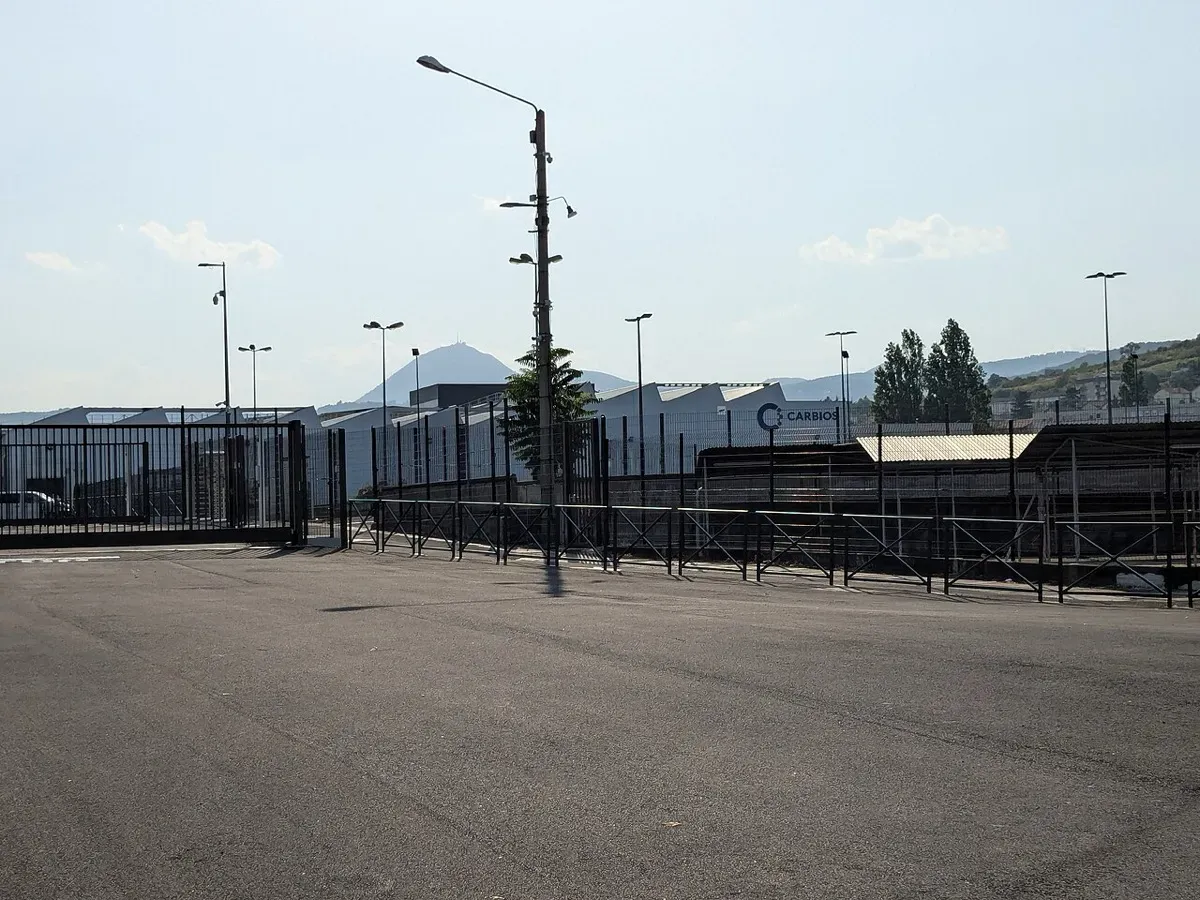
- Wikimedia Commons, “Clermont-Ferrand - Rue des Planchettes - Locaux de Carbios”. https://commons.wikimedia.org/wiki/File:Clermont-Ferrand_-_Rue_des_Planchettes_-_Locaux_de_Carbios.jpg
Images: “Clermont-Ferrand - Rue des Planchettes - Locaux de Carbios”, Romainbehar, CC0 1.0, via Wikimedia Commons. Illustrative; company premises, not the product.