The problem
Buildings are responsible for a large share of Europe’s emissions, and as heating gets cleaner, the carbon locked into materials becomes the bigger part of the story. Cement and steel are energy hungry to make. A typical concrete frame carries a heavy “upfront” carbon load before anyone moves in.
Timber has always been an alternative for houses, but for years it was hard to use for mid-rise and large buildings. Single beams and boards are not stiff enough for wide floors or tall walls, and building on site with many small parts is slow. Cross-laminated timber (CLT) solves much of that by turning sawn boards into large, stiff panels that behave like slabs.
The question now is not whether CLT works but whether it can be made cheaply enough, at large enough scale, to compete with concrete in a weak construction market.
The product
CLT by Stora Enso is a solid wood panel made from layers of kiln-dried spruce boards, each layer glued at right angles to the one below. Panels are used for walls, floors, roofs and stairs (Stora Enso).
According to the product page, panels are:
- up to 16 m long, 3.45 m wide and 320 mm thick, with 3 to 8 layers;
- made from C24 spruce, with a density of about 490 kg/m³;
- covered by European Technical Assessment ETA-14/0349 and classed Euroclass D-s2,d0 for reaction to fire;
- glued with a polyurethane adhesive that makes up about 1% of the panel and is free of formaldehyde.
Sylva is the company’s prefabricated building system. Instead of selling panels only, Stora Enso supplies CLT and laminated veneer lumber components cut to size, with openings and service channels made in the factory, delivered “just in time” for assembly. Sylva is offered in Europe and Australia (Stora Enso Building Concepts).
How it works
- Saw and dry: spruce logs from managed forests are sawn into boards and kiln dried.
- Grade and finger-joint: boards are strength graded, defects cut out, and the pieces joined end to end into long lamellas.
- Lay up: lamellas are laid side by side in layers, each layer turned 90 degrees, with adhesive between layers.
- Press: the stack is pressed into one solid panel, then planed.
- Machine: CNC machines cut windows, doors, joints and service holes to the architect’s digital model.
- Assemble: panels arrive on site in assembly order and are lifted straight into place by crane, so a floor can go up in days.
In a fire, CLT chars from the outside at a predictable rate, about 0.63 to 0.65 mm a minute for the cover layer according to Stora Enso, and the char protects the wood beneath. Engineers size panels so that enough timber remains to carry loads for the required time.
Timeline
| Date | Milestone |
|---|---|
| 5 Jun 2008 | CLT mill at Bad St. Leonhard, Austria, inaugurated (65,000 m³ a year at start) |
| 2019 | Investment in a CLT line at Gruvön sawmill, Sweden |
| 2022 | CLT production starts at Ždírec, Czechia |
| Oct 2025 | Bad St. Leonhard passes 1 million m³ of CLT, about 15,000 projects |
| Nov 2025 | Strategic review of Central European sawmills and building solutions launched |
| 29 Sep 2026 | Plan announced to stop CLT production at Gruvön by end 2026 |
Impact and numbers
- Milestone: Bad St. Leonhard’s output passed 1 million m³ in October 2025, with material for roughly 15,000 projects. Its largest single project, Arboretum in Nanterre near Paris, used about 20,000 m³ (Lesprom).
- Carbon claim: Stora Enso says building with its CLT can cut a building’s emissions by up to 70% compared with concrete and steel, and thinner walls can add up to 10% more living space. These are company figures and depend on the design compared.
- Stored carbon: wood is about half carbon by dry weight, so each cubic metre of spruce panel stores carbon for as long as the building stands.
- Market: world CLT output was about 2.3 million m³ in 2024, up 13%, with Europe making more than 82% and Austria about 38% (Wood Central).
Honest caveats. The growth story has stalled. On 29 September 2026 Stora Enso said it plans to stop CLT production at Gruvön by the end of 2026, citing slower market growth than expected, rising wood costs and high fixed costs; up to 80 of about 220 jobs could go, subject to negotiations (Stora Enso). Nordic customers will be served from Czechia and Austria, meaning longer delivery routes. The Central European sawmills and building solutions business, including its CLT mills, has been under strategic review since November 2025, and a sale is one option (Stora Enso). Those mills reportedly cut output by 55,000 to 160,000 m³ in 2024. The “up to 70%” saving is a company claim, not an independent comparison, and it does not account for what happens to the wood at end of life. Timber’s climate benefit also depends on forests being managed so that harvests do not outpace regrowth, a live debate in Finland and Sweden. CLT also needs careful design for moisture during construction, acoustics and fire, and insurers in some markets still charge more for tall timber.
What’s next
Stora Enso will keep making CLT at Ždírec, Ybbs and Bad St. Leonhard, and says it will put Gruvön’s focus back on sawn timber. The outcome of the Central European review, expected by the end of 2026, will decide whether Europe’s leading CLT brand stays with Stora Enso or moves to a new owner. Watch for whether Sylva’s prefabricated kits win more multi-storey housing and schools, where repeat designs make factory production pay off.
Why it matters for Europe / green buyers
The revised Energy Performance of Buildings Directive, Directive (EU) 2024/1275, makes the whole-life carbon of buildings visible. The life-cycle global warming potential (GWP) of new buildings above 1,000 m² must be calculated and disclosed in the energy performance certificate from 1 January 2028, and for all new buildings from 2030 (EUR-Lex). Member states must also publish roadmaps towards limit values. In 2026, the Commission adopted Delegated Regulation (EU) 2026/52 setting a common calculation framework based on EN 15978 and a 50-year reference period (European Commission). Once those numbers appear on certificates, low-carbon structures like CLT become easier to reward. For buyers, the practical point is to ask for an EPD for the actual panels, check delivery distances and confirm who will own the mills after the review.
For India, CLT is still rare, and there is no domestic production at scale. Imported European panels are expensive, and the climate brings humidity and termite risk. But India’s building boom is heavily concrete-based, and engineered timber made from fast-growing plantation species, or bamboo-based laminated products, could follow the CLT model. Stora Enso’s experience shows that factory scale and steady demand matter as much as the material itself.
Sources & image credits
- Stora Enso, “Cross-laminated timber (CLT)” product page: https://www.storaenso.com/en/products/mass-timber-construction/building-products/clt
- Stora Enso Building Concepts, “Sylva by Stora Enso”: https://buildingconcepts.storaenso.com/en/find-your-concept/multi-storey-residential---beam-and-column
- Lesprom, “Stora Enso’s Bad St. Leonhard, Austria, mill produces 1 million m3 of CLT” (13 Nov 2025): https://www.lesprom.com/en/news/Stora_Enso%E2%80%99s_Bad_St_Leonhard_Austria_mill_produces_1_million_m3_of_CLT_121265/
- Stora Enso, “Stora Enso plans to focus on sawmill operations and discontinue CLT production at Gruvön in Sweden” (29 Sep 2026): https://www.storaenso.com/en/newsroom/press-releases/2026/9/stora-enso-plans-to-focus-on-sawmill-operations-and-discontinue-clt-production-at-gruvon-in-sweden
- Wood Central, “Stora Enso CLT plant in Sweden set to close” (30 Sep 2026): https://woodcentral.com.au/stora-enso-clt-gruvon/
- Stora Enso, “Stora Enso initiates a strategic review of its Central European sawmills and building solutions operations” (Nov 2025): https://www.storaenso.com/en/newsroom/regulatory-and-investor-releases/2025/11/stora-enso-initiates-a-strategic-review-of-its-central-european-sawmills-and-building-solutions-operations-inside-information
- EUR-Lex, Directive (EU) 2024/1275 on the energy performance of buildings (recast): https://eur-lex.europa.eu/eli/dir/2024/1275/oj/eng
- European Commission, “Calculation framework for new building life-cycle Global Warming Potential” (2026): https://energy.ec.europa.eu/news/calculation-framework-new-building-life-cycle-global-warming-potential-2026-05-04_en
Images:
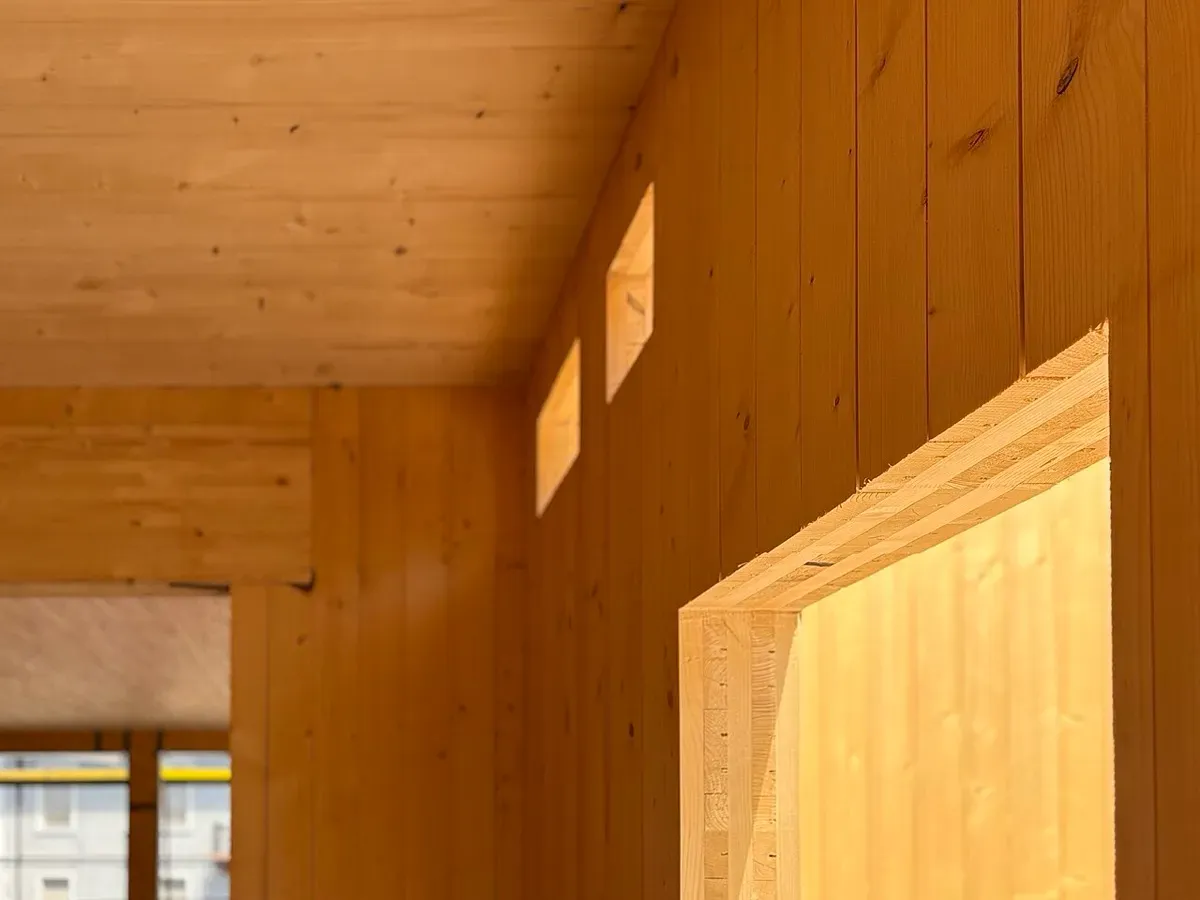
- “Brettsperrholzkonstruktion” by RoterRolf, released under CC0 1.0 (http://creativecommons.org/publicdomain/zero/1.0/deed.en), via Wikimedia Commons: https://commons.wikimedia.org/wiki/File:Brettsperrholzkonstruktion.jpg