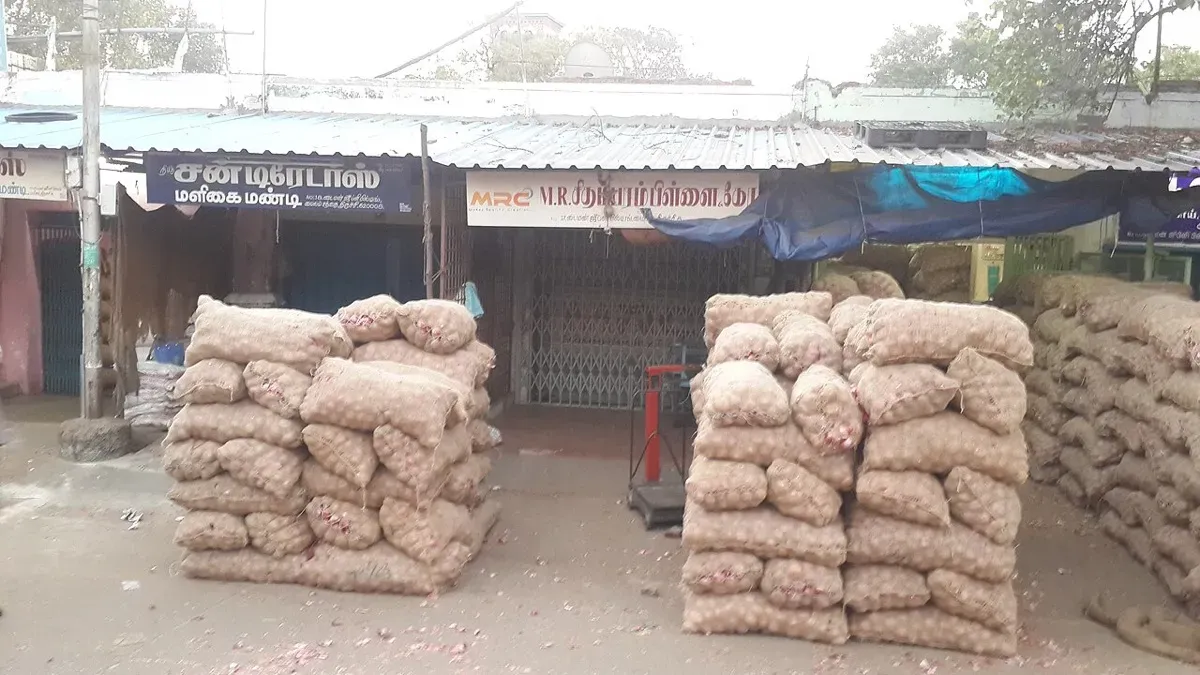
The problem
Food loss in India starts at the farm gate. A study by NABARD Consultancy Services for the Ministry of Food Processing Industries, reported to the Rajya Sabha in February 2025, estimated annual post-harvest losses of 7.36 million tonnes of fruit (6.02% to 15.05% depending on the crop) and 11.97 million tonnes of vegetables (4.87% to 11.61%) (MoFPI). The Earthshot Prize puts the share of agricultural produce wasted before it leaves farms at about 30%.
Smallholders have few options. Cold storage is expensive and scarce in villages, transport is slow, and prices for perishables like tomatoes and onions can collapse after a bumper harvest. Produce that is too small, misshapen or discoloured is rejected by buyers altogether. The waste squanders the water, fertiliser and labour used to grow it, and it hits incomes. Many rural women, meanwhile, work as farm labourers; the Global Innovation Fund notes they can earn around $3 for up to ten hours of work in intense heat (GIF).
The product
S4S Technologies was founded in 2013 by university friends, with Nidhi Pant as one of the co-founders. Its core hardware is the Solar Conduction Dryer: a compact, solar-powered food dehydrator designed for use in villages. It reduces the moisture content of produce so it can be stored for up to a year without chemicals or preservatives (S4S).
The dryer is only half the model. S4S trains local women to operate the dryers from their homes as micro-entrepreneurs. The company buys lower-grade produce from nearby smallholder farmers, which buyers would otherwise reject, and brings it to the processors. The dried output is packaged at a central S4S facility and sold to large food manufacturers and food service companies, with S4S providing traceability and quality assurance. The Earthshot Prize describes products such as ingredients for ketchup.
How it works
Most simple solar dryers work by convection: the sun heats air, and the warm air passes over the food to carry moisture away, often with fans. S4S says its dryer is the first to combine all three modes of heat transfer, conduction, convection and radiation, with heat supplied directly to the drying trays by conduction. Because air is then needed mainly to remove moisture rather than to carry heat, the air requirement drops by about ten times. That removes the need for fans or blowers, and therefore for electricity.
S4S claims a drying efficiency of about 22%, among the best for solar dryers, and says the design has been refined with designers and engineers from MIT in the United States. In practice, a woman entrepreneur slices produce such as tomatoes, onions, ginger or fruit, loads the trays and lets the sun do the work, producing dried ingredients that are light, easy to transport and stable for months.
 Dried fruit and vegetables in storage jars. Drying removes the water that lets microbes grow, which is why dried produce can last for months. Generic example, not S4S products. Photo: Nutrition, Food Safety & Health, CC0 1.0, via Wikimedia Commons.
Timeline
| Date | Milestone |
|---|---|
| 2013 | S4S Technologies founded by a group of university friends |
| 2 April 2023 | Global Innovation Fund announces a $2 million investment under its ADVANCE partnership with Unilever |
| November 2023 | S4S named a 2023 Earthshot Prize winner in “Build a Waste-free World” |
| 2025 | Earthshot-stated target year to reach three million smallholder farmers and 30,000 entrepreneurs |
| 2026 | Earthshot-stated target to have reduced food waste by 1.2 million tonnes |
Impact and numbers
- Installations: 2,600 installations in 15 countries, according to S4S’s impact page.
- Entrepreneurs and farmers: S4S’s website lists 800 micro-entrepreneurs with assured additional income and market linkage for thousands of farmers. GIF’s April 2023 announcement described a network of 800 women entrepreneurs and 25,000 smallholder farmers, with plans to grow to 9,000 entrepreneurs and more than 100,000 farmers, and 200,000 tonnes of processing capacity a year.
- Incomes: S4S says farmers turned micro-entrepreneurs see profits rise by 60% to 110%, and farmers gain an assured additional income of $1,000 to $1,500 a year. The Earthshot Prize reports that 300,000 women smallholders supported by S4S recorded profit increases of 10% to 15%, and that its 2,000 female entrepreneur partners have doubled or tripled their incomes (Earthshot Prize).
- Food and climate: the impact page cites a 40,000-unit annual capacity for farm-level solar processing, 37,000 units of CO2 saved a year and more than one million people supplied with nutritious food, without stating the units.
Honest caveats. The figures published by S4S, GIF and the Earthshot Prize use different scopes and dates and do not fully match, for example 800 versus 2,000 entrepreneurs, and some website figures lack units. Earthshot’s targets for 2025 and 2026 were ambitious, and S4S has not published an update confirming whether they were met. Solar drying also depends on weather, and dried products serve different markets from fresh ones, so it complements rather than replaces cold chains.
What’s next
With GIF’s investment, S4S set out to improve its model and product, strengthen its team, scale procurement and expand into new Indian states. Its listed research priorities include a hybrid solar and biomass dryer for cloudy periods, higher-capacity dryers, and new products such as a domestic solar dryer called FooDer, a solar seed dryer and a solar grain dryer. It is also seeking government subsidy models for end users, which would lower the upfront cost for women entrepreneurs. Globally, UNEP estimates that food loss and waste account for 8% to 10% of greenhouse gas emissions (UNEP), and decentralised, zero-electricity processing is one of the few options that works where grids and cold storage do not.
Why it matters for Europe / green buyers
S4S shows how a small piece of hardware can sit at the centre of a supply chain that tackles several problems at once: food loss, rural poverty, gender inequality and emissions from refrigeration. European food companies sourcing dried vegetables, spices or fruit ingredients from India increasingly need traceable, low-carbon and socially responsible supply. S4S offers end-to-end traceability and all women-led sourcing and processing, which can help buyers meet supply chain due diligence and Scope 3 goals.
For buyers, the questions are about verification: how incomes and volumes are measured, what share of produce would otherwise have been wasted, and how quality and food safety are assured across thousands of small units. If the answers hold up, solar-dried ingredients are a rare example of a product that is better for farmers, the climate and the buyer’s balance sheet.
Sources & image credits
- The Earthshot Prize, S4S Technologies 2023 winner profile: https://earthshotprize.org/winners-finalists/s4s-technologies/
- S4S Technologies, Impact page (accessed 6 October 2026): https://s4stechnologies.com/impact/
- Global Innovation Fund, “GIF backs food-tech business which empowers female processors in India”, 2 April 2023: https://www.globalinnovation.fund/news/our-innovations/gif-backs-food-tech-business-which-empowers-female-processors-in-india
- Ministry of Food Processing Industries, Rajya Sabha Unstarred Question No. 572, answered 7 February 2025 (NABCONS post-harvest loss study): https://www.mofpi.gov.in/sites/default/files/572.pdf
- UNEP, Food Waste Index Report 2024 press release, 27 March 2024: https://www.unep.org/news-and-stories/press-release/world-squanders-over-1-billion-meals-day-un-report
- Acumen, S4S Technologies case study: https://acumen.org/case-studies/s4s-technologies/
- Shell Foundation, “Shell Foundation supported S4S Technologies claims Earthshot Prize”: https://shellfoundation.org/news/shell-foundation-supported-s4s-technologies-claims-earthshot-prize/
Images:
- “Onion Mandi” by Balablitz, licensed CC BY-SA 3.0 (https://creativecommons.org/licenses/by-sa/3.0), via Wikimedia Commons: https://commons.wikimedia.org/wiki/File:Onion_Mandi.jpg
- “Dehydrated fruits and vegetables in labeled mason jars” by Nutrition, Food Safety & Health, CC0 1.0 public domain dedication (http://creativecommons.org/publicdomain/zero/1.0/deed.en), via Wikimedia Commons: https://commons.wikimedia.org/wiki/File:Dehydrated_fruits_and_vegetables_in_labeled_mason_jars.jpg