The problem
Road transport is one of the hardest parts of the economy to clean up quickly. Neste, citing the IEA, says transport is almost 22% of global greenhouse gas emissions and road transport about 75% of that (Neste). Battery trucks are coming, but millions of diesel lorries, buses, ships, generators and construction machines will run for another decade or more.
The older answer, biodiesel (FAME), can only be blended in small shares because it behaves differently from fossil diesel in engines and in cold weather. Fleets wanted a fuel they could use at 100% without voiding warranties.
The product
Neste MY Renewable Diesel is a hydrotreated vegetable oil, or HVO, sold as HVO100. Despite the name, it is mostly made from wastes and residues. Neste says waste and residue raw materials make up about 90% of its renewable inputs globally, led by used cooking oil (UCO), animal fat waste and residues from vegetable oil processing (Neste raw materials).
Because it is a pure paraffinic hydrocarbon, it can be used neat or blended at any ratio with fossil diesel. Neste says most leading engine makers have approved HVO fuels and that no vehicle or tank modifications are needed. Deutsche Bahn uses it where it cannot yet do without diesel, and the Nordic bus operator Nobina runs 1,200 of its 3,700 buses on it (Neste).
When it launched in Finland in January 2017, Neste MY was priced somewhat higher than Neste Pro Diesel, a blend containing at least 15% renewable diesel, and Neste stressed that its cold properties suit Finnish winters (Neste, 2017). Corporate fleets such as DB Schenker and Lassila & Tikanoja were among the first named users.
The same NEXBTL platform also makes Neste MY Sustainable Aviation Fuel and renewable feedstock for plastics.
How it works
- Collect: UCO from restaurants and food makers, rendered animal fat and other residues are bought from collectors worldwide; Neste owns collectors such as Mahoney Environmental in the US.
- Pre-treat: impurities are removed so the oils can go into a refinery unit.
- Hydrotreat: in the NEXBTL process, hydrogen removes the oxygen from the fats and turns them into straight-chain hydrocarbons.
- Isomerise: the chains are reshaped to give good cold-weather properties.
- Certify and blend: batches are certified against EU RED or US rules and sold as HVO100 or blended into diesel and jet fuel.
- Use: the fuel goes straight into existing tanks, pumps and engines.
Timeline
| Date | Milestone |
|---|---|
| 2007 | First NEXBTL renewable diesel unit inaugurated at Porvoo |
| 2011 | Renewable production starts at Rotterdam |
| 9 Jan 2017 | Neste MY Renewable Diesel goes on sale at six Helsinki-region stations, then nine Neste Truck stations |
| 2025 | 3.31 million tonnes of renewable diesel and 0.84 million tonnes of SAF produced |
| 28 Jul 2026 | H1 2026 report: Rotterdam expansion still on track for 2027 |
Impact and numbers
- Emissions: Neste MY sold in the EU and Asia-Pacific meets the EU RED rule of at least 50% lower life-cycle emissions than fossil fuel (Neste). At launch in 2017, Neste claimed up to 90% lower emissions (Neste, 2017); the real figure depends on the feedstock mix.
- Output: 1,750,000 tonnes of renewable diesel in H1 2026, up slightly from 1,721,000 tonnes a year earlier. SAF output fell to 202,000 tonnes from 497,000 tonnes (Neste H1 2026).
- Utilisation: 71% of nameplate capacity in H1 2026, held back by a delayed equipment replacement in Singapore.
- Growth: the EUR 2.5 billion Rotterdam expansion will lift Rotterdam from 1.4 to 2.7 million tonnes a year in 2027, including 1.2 million tonnes of SAF capability (Neste Rotterdam). Group renewables capacity should then reach 6.8 million tonnes.
Honest caveats. HVO is only as clean as its feedstock, and waste fats are limited. Used cooking oil and animal fats are collected all over the world, so demand from Europe pulls supply from Asia and the Americas. Transport & Environment has reported suspected fraud in which virgin palm oil may be relabelled as palm oil mill effluent (POME) or other residues to earn waste-based incentives (T&E). Neste says it audits suppliers and uses third-party verification, but it still uses some palm-related residues such as PFAD and POME. Tailpipe CO2 is unchanged; the savings are counted over the life cycle. HVO also costs more than fossil diesel at the pump, and the 2026 SAF dip shows how output swings with margins and maintenance. Finally, HVO keeps diesel engines in use: it is a bridge for fleets that cannot electrify yet, not a reason to delay electrification.
What’s next
Neste’s priority is finishing Rotterdam in 2027, which it says will be the world’s largest renewable diesel and SAF refinery, while improving reliability at existing plants. Planned eight-week turnarounds at Porvoo (from August 2026) and Rotterdam (Q4 2026) and an 11-week stop on one Singapore line will limit output this year. The company is also working on new feedstocks such as regeneratively grown oils, because the waste stream alone cannot meet future demand.
Why it matters for Europe / green buyers
The revised Renewable Energy Directive (RED III, Directive (EU) 2023/2413) requires member states to cut the greenhouse gas intensity of transport fuels or reach a renewable share, with sub-targets for advanced fuels (EUR-Lex). HVO is one of the few options a logistics firm can use today without new vehicles. Buyers should ask for the feedstock mix and certification for each delivery, not just a brand name, and treat HVO as part of a plan that also includes electric trucks.
India is starting with jet fuel rather than road HVO. A government committee set indicative SAF blending targets of 1% in 2027 and 2% in 2028, initially for international flights (PIB). IndianOil’s Panipat refinery received ISCC CORSIA certification to make SAF from used cooking oil, with about 35,000 tonnes a year planned (Times of India). That will compete with exporters for the same Indian restaurant oil that European HVO plants want.
Sources & image credits
- Neste, “Neste MY Renewable Diesel”: https://www.neste.com/products-and-innovation/neste-my-renewable-diesel
- Neste, “Neste launches Neste MY Renewable Diesel made 100% from waste and residues in Finland” (9 Jan 2017): https://neste.com/news/neste-launches-neste-my-renewable-diesel-made-100-from-waste-and-residues-in-finland
- Neste, “Renewable raw materials”: https://www.neste.com/renewable-raw-materials
- Neste, “Neste’s half-year financial report for January-June 2026” (28 Jul 2026): https://www.neste.com/news/nestes-half-year-financial-report-for-january-june-2026
- Neste, “Rotterdam refinery”: https://www.neste.com/about-neste/how-we-operate/production/rotterdam-refinery
- Transport & Environment, “Palm oil in disguise?” (Apr 2025): https://uploads.transportenvironment.org/production/files/202504_POME_fraud_Report.pdf
- EUR-Lex, Directive (EU) 2023/2413 (RED III): https://eur-lex.europa.eu/eli/dir/2023/2413/oj/eng
- Times of India, “IndianOil’s Panipat refinery bags global certification for SAF production” (Aug 2025): https://timesofindia.indiatimes.com/business/india-business/cooking-oil-to-aviation-fuel-indianoils-panipat-refinery-bags-global-certification-35000-tonnes-saf-production-targeted-by-year-end/articleshow/123342719.cms
- Press Information Bureau, CBG Blending Obligation and SAF indicative targets: https://www.pib.gov.in/PressReleaseIframePage.aspx?PRID=1979705
Images:
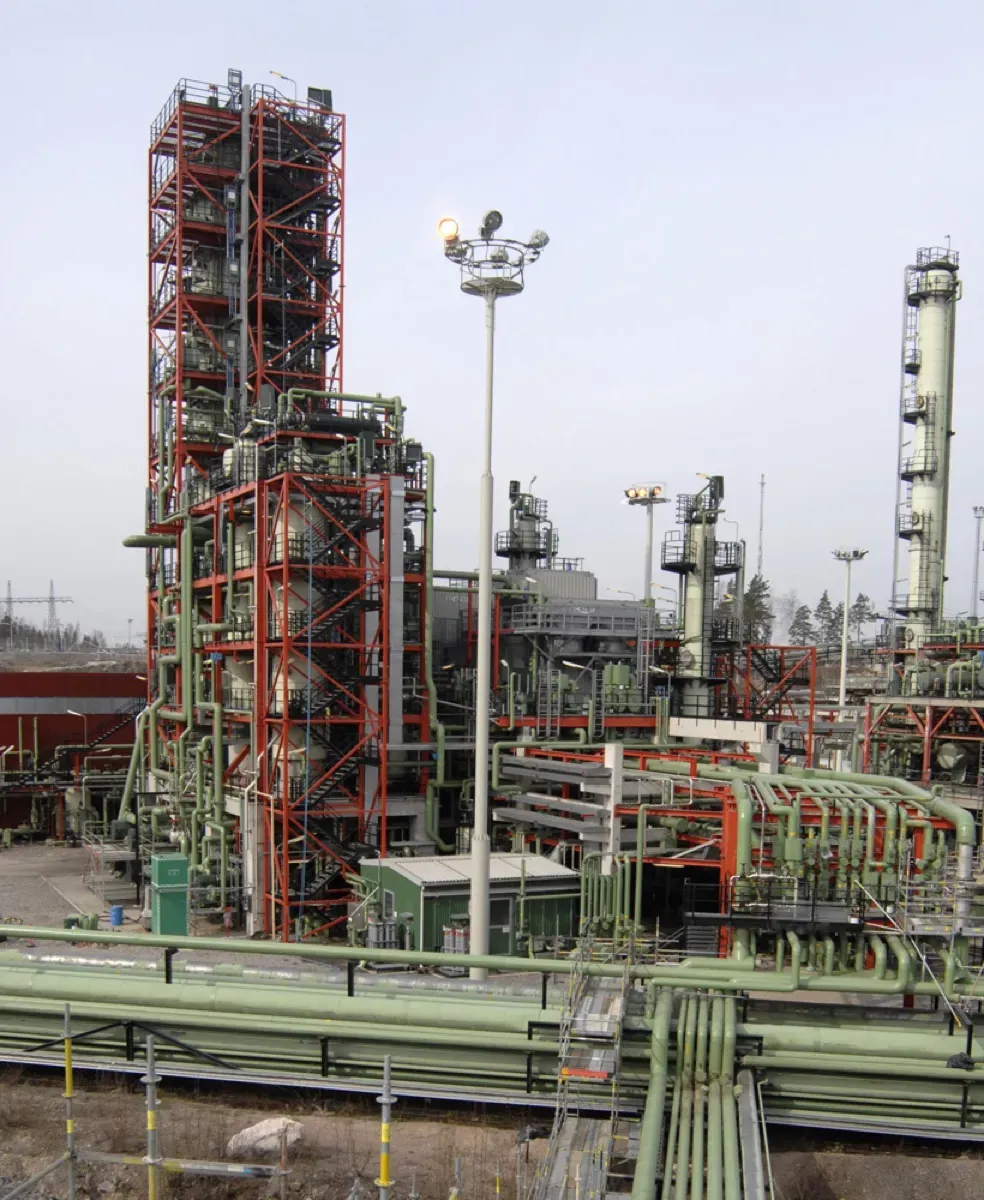
- “Neste Porvoo refinery” by NesteCorp, licensed under CC BY-SA 4.0 (https://creativecommons.org/licenses/by-sa/4.0), via Wikimedia Commons: https://commons.wikimedia.org/wiki/File:Neste_Porvoo_refinery.jpg