The problem
Even fast emissions cuts will not stop warming overnight. That has revived interest in stratospheric aerosol injection, the idea of adding reflective particles high in the atmosphere to bounce a little sunlight back to space. Nature offers a rough proof: CNBC, citing the US Geological Survey, notes that the 1991 eruption of Mount Pinatubo cooled average global temperatures by about 1°F (about 0.6°C).
But the risks are large and poorly understood. The European Commission’s scientific advisers warned in December 2024 that such technologies could harm ecosystems, change rainfall patterns and hurt food production, and would do nothing about ocean acidification. There is no international system for deciding whether, where or how to use them.
The product
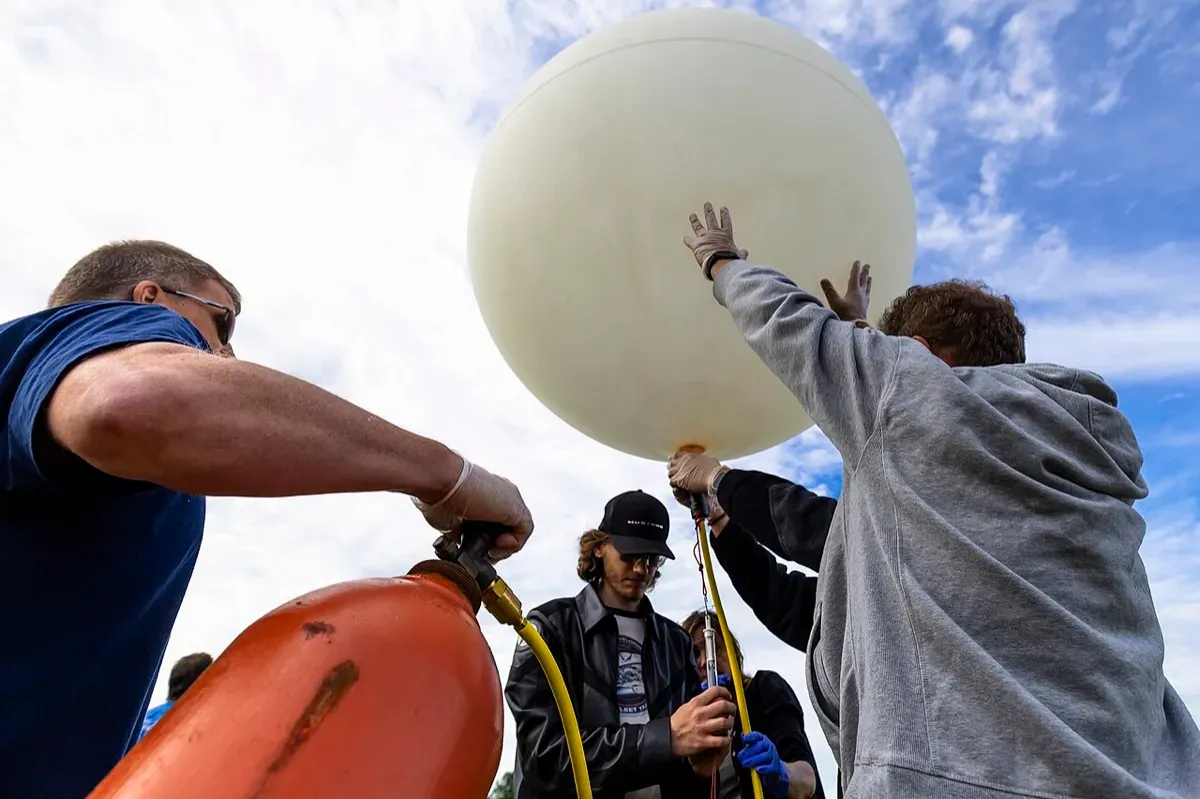
Make Sunsets was founded in October 2022 by Luke Iseman, a former director of hardware at Y Combinator, with co-founder Andrew Song. Its product is simple: latex weather balloons filled with SO2 and a lift gas, released so they rise to about 20 km and burst, leaving a small sulphate haze. The company says it now uses hydrogen for most launches after starting with helium.
What customers buy is a “Cooling Credit”. The company’s FAQ says one gram of SO2 delivered to 20 km creates as much cooling as one tonne of CO2 causes warming in a year. It says each credit costs it about $0.28 to deliver and that it aims for 70% margins. The balloons carry instruments to log position and altitude; if a launch does not reach 20 km, the credits do not count and it flies again.
The company’s own FAQ admits large uncertainty in these numbers. It also accepts that stratospheric sulphate could cause “a slight but meaningful depletion in ozone”.
How it works
- Fill. A latex balloon is filled with lift gas and a few grams of SO2.
- Launch. The balloon is released and climbs into the stratosphere.
- Track. On-board instruments record latitude, longitude and altitude.
- Burst. At around 20 km the balloon pops and releases the gas.
- Convert. SO2 forms tiny sulphate particles that reflect some sunlight.
- Credit. Buyers are issued Cooling Credits based on grams delivered.
Timeline
| Date | Milestone |
|---|---|
| 2022 | First balloons released in Baja California, Mexico, each with under 10 grams of SO2 and without tracking |
| Oct 2022 | Make Sunsets is founded |
| Jan 2023 | Mexico’s environment ministry announces it will prohibit solar geoengineering experiments; launches in Mexico halted |
| Feb 2024 | UN Environment Assembly fails to agree on solar geoengineering; Swiss draft withdrawn |
| 15 Apr 2025 | US EPA issues a Clean Air Act information demand to Make Sunsets |
| May 2025 | EPA says the company reported releasing about 0.1 tonnes of SO2 |
| Apr 2026 | Company says it has delivered Cooling Credits for more than 1,070 individuals |
Impact and numbers
The physical scale is tiny. The EPA said that, by May 2025, Make Sunsets reported releasing about 0.1 tonnes of SO2 into the stratosphere, “an extraordinarily low amount”. Iseman told SRM360 that the company’s biggest balloon so far carried 3.1 kg. Daniele Visioni, a Cornell climate scientist, pointed out that some US coal plants emit more than 20 tonnes of sulphate into the air every day.
The commercial scale is also small but growing. Iseman cited more than 875 paying customers in April 2025, and the company’s FAQ says that as of April 2026 it had delivered credits for more than 1,070 individuals. When the EPA wrote to it, its website claimed more than 124 deployments.
Its ambitions are much bigger. The FAQ says it could offset a year’s new warming for about $30 million a year and global warming of 0.5°C for about $100 billion a year. These are company estimates, not independent findings.
Honest caveats
Unilateral action. Make Sunsets’ first launches in Mexico took place without notice to, or consent from, the Mexican government, according to the Verge. Mexico then said it would prohibit solar geoengineering experiments, citing the lack of any international agreement. The company told CNBC it regretted that it “had failed to take this into consideration sooner”.
Regulators are circling. In April 2025 the EPA demanded information under the Clean Air Act. Administrator Lee Zeldin called the idea of selling “cooling” credits for air pollutants an example of “climate extremism”. The EPA says it is reviewing whether it can halt the activity if it scales. In the US, solar geoengineering must also be reported to NOAA under weather modification rules. SRM360 reported bills in 31 US states, with Tennessee the only one to have passed a ban at the time.
Scientific and justice critiques. Many researchers object that releasing aerosols to sell credits, before proper research and governance exist, damages trust in legitimate science. Jennie Stephens of Maynooth University told SRM360 that such start-ups show the “ineffectiveness of market-based climate governance”.
Credits are not removals. A Cooling Credit does nothing about the CO2 already in the air. The cooling from sulphate lasts months to a year or two, while CO2 warms the planet for centuries, so the effect must be repeated indefinitely.
Termination risk. If large-scale use ever began and then stopped suddenly, the masked warming could return quickly. This is one reason the EU advisers want a global governance system first.
What’s next
Make Sunsets says it will keep launching and wants to find countries willing to host launch sites. The EPA review and state bills could limit it in the US. Internationally, the debate continues after the UN Environment Assembly failed in 2024 to agree on either an expert panel or a non-use agreement.
Why it matters for Europe and green buyers
For Europe, Make Sunsets is the test case behind the EU advisers’ call for a moratorium on solar radiation modification and for an EU position against deployment in global talks. Companies should treat Cooling Credits as reputational risk, not as climate action. They are not carbon removals and should not be used to offset emissions.
For India, the stakes are high. Changes to rainfall patterns could affect the monsoon, which feeds hundreds of millions of people. Climate Home News reported that India and the US opposed an African Group call for a UN repository of solar geoengineering research at the 2024 UN Environment Assembly. India’s voice will matter as rules take shape. For the world, the lesson is that sunlight reflection needs public research and shared rules before private sales.
Sources & image credits
- Make Sunsets, FAQ. https://makesunsets.com/pages/faq
- US EPA, “Government Action” on solar geoengineering. https://www.epa.gov/geoengineering/government-action
- US EPA, “EPA Demands Answers from Unregulated Geoengineering Start-Up Launching Sulfur Dioxide into the Air”, Apr 2025. https://www.epa.gov/newsreleases/epa-demands-answers-unregulated-geoengineering-start-launching-sulfur-dioxide-air
- The Verge, “Mexico bans solar geoengineering experiments after startup’s field tests”, 18 Jan 2023. https://www.theverge.com/2023/1/18/23560446/mexico-ban-solar-geoengineering-make-sunsets-startup-experiments
- CNBC, “Mexico cracks down on solar geoengineering, stalling Make Sunsets”, 18 Jan 2023. https://www.cnbc.com/2023/01/18/mexico-cracks-down-on-solar-geoengineering-stalling-make-sunsets.html
- SRM360, “US Environmental Protection Agency Shines Spotlight on Make Sunsets”, Apr 2025. https://srm360.org/news-reaction/us-environmental-protection-agency-make-sunsets/
- Climate Home News, “Nations fail to agree on solar geoengineering regulations”, 29 Feb 2024. https://www.climatechangenews.com/2024/02/29/nations-fail-to-agree-ban-or-research-on-solar-geoengineering-regulations/
- European Commission, “Solar radiation modification technologies cannot fully address climate change, and responsible research on impacts is needed”, 9 Dec 2024. https://research-and-innovation.ec.europa.eu/news/all-research-and-innovation-news/solar-radiation-modification-technologies-cannot-fully-address-climate-change-and-responsible-2024-12-09_en
- Wikimedia Commons, “2024-07-02 Weather Balloon Launch 019”. https://commons.wikimedia.org/wiki/File:2024-07-02_Weather_Balloon_Launch_019.jpg
Images: “2024-07-02 Weather Balloon Launch 019”, Indiana University South Bend (uploaded by Photouploadforscience), Elkhart, Indiana, USA, 2 Jul 2024, CC BY 4.0, via Wikimedia Commons. Illustrative; not a Make Sunsets launch.