The problem
Dense, hot cities such as Hong Kong run air conditioning for much of the year. Dark roofs, metal sheds, tanks and electrical cabinets soak up sunlight, overheat and push up power demand at the worst time of day. Heat also shortens the life of equipment and makes buildings without cooling dangerous.
Ordinary white paint helps by reflecting visible light, but it still absorbs some ultraviolet and near-infrared energy, and it is not designed to shed heat by radiating it to the sky.
The product
i2Cool grew out of research at City University of Hong Kong (CityU). Its company history says it was founded in 2021 through a CityU entrepreneurship programme and in 2022 expanded to Shenzhen, with a manufacturing base in Guangzhou. Co-founder Professor Edwin Chi-Yan Tso leads the core research team, and co-founder Professor Martin Zhu is chief executive.
The flagship product is i2Coating, a roller or spray applied coating for roofs and outside surfaces. The company also sells i2Film for windows and glass facades, membranes and fabrics for awnings and tents, and, since August 2026, CorroCool, a combined cooling and anti-corrosion coating for metal structures and outdoor electrical cabinets.
The science is inspired by the hairs of the Saharan silver ant, which reflect sunlight and shed heat. i2Cool says its core products achieve more than 95% solar reflectance and mid-infrared emissivity. Related research by members of the team, published in Science on 10 November 2023, described a ceramic with 99.6% solar reflectivity and 96.5% mid-infrared emissivity. The company itself stresses that those lab figures should not be read as specifications for its commercial products.
How it works
- Coat. A white coating is rolled or sprayed onto a roof, wall, tank or cabinet.
- Reflect. Engineered nanoparticles scatter sunlight across ultraviolet, visible and near-infrared wavelengths.
- Radiate. The surface emits heat through the 8 to 13 micrometre atmospheric window toward cold space.
- Cool. Surface temperatures drop, so less heat flows into the building or equipment.
- Save. Air conditioners run less, and equipment such as solar panels or transformers runs cooler.
Timeline
| Date | Milestone |
|---|---|
| 2021 | i2Cool founded out of City University of Hong Kong |
| 2022 | Expands to Shenzhen, with manufacturing in Guangzhou |
| 10 Nov 2023 | Team members publish a radiative cooling ceramic paper in Science |
| 10 Mar 2025 | Strategic partnership with Marubeni, including marine coatings for ships |
| Mar 2026 | More than 500 projects completed in nearly 30 countries and regions |
| 30 Apr 2026 | Named to Cleantech Group’s 2026 APAC Cleantech 25 |
| 28 Aug 2026 | Launches CorroCool cooling and anti-corrosion coating, citing Europe’s heatwaves |
| 8 Sep 2026 | Announces a Series B round of tens of millions of yuan led by TopoScend Capital |
Impact and numbers
i2Cool’s featured cases give a sense of results, all reported by the company. On the 1,200 square metre roof of Citibank Tower in Hong Kong, it reports a maximum surface temperature drop of 25.7°C and an 8% gain in solar power generation. On a 3,416 square metre library at Huashang College in Guangzhou, it reports a maximum surface drop of 42.9°C and 35.2% energy savings on the treated floor. A 50 square metre shipping container in Abu Dhabi saw a maximum surface drop of 29.9°C.
Across all projects, the company says its solutions have cut rooftop surface temperatures by up to 42.9°C, indoor temperatures by up to 10°C and air conditioning energy by up to 42%. Its website counted 813,592 square metres of applications and about 15.2 million kWh of energy saved by October 2025.
The business is growing. In September 2026 i2Cool reported an order backlog of CNY 120 million (about US$17.9 million), three-year compound revenue growth of 377% and more than 1.1 million square metres covered, with overseas markets making up half of revenue. Its Series B, led by Shenzhen TopoScend Capital, will fund standard nanoparticle production lines. Earlier, Japanese trading house Marubeni signed a partnership to take the technology into Japan and develop cooling coatings for ships.
Honest caveats
Best-case numbers. The headline temperature drops are maximums, measured on hot surfaces by the company or its clients. Typical savings will be lower, and the company says actual performance varies with climate and building.
Humidity, dust and dirt. Radiative cooling works best under clear, dry skies. Humid air, haze and dust on the coating all reduce the effect, and white roofs need cleaning or recoating over time to keep their reflectance.
Inconsistent company facts. One press release says i2Cool was founded in 2022, while the company’s own history says 2021. The 2022 date appears to refer to the Shenzhen entity.
Local cooling, not climate control. A reflective coating cools a roof, not the planet. Some advocates group large-scale surface brightening with solar radiation modification, the set of sunlight reflection ideas that the European Commission’s scientific advisers want held under an EU moratorium until there is global governance. Roof coatings are low risk by comparison, but they should not be marketed as a fix for global warming or as a substitute for cutting emissions.
Winter penalty. In cooler climates, a surface that dumps heat all year can slightly raise heating needs in winter. Buyers in Europe should check this for their own climate.
What’s next
i2Cool plans to use its Series B to build standard nanoparticle production lines and expand into AI data centres, electric vehicles and robotics. It is targeting Southeast Asia and the Middle East and, with CorroCool, is pitching to European infrastructure owners after the record heat of May and June 2026.
Why it matters for Europe and green buyers
For Europe, where many homes lack air conditioning and older buildings are hard to retrofit, a coating that cools roofs, cabinets and metal structures without electricity or refrigerants is a practical heat resilience tool. Buyers should ask for independent, metered results in European conditions, and check the winter heating trade-off before specifying it.
For India, the fit is obvious: intense sun, tin and concrete roofs, cold storage needs and a stretched power grid. Coatings like this could protect warehouses, telecom towers and informal homes, though humidity and dust in many Indian cities will reduce gains, and local testing is essential. For the world, passive cooling helps people adapt to heat without adding to the electricity demand that drives more warming.
Sources & image credits
- i2Cool, company website and featured cases. https://i2cool.com/
- i2Cool, “Electricity-free cooling technology” research page. https://i2cool.com/technology
- PR Newswire, “i2Cool Secures Tens of Millions of Yuan in Series B Funding from TopoScend Capital”, 8 Sep 2026. https://www.prnewswire.com/apac/news-releases/i2cool-secures-tens-of-millions-of-yuan-in-series-b-funding-from-toposcend-capital-302871986.html
- PR Newswire, “i2Cool Expands Electricity-Free Cooling Portfolio as Europe Faces Intensifying Heatwaves”, 28 Aug 2026. https://www.prnewswire.com/news-releases/i2cool-expands-electricity-free-cooling-portfolio-as-europe-faces-intensifying-heatwaves-302862621.html
- PR Newswire, “i2Cool Forges Strategic Partnership with Marubeni”, 10 Mar 2025. https://www.prnewswire.com/news-releases/i2cool-forges-strategic-partnership-with-marubeni-to-advance-the-global-application-of-electricity-free-cooling-technology-302396799.html
- i2Cool, “i2Cool Named to Cleantech Group’s 2026 APAC Cleantech 25”, Apr 2026. https://www.i2cool.com/company-news/70
- CityUHK Scholars, “Hierarchically structured passive radiative cooling ceramic with high solar reflectivity”, Science 382, 10 Nov 2023. https://scholars.cityu.edu.hk/en/publications/hierarchically-structured-passive-radiative-cooling-ceramic-with-/
- European Commission, “Solar radiation modification technologies cannot fully address climate change, and responsible research on impacts is needed”, 9 Dec 2024. https://research-and-innovation.ec.europa.eu/news/all-research-and-innovation-news/solar-radiation-modification-technologies-cannot-fully-address-climate-change-and-responsible-2024-12-09_en
- Wikimedia Commons, “Hong Kong Coliseum in 2018”. https://commons.wikimedia.org/wiki/File:Hong_Kong_Coliseum_in_2018.jpg
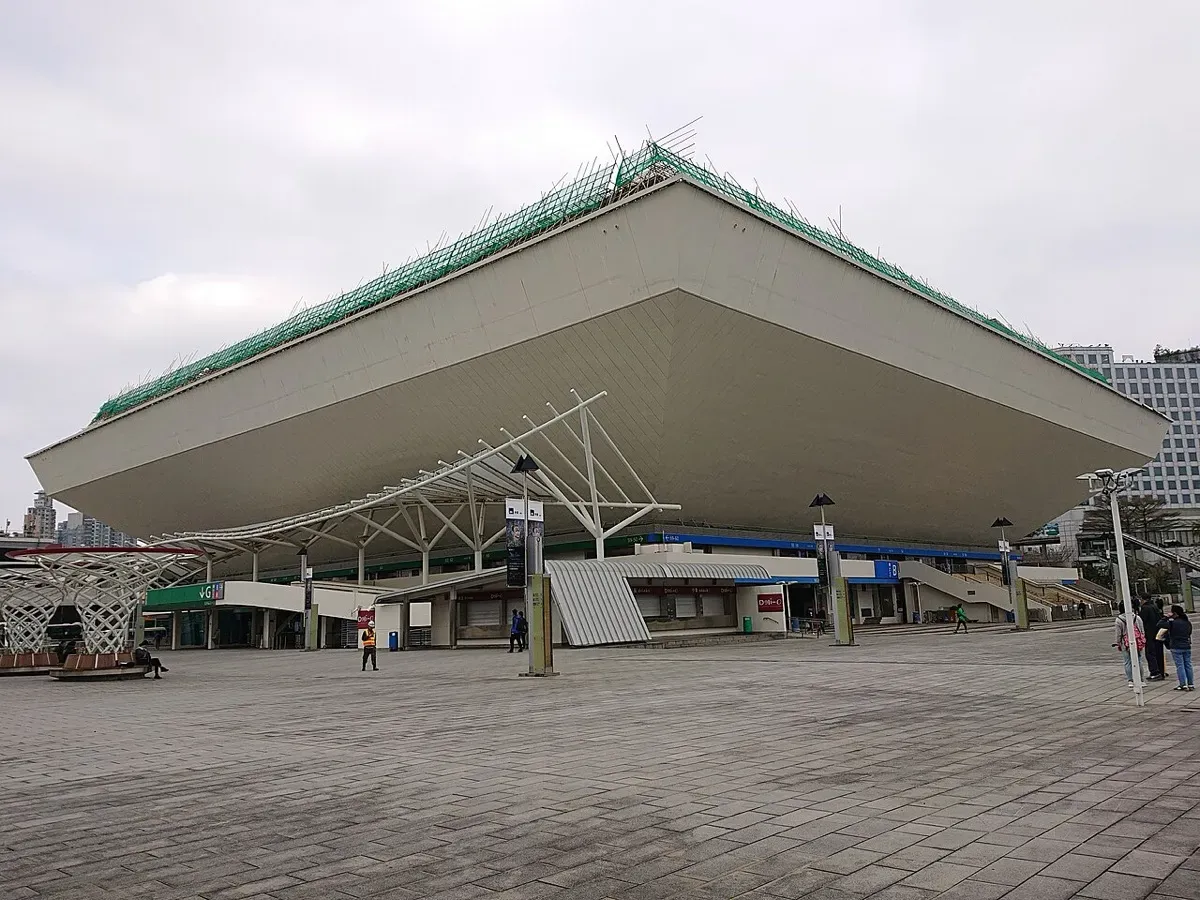
Images: “Hong Kong Coliseum in 2018”, Ceeseven, Hong Kong, 29 Dec 2018, CC BY-SA 4.0, via Wikimedia Commons. Illustrative; the coating is not visible.