The problem
Most timber in Europe’s northern forests is cut by harvesters: large wheeled machines with a crane and a head that grips, fells, strips and cuts trees into logs in seconds. They are efficient, but they burn a lot of diesel, and their load jumps constantly. Felling a big tree or feeding it through the head needs a burst of power, then the machine idles while the operator picks the next stem. To cover those peaks, harvesters carry large engines that run inefficiently much of the time.
Fuel is one of the largest running costs in forestry, and the sector is under growing pressure to cut emissions in its supply chain. Fully electric harvesters are still at concept stage because forests have no charging points and the energy demand over a long shift is high. The question is how to save fuel now with machines that can work all day far from any grid.
The product
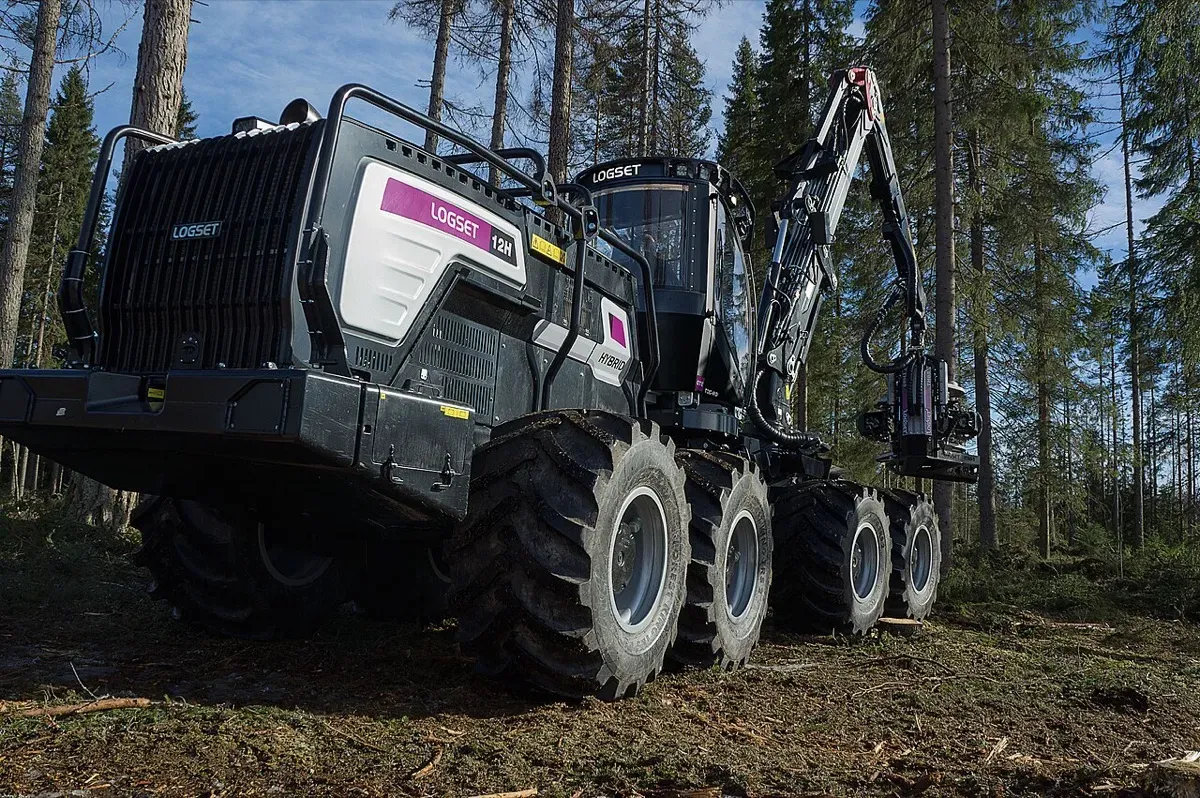
Logset is a forest machine maker from Koivulahti, near Vaasa on Finland’s west coast. In May 2016 it launched its largest ever harvesters, including the 12H GTE Hybrid. At Elmia Wood in Sweden in 2017 the company presented it as the world’s first series-manufactured hybrid harvester.
The 12H GTE Hybrid weighs about 24.5 tonnes and runs on eight wheels. Its current specification lists:
- a 7.4-litre, Stage V diesel engine rated at 214 kW;
- a 155 kW electric motor working alongside it, for a combined 369 kW (502 hp) and 2,080 Nm of torque;
- supercapacitors, not batteries, to store and release energy;
- a Mesera 285 crane and Logset TH80 or TH90 harvester heads, built for large stems.
Because the electric motor fills in the peaks, the diesel can run at a steady, low speed of around 1,500 rpm. Logset claims fuel savings of about 25%, or around half a litre less per cubic metre of wood. In 2019 it added the smaller 8H GTE Hybrid, for which it claims savings of up to 30%.
How it works
- Steady engine. The diesel runs at a fixed, efficient speed and drives a generator as well as the hydraulics.
- Store. When demand is low, for example while the operator positions the crane, spare energy charges the supercapacitors.
- Boost. When the head fells or feeds a big stem, the supercapacitors release power to the electric motor in a fraction of a second.
- Control. Software balances the diesel and electric sides, so the operator just sees more power on demand.
Supercapacitors are chosen over batteries because they handle very fast charging and discharging, survive cold and vibration well, and last many more cycles. The trade-off is that they store only small amounts of energy, so they help with peaks rather than running the machine on electricity alone.
Timeline
| Date | Milestone |
|---|---|
| 20 May 2016 | Logset launches its largest harvester models, including the 12H GTE Hybrid |
| Jun 2017 | Shown at Elmia Wood as the world’s first series-manufactured hybrid harvester |
| 2019 | 8H GTE Hybrid launched for medium-sized stems |
| 2020 to 2021 | Independent fuel efficiency study by Finnish forestry research body Metsäteho |
| Jun 2025 | At Elmia Wood 2025, Logset says it is the only maker to have commercialised an electric hybrid harvester |
| 20 Aug 2026 | Harvester 4.0 update and new two-roller heads announced ahead of FinnMETKO (3 to 5 Sep 2026) |
Impact and numbers
The most useful numbers come from Metsäteho, the research company owned by Finnish forest industry and forest owner groups. Its study, published in 2022, compared the hybrid with a conventional machine in final fellings with stems of about one cubic metre. The hybrid’s productivity was about 14 to 15% higher, and fuel use per cubic metre was about 7 to 8% lower. But the researchers stressed that the fuel benefit depended on using the extra productivity. If the operator worked at the same pace as on a normal harvester, there was no fuel saving.
Forest Machine Magazine’s 2022 test told a similar story: the hybrid’s strength is in heavy stands, where it can cut more wood per hour with the same or less fuel. Early units went to Sweden, France and Australia, markets where big, heavy stems are common.
In August 2026 Logset announced Harvester 4.0, an update with new TH52 to TH82 two-roller heads and transmission upgrades across its range, including the 6HP and 8H GTE Hybrid, launched at the FinnMETKO show in September.
Honest caveats
Savings are smaller than the brochure. The company’s 25% claim and the independent 7 to 8% result are far apart. Buyers should plan with the lower number.
Operator dependent. The independent study showed that the fuel benefit only appears when operators use the extra power. Training and work methods matter as much as the hardware.
Still a diesel machine. The hybrid cuts fuel per cubic metre but does not remove fossil fuel. Its real climate benefit depends on also running on renewable diesel such as HVO.
Niche product. Logset remains a small maker, and the hybrid suits big stems. In thinning of small trees the advantage is smaller.
Forest impact. A more efficient harvester does not make a harvest sustainable on its own. That depends on forest management, retention trees, soil protection and certification.
What’s next
Logset is the only company selling a hybrid harvester in series, and it is extending the idea to smaller machines. The next steps are likely to be better energy storage, renewable fuels and more automation in the head and crane. Fully electric harvesters remain prototypes in the industry, so hybrids are the practical step for now.
Why it matters for Europe and green buyers
For Europe, harvesters are the backbone of timber supply in Finland, Sweden and the Baltic states, and forest companies face pressure under the EU’s climate and supply chain rules to show lower emissions per tonne of wood. A hybrid that cuts fuel per cubic metre, especially when combined with renewable diesel, helps contractors and forest owners show progress now, while fully electric machines are still years away. The independent Finnish study gives buyers a fair benchmark.
For India, mechanised cut-to-length harvesting is rare, and most plantation wood is cut by hand or with chainsaws. But as paper, panel and bioenergy companies scale up eucalyptus and poplar plantations, mechanisation will come. The Logset story is a reminder to judge new machines on independent fuel and productivity data, not marketing claims, and to look at hybrid and low-emission designs from the start.
Sources & image credits
- Bioenergy International, “Logset launches largest ever harvester models” (20 May 2016). https://www.bioenergyinternational.com/logset-launches-largest-ever-harvester-models/
- Bioenergy International, “Super sports car hybrid tech: Logset 12H GTE” (7 Jun 2017). https://www.bioenergyinternational.com/super-sports-car-hybrid-tech-logset-12h-gte/
- Forestry Journal, “Logset launches new hybrid harvester”. https://www.forestryjournal.co.uk/machinery/17713204.logset-launches-new-hybrid-harvester/
- Logset, 12H GTE Hybrid product page and specifications. https://www.logset.fi/12h-gte-hybrid/
- Metsäteho, “Logset hybridiharvesterin polttoainetehokkuus” (tiedote 4/2022). https://www.metsateho.fi/logset-hybridiharvesterin-polttoainetehokkuus/
- Forest Machine Magazine, “Hybrid harvester, hybrid power” (8 Jul 2022). https://www.forestmachinemagazine.com/hybrid-harvester-hybrid-power/
- Elmia, “Logset demonstrates power and innovation at Elmia Wood 2025”. https://www.elmia.se/en/wood/for-visitors/news/Logset-demonstrates-power-and-innovation-at-elmia-wood-2025/
- Logset, Harvester 4.0 news (20 Aug 2026). https://www.logset.fi/uutiset/harvester4/
- Wikimedia Commons, “Logset 12H GTE Hybrid-black from behind.jpg”. https://commons.wikimedia.org/wiki/File:Logset_12H_GTE_Hybrid-black_from_behind.jpg
Images: “Logset 12H GTE Hybrid-black from behind”, WavingHand, 1 June 2017, CC BY-SA 4.0, via Wikimedia Commons.