The problem
India’s paper, board and panel industry needs millions of tonnes of wood a year, but natural forests are protected and cannot supply it. At the same time, many farmers in dry and degraded regions earn little from rain-fed crops on poor soils. Imported pulp is costly, and illegal cutting from forests remains a risk where supply is short.
Trees grown on farms can link these two problems. But ordinary seedlings grow unevenly, many die, and farmers who plant them face years without income and no guaranteed buyer at the end. To work, farm forestry needs better planting material, technical help and a market.
The product
ITC’s paper business, the Paperboards and Specialty Papers Division, runs a large mill at Bhadrachalam in Telangana. Over two decades it has built a farm forestry programme around one tangible product: clonal saplings. Alongside it, ITC launched a social forestry programme in 2001 to 2002, in support of the national poverty alleviation programme, to help tribal and poor households earn from wood grown on their own wasteland.
A clone is a copy of an especially good tree, grown from a cutting rather than a seed, so every sapling shares the parent’s traits. ITC’s researchers selected clones of eucalyptus, subabul and casuarina for fast growth, straight stems, disease resistance and suitability for local soils. In 2013 the company commissioned a Clonal Production Centre on 30 acres near the mill, with capacity for about 15 million saplings a year. Apical cuttings taken from mother plants are grown with hydroponic technology in soil-less media in sand beds, and a soil testing lab on site helps match clones to the land where they will be planted. In 2018 ITC introduced next-generation clones that it says yield 15 to 20% more wood.
Farmers buy the saplings, get advice on planting and care, and receive a non-binding offer to sell the wood back to ITC at market price. They can also sell elsewhere.
How it works
- Select. Researchers test clones in trials and choose the best for each region.
- Multiply. Mother plants grow in hydroponic beds. Shoot tips are cut, rooted in mist chambers and hardened in nurseries.
- Distribute. Saplings are sold to farmers, often through local extension staff, with advice on spacing and care.
- Grow. Farmers plant blocks, field boundaries or rows with crops in between. ITC managers give technical guidance from planting until harvest, and growers can follow advice through ITC’s MyTree app on Google Play.
- Sell. At harvest, farmers sell the wood to ITC under the buy-back offer, or to other buyers.
- Certify. Plantations in the certified group follow FSC rules and are audited.
Timeline
| Date | Milestone |
|---|---|
| 2001 to 2002 | ITC starts its social forestry programme to support poverty alleviation around its Bhadrachalam mill |
| 2013 | 30-acre Clonal Production Centre commissioned, capacity about 15 million saplings |
| 2018 | Next-generation clones introduced, about 15 to 20% higher yield |
| FY25 | About 65,000 ha planted in one year, up about 30%; 4.85 lakh tonnes of FSC-certified wood procured |
| 2030 target | Cumulative coverage target of 15 lakh acres |
Impact and numbers
ITC reports that its social and farm forestry programmes have covered about 14.8 lakh acres in total, roughly 600,000 hectares, and generated about 270 million person-days of work. Its paper division’s site gives a figure of more than 1.32 million acres of plantations. In FY25, according to India CSR, the company planted about 65,000 hectares, around 30% more than the year before.
Certification is a key part of the story. ITC says it was the first company in India to gain FSC Forest Management certification, and that more than 1.49 lakh acres owned by over 25,000 farmers are now certified. In FY25 it sourced about 4.85 lakh tonnes of FSC-certified wood.
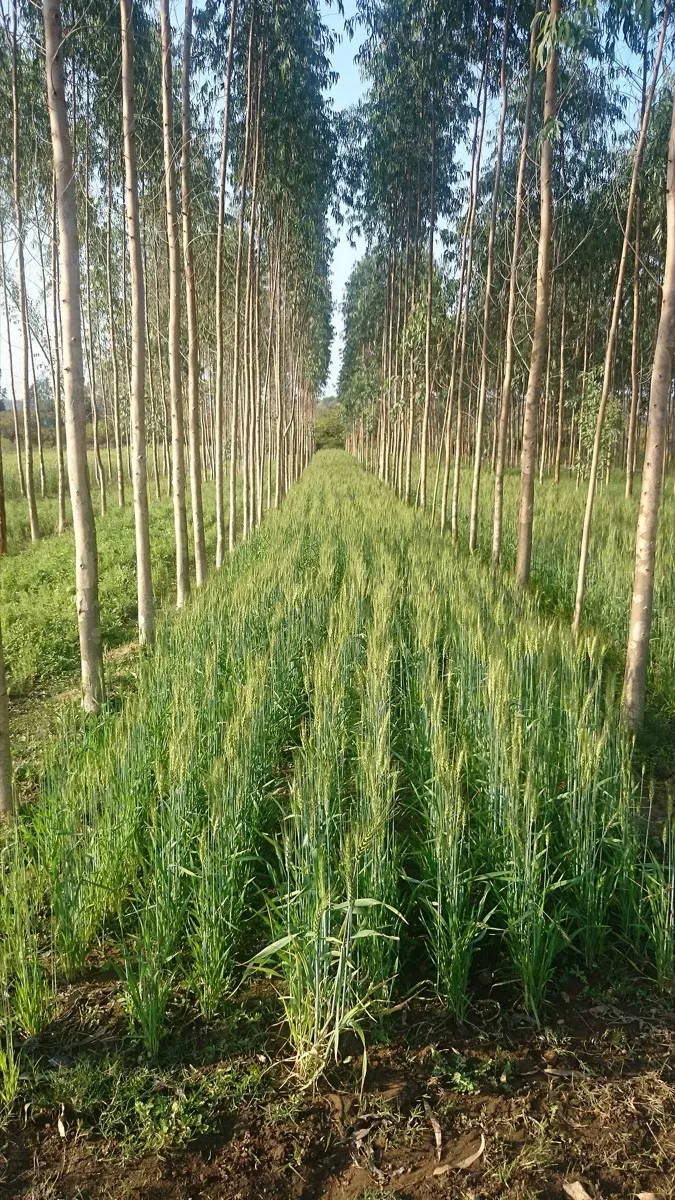
Under the social forestry model, ITC promotes multi-species plantations with intercrops on private wasteland, backed by long-term loans to households. The programme also includes agro and bund plantations, where trees grow on field edges or between crops, and a “Grow your own fuel” effort to reduce pressure on forests for firewood. For many farmers in dry areas, the trees provide a lump sum at harvest that rain-fed crops rarely match.
Honest caveats
Monocultures. Most of the area is fast-growing clonal plantation, usually of one species. These are tree farms, not natural forests, and they support far less biodiversity.
Water. Eucalyptus uses a lot of water in dry regions. A 2020 ICRISAT study in Kolar, Karnataka, found up to 33% lower groundwater recharge under eucalyptus, and Karnataka has restricted new eucalyptus planting. A 2025 review in Forests found that impacts depend heavily on climate, soil and management, but the concern is real.
Narrow genetics. Large areas of a few clones are more exposed to pests and disease.
Company figures. Area and job numbers come from ITC. Different ITC pages give different area totals, and “cumulative” areas include repeat planting.
Farmer risk. The buy-back is non-binding and at market price, so farmers still bear price risk.
What’s next
ITC has set a target of 15 lakh acres of cumulative coverage by 2030 and is expanding FSC certification. The test for the programme is whether it can diversify species, encourage mixed agroforestry over block monoculture and avoid water-stressed areas, while keeping farmer incomes and its wood supply steady.
Why it matters for Europe and green buyers
For Europe, the programme is a reminder of where packaging comes from. European brands that buy Indian paperboard, and investors who track deforestation-free supply chains under the EU Deforestation Regulation, can see in ITC’s model a way to source wood from farms rather than forests, backed by FSC certification. They should still ask how much comes from mixed agroforestry and how water risk is managed.
For India, the model shows that farm forestry can work at scale when farmers get good planting material, advice and a buyer. It supports the national goal of increasing tree cover outside forests and cuts pressure on natural forests for wood. The next step is to make these plantations more diverse and better matched to local water supply.
Sources & image credits
- ITC PSPD, “Development of our plantations” (Clonal Production Centre, clones, buy-back). https://www.itcpspd.com/Page/Development_of_our_Plantations
- ITC PSPD, plantations and FSC certification. https://www.itcpspd.com/Page/plantations
- ITC, afforestation programme. https://www.itcportal.com/about-itc/sustainability/afforestation.html
- India CSR, “ITC grows plantation area by 30% in FY25 to boost wood sustainability” (27 Jun 2025). https://indiacsr.in/itc-grows-plantation-area-by-30-in-fy25-to-boost-wood-sustainability/
- The Pulp and Paper Times, ITC PSPD outlook. https://thepulpandpapertimes.com/news/industry-news/itcpspd-expects-to-drive-structural-improvement-in-cpp-2338
- Garg, K. K. et al. (2020), ICRISAT, eucalyptus and groundwater in Kolar district. https://oar.icrisat.org/11633/1/2020_Kolar.pdf
- Medeiros et al. (2025), review of eucalyptus plantation impacts, Forests 16(3): 423. https://www.mdpi.com/1999-4907/16/3/423
- Wikimedia Commons, “Eucalyptus and wheat.jpg”. https://commons.wikimedia.org/wiki/File:Eucalyptus_and_wheat.jpg
Images: “Eucalyptus and wheat”, Ajaynioding, 15 January 2015, CC BY-SA 4.0, via Wikimedia Commons. Illustrative: not an ITC plantation.