The problem
Neurological disorders are rising fast. The WHO says the prevalence of Parkinson’s disease has doubled in the past 25 years, and in 2019 it caused 329,000 deaths, more than double the figure in 2000. Deep brain stimulation and other neuromodulation help some patients but use fairly coarse metal electrodes.
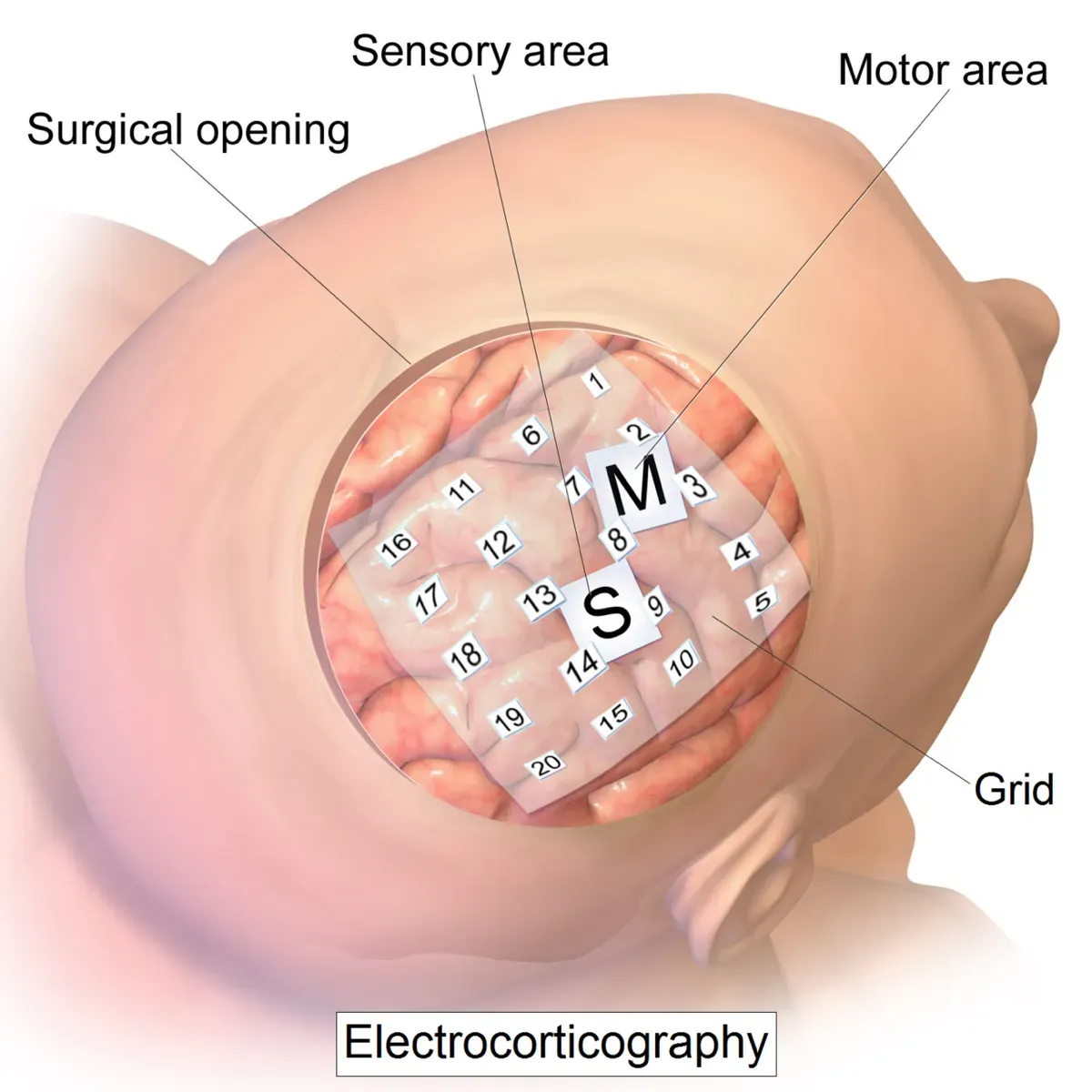
Brain surgery has a related problem. When removing a tumour, surgeons map brain activity with electrodes to find and protect areas that control movement and speech. Conventional electrodes are rigid, large and limited in sensitivity, so they cannot fully follow the brain’s folded surface or capture detailed activity.
The product
INBRAIN’s graphene cortical interface is an ultra-thin, micrometre-scale, flexible array that conforms to the brain’s contours and reaches hard-to-access areas. Replacing metal contacts with graphene, a highly sensitive carbon material, gives higher-resolution recording and more precise stimulation, which supports real-time brain decoding and mapping during surgery. The company says the implant is only 10 micrometres thick.
The wider platform, which INBRAIN calls BCI therapeutics or BCI-Tx, is bidirectional: it decodes neural activity and modulates it. Machine learning software picks out therapy-specific biomarkers, and the system delivers focused, adaptive stimulation intended to rebalance diseased neural networks. In 2023 the FDA granted Breakthrough Device Designation to INBRAIN’s platform for Parkinson’s disease. The company says continuous monitoring and real-time adjustment are meant to improve outcomes while reducing side effects, and that, with Merck KGaA and its subsidiary INNERVIA Bioelectronics, it is extending the approach to peripheral nerves and systemic diseases.
When the Series B closed, chief executive Carolina Aguilar said the technology “has already shown great results versus current commercial neuromodulation technology,” a claim made when only the first patient had been treated in the human study, so it cannot rest on patient outcomes. The first-in-human study was also designed to assess whether graphene outperforms traditional materials for neural applications, imec noted.
How it works
- Place. A surgeon lays the flexible graphene array on the brain surface.
- Conform. The thin film follows the brain’s folds closely.
- Record. Graphene contacts pick up fine, high-frequency neural signals.
- Decode. Software maps functions such as movement and speech.
- Stimulate. The same contacts can deliver precise, focused pulses.
- Adapt. In future therapy, stimulation would adjust to the brain’s signals in real time.
Timeline
| Date | Milestone |
|---|---|
| 2023 | FDA Breakthrough Device Designation for the BCI-Tx platform in Parkinson’s disease |
| 16 Apr 2024 | First-in-human study NCT06368310 posted, sponsored by the University of Manchester |
| 6 Aug 2024 | Study starts at Salford Royal Hospital, Northern Care Alliance NHS Foundation Trust |
| Oct 2024 | $50 million Series B led by imec.xpand, with the EIC Fund; Merck KGaA support |
| Jul 2025 | Positive interim results reported |
| Apr 2026 | Enrolment completed: 10 patients recruited, eight treated |
| 24 Jun 2026 | Study completed; final results expected by end of 2026 |
Impact and numbers
The first-in-human study tested the graphene array during brain tumour removal. Its main aim was safety; secondary aims covered signal quality, stability, stimulation and compatibility with standard surgical tools and recording equipment. Of ten patients recruited, eight were treated, with no perioperative device failures and complete data from all eight. No device-related adverse events were seen up to discharge, and a 90-day follow-up with imaging forms part of the primary endpoint. In awake surgery, patients named objects so researchers could test speech decoding.
“The ability to detect high-frequency neural activity with micrometer-scale precision and also modulate it provides a fundamentally new level of insight,” said neurosurgeon Dr David Coope, the chief clinical investigator. Co-founder Professor Kostas Kostarelos said the study “demonstrates that graphene can safely interface with the human brain.”
The company has raised $68 million since inception. Its Series B was led by imec.xpand with the European Innovation Council Fund, Fond ICO Next Tech, CDTI-Innvierte and Avançsa, and imec agreed to help scale graphene interfaces commercially. The European Investment Bank linked the success to the EU’s Graphene Flagship. MassDevice reports later partnerships with Mayo Clinic and Microsoft. The EIB’s Marcin Nowak said the technology could help “position Europe as one of the leaders in the global BCI industry.”
Honest caveats
Evidence status. Eight patients, short procedures and a safety focus. Final results are still pending, and no therapeutic benefit has yet been shown in humans.
No approval. Breakthrough designation speeds FDA review but is not approval. There is no CE mark or FDA clearance.
Privacy and ethics. A device that decodes speech-related brain signals raises serious questions about neural data ownership, consent and use of AI. A Microsoft cloud AI partnership makes data governance central.
Long-term safety. Graphene’s behaviour in the body over years of implantation is not yet known.
What’s next
INBRAIN says it will announce full results in 2026 as it moves towards commercialisation, starting with brain mapping in surgery. ICN2 notes earlier-stage studies exploring graphene electrodes for neurodegenerative disorders, and the company lists Parkinson’s, epilepsy and stroke rehabilitation as targets.
Why it matters for Europe and green buyers
For Europe, INBRAIN is a clear return on public research: graphene work at ICN2 and CSIC, nurtured by the EU Graphene Flagship and backed by the EIC Fund, has become a clinical product tested in a UK NHS hospital.
For India, which faces a growing burden of neurological disease with few specialists, more precise mapping and future adaptive therapies could improve outcomes if costs fall. For the world, a safe, high-resolution brain interface could make neurological treatment more personal while replacing metal contacts with a thin carbon material.
Sources & image credits
- Parc Científic de Barcelona, “INBRAIN Neuroelectronics completes the first-in-human study of its brain-computer interface”, April 2026. https://www.pcb.ub.edu/en/inbrain-neuroelectronics-completes-the-first-in-human-study-of-its-brain-computer-interface/
- MassDevice, “InBrain completes enrollment in first-in-human BCI trial”, April 2026. https://www.massdevice.com/inbrain-completes-enrollment-first-human-bci-trial/
- ICN2, “Patient Enrolment for First-in-Human Trial of ICN2-developed Graphene Electrodes is Completed”, 2026. https://icn2.cat/en/news/5605-patient-enrolment-for-first-in-human-trial-of-icn2-developed-graphene-electrodes-is-completed
- imec, “INBRAIN Neuroelectronics Raises $50M Series B to Advance Graphene-Based Brain-Computer Interface Technology”, October 2024. https://www.imec-int.com/en/press/inbrain-neuroelectronics-raises-50m-series-b-advance-graphene-based-brain-computer-interface
- ClinicalTrials.gov, NCT06368310, “First in Human Clinical Investigation of Safety and Feasibility of a Novel Graphene Micro-electrocorticography Array for Brain Mapping in Neuro-oncology”. https://clinicaltrials.gov/study/NCT06368310
- World Health Organization, “Parkinson disease” fact sheet. https://www.who.int/news-room/fact-sheets/detail/parkinson-disease
- Wikimedia Commons, “Intracranial electrode grid for electrocorticography”. https://commons.wikimedia.org/wiki/File:Intracranial_electrode_grid_for_electrocorticography.png
Images: “Intracranial electrode grid for electrocorticography”, BruceBlaus (Blausen Medical), 2014, CC BY 3.0, via Wikimedia Commons. Illustrative; a conventional electrode grid, not the INBRAIN device.