The problem
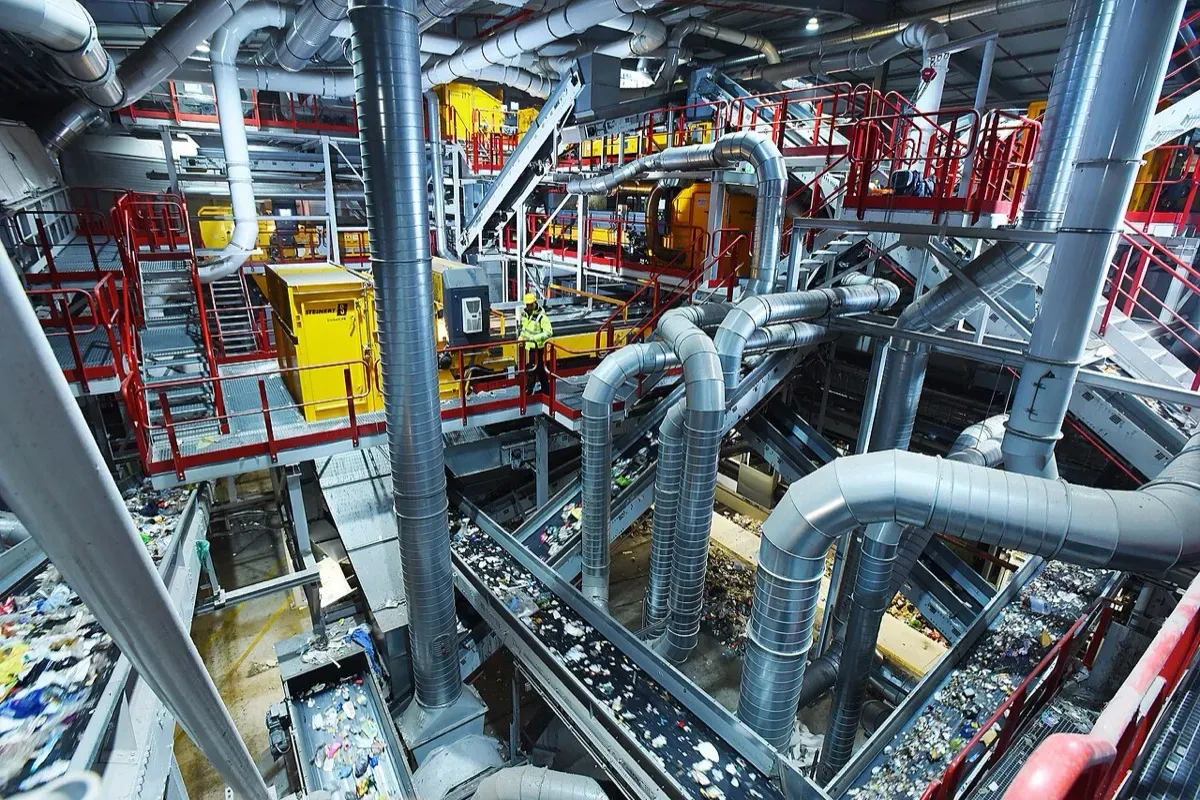
A materials recovery facility (MRF) receives mixed recycling, separates it into bales of paper, cardboard, plastics and metals, and sends the rest to landfill or incineration. Operators often do not know exactly what arrives, what ends up in each bale, or what valuable material escapes on the residue line.
Most plants rely on manual sampling, which covers less than 1% of material, according to Greyparrot (Greyparrot). A belt can carry several tonnes of mixed material an hour, and its composition changes with the season, the collection route and even the weather. That makes it hard to fix problems quickly, prove bale quality to buyers or report reliable data to regulators.
The product
The Greyparrot Analyzer is a camera unit with on-board AI, installed on a simple metal frame above a conveyor belt. It needs only a 110 to 230 V power supply and a wired internet connection, and works on belts up to 1,600 mm wide, with options up to 2,800 mm (Greyparrot FAQ).
It can identify more than 110 categories of solid municipal waste and tell food-grade from non-food-grade plastics. For item-based classes, such as cans, it estimates weight by counting objects and multiplying by average mass; for area-based classes, such as film, it uses area. Data appear on live dashboards, can be exported, or fed to robots and air-jet sorters from any brand through Greyparrot Sync.
Greyparrot does not sell the hardware outright: customers buy a licence that includes the Analyzer units, software updates and support. Greyparrot says the AI runs locally and uses about as much energy as a games console, and that the latest units are 15% more efficient and use lighter, recyclable parts.
How it works
- Mount: units are fixed above infeed, product and residue belts, often during scheduled downtime.
- Calibrate: Greyparrot sets average masses for each waste class at that plant.
- Detect: cameras capture objects as they pass and the AI classifies them, including packaging types and brands.
- Report: dashboards show composition, purity and losses, with alerts when something drifts.
- Act: operators adjust machinery, feed blends or staffing; data can also guide robots and optical sorters.
Timeline
| Date | Milestone |
|---|---|
| 2019 | Greyparrot founded in London |
| May 2022 | USD 11 million Series A led by Una Terra |
| 7 Feb 2024 | Bollegraaf invests USD 12.8 million and becomes worldwide distributor; more than 100 Analyzers deployed |
| Dec 2024 | 140+ units in 55 facilities in 20 countries; 40 billion objects detected that year |
| 9 Oct 2025 | Analyzer named one of TIME’s Best Inventions of 2025 |
| 16 Sep 2026 | Live OEE dashboard launched at RWM 2026; more than 300 Analyzers deployed |
Impact and numbers
- Reach: more than 300 Analyzers across 20+ countries, used by WM, Veolia, Biffa, FCC Environment and Circular Services (Greyparrot).
- Customer gains: facilities have reported gains of 10% to 30%, and one site saved more than GBP 1.5 million in a year. Case studies include a 10% recovery increase at KSI Recycling and 200 tonnes a month more throughput at Green Tech.
- What the data show: in 2024, Analyzers detected more than 6 billion PET bottles and over 2 billion aluminium cans, and tracked over 35,000 tonnes of recyclable plastics lost to residue lines. Paper and card made up 56% of residue material (Greyparrot).
- Speed: sampling that would take a person 375 hours takes the Analyzer six hours (Greyparrot).
Honest caveats. All impact numbers are Greyparrot’s own or from its customer case studies, and the company does not offer free trials. Its figures are not always consistent: the TIME announcement mentions 111 categories and “over 100 billion” items analysed in 2025, while the same release says 52 billion objects were detected in 2025, and the FAQ lists 115 categories. Cameras only see the top layer of material, so on crowded belts the system estimates what lies underneath. The Analyzer does not sort anything; savings depend on operators changing equipment or processes. Greyparrot owns anonymised data from all units to train its AI, which some operators may weigh carefully. Whether regulators accept AI data for official reporting is still up to each authority. The “manual logs report OEE 8 to 15 points too high” claim comes from Greyparrot’s own launch.
What’s next
Greyparrot’s new OEE dashboard scores availability, performance and quality shift by shift from live data, initially for customers with site-wide installations. Its Deepnest platform sells waste data to brands and packaging producers so they can see how their packaging behaves in real plants. In 2022, its Series A, led by Una Terra with Closed Loop Partners, Speedinvest and a fund linked to the UK’s WRAP, was raised to expand the recognition library, upgrade hardware and enter the US market (Greyparrot); at that time the AI covered about 50 categories, so the library has more than doubled. With Bollegraaf, which serves more than 3,000 plants worldwide, it is working on “smart” plants with AI built in from the start.
Why it matters for Europe / green buyers
Under England’s Simpler Recycling rules, all households must have separate collections for dry recyclables, food waste and residual waste from 31 March 2026, which means more material arriving at MRFs (GOV.UK). The UK’s packaging extended producer responsibility and the EU’s Packaging and Packaging Waste Regulation (EU) 2025/40, which sets recyclability grades for packaging, both depend on knowing what is actually recovered (EUR-Lex). For waste operators, live composition data can support bale quality, offtake prices and compliance reporting. For brands, such data show whether “recyclable” packaging is really sorted and recycled.
India’s MRFs, many run by municipalities or the informal sector, rarely measure composition at all. As EPR for plastic packaging tightens in India, low-cost monitoring of what reaches and leaves sorting lines could help verify recycling claims, although Greyparrot has not announced Indian deployments.
Sources & image credits
- Greyparrot, “Frequently asked questions” (Analyzer): https://www.greyparrot.ai/faq
- Greyparrot, “Greyparrot signs strategic partnership with Bollegraaf” (7 Feb 2024): https://www.greyparrot.ai/resources/blog/bollegraaf-partnership
- Greyparrot, “What we learned about recycling by detecting 40 billion waste objects in 2024” (17 Dec 2024): https://www.greyparrot.ai/resources/blog/2024-recycling-data
- Greyparrot, “TIME names Greyparrot Analyzer one of the Best Inventions of 2025” (9 Oct 2025): https://www.greyparrot.ai/time-names-greyparrot-analyzer-one-of-the-best-inventions-of-2025
- Greyparrot, “Greyparrot launches live OEE tracking for recovery facilities” (16 Sep 2026): https://www.greyparrot.ai/live-oee-tracking-greyparrot-launch
- Greyparrot, “Greyparrot raises USD 11M Series A funding” (2022): https://www.greyparrot.ai/resources/blog/series-a-funding
- GOV.UK, “Simpler recycling: household recycling in England”: https://www.gov.uk/guidance/simpler-recycling-household-recycling-in-england
- EUR-Lex, Regulation (EU) 2025/40 on packaging and packaging waste: https://eur-lex.europa.eu/eli/reg/2025/40/oj/eng
Images:
- “STEINERT UniSort PR” by STEINERT, 2019, licensed under CC BY 4.0 (https://creativecommons.org/licenses/by/4.0), via Wikimedia Commons: https://commons.wikimedia.org/wiki/File:STEINERT_UniSort_PR.jpg