The problem
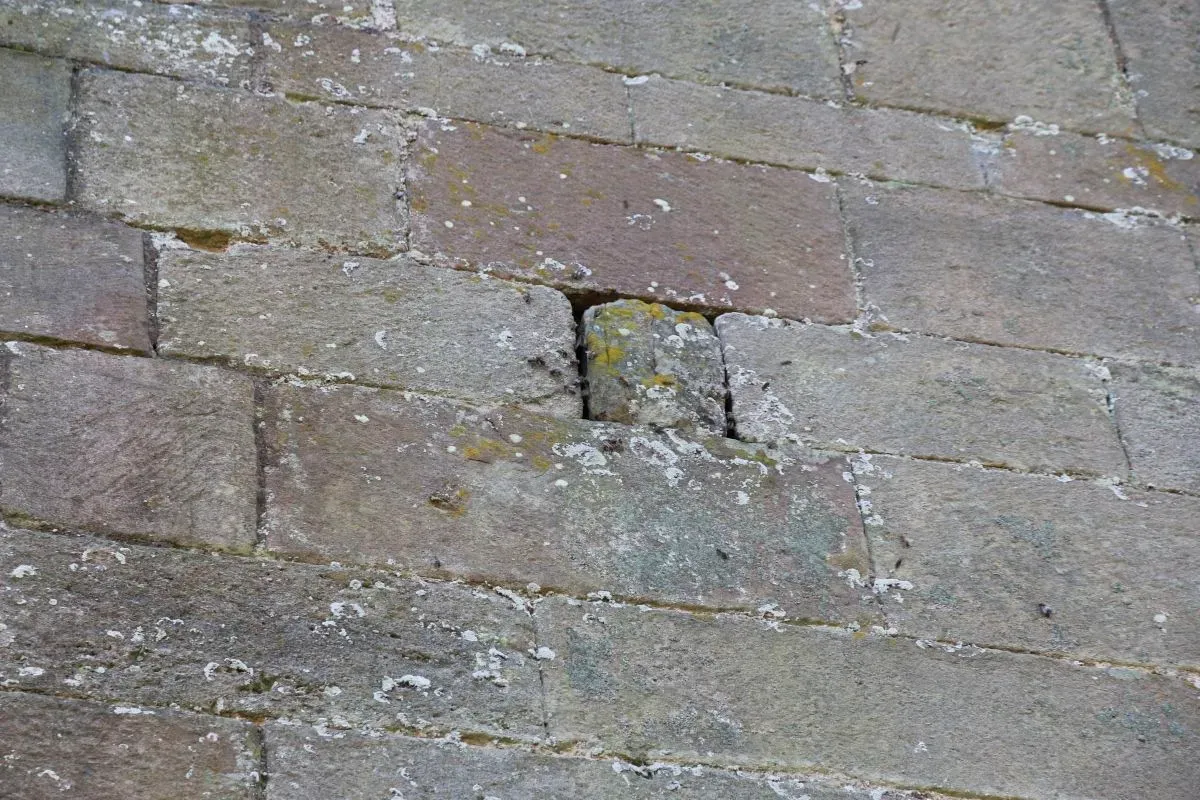
Most British bee species are not honeybees but solitary bees, which have no hive, no queen and no honey to defend. Some of them, such as the red mason bee and leafcutter bees, nest in narrow cavities: hollow stems, beetle holes in dead wood and gaps in old walls. Green&Blue says solitary bees are declining because of disease, chemical use and habitat loss (Green&Blue).
Cities can be surprisingly good for pollinators, with gardens and parks flowering for long seasons. But new buildings are sealed and precise, so the nesting places that older streets once offered are disappearing. The academic paper on the brick’s design argues that construction materials themselves could replace the habitat that construction removes (Christman et al.).
The product
The Bee Brick is a concrete block the size of a standard UK brick (215 x 105 x 65 mm), solid at the back, with moulded cavities in the front face. The University of Exeter study describes 19 holes of 5 to 8 mm diameter and 70 to 80 mm deep (Shaw et al., 2021). Female bees lay eggs in the holes and seal each entrance with mud or chewed leaves; offspring emerge the following spring.
Green&Blue’s specifications:
- concrete with up to 75% recycled material from the Cornish china clay industry;
- colours white, charcoal, red and yellow, to match common bricks;
- listed at about GBP 36 each on Green&Blue’s shop;
- best placed in a warm, south-facing spot at least 1 metre off the ground, with no plants in front of the face.
It can be built into a wall with ordinary mortar in place of a brick, or simply stood in a garden or allotment. Green&Blue says the range is made in its own Cotswold workshops (Green&Blue).
How it works
- Build in: the brick is laid in a sunny wall like any other brick, ideally at least 0.75 to 1 metre above ground.
- Plant: nectar-rich planting nearby provides food; Brighton & Hove asks for this alongside the brick.
- Nest: in spring and summer, females fill cavities with a row of cells, each with pollen and an egg.
- Seal: each hole is capped with mud (mason bees) or leaf material (leafcutter bees).
- Emerge: new adults chew out the next spring and the cycle repeats.
- Maintain: researchers suggest checking for mites or mould and cleaning cells after emergence if needed.
Timeline
| Date | Milestone |
|---|---|
| 2005 | Green&Blue founded |
| 2014 | Bee Brick launched; wins the Soil Association Innovation Award |
| 2016 to 2017 | University of Exeter field trial in 23 Cornish gardens |
| 2018 | Cornwall Council recommends a bee brick in 50% of new builds |
| 1 Apr 2020 | Brighton & Hove begins including bee bricks in planning permissions |
| 2022 | Brighton & Hove SPD11 sets one bee brick per dwelling |
| 2023 | Design paper published; Wildcare buys Green&Blue |
Impact and numbers
- Occupancy: in 2016, 1.3% of brick holes were capped, against 1.1% in drilled wooden controls; in 2017, 2.8% against 0.7%. Mud capping made up 79% of capped holes, cut leaves 13% and chewed leaves 8%. Only one of 39 bricks at ground level was used (Shaw et al., 2021).
- Sales: over 21,000 bricks sold worldwide, including Europe, Brazil, the USA, Canada and New Zealand, or a potential 350,000 nesting cavities (Christman et al.).
- Planning: Brighton & Hove’s Biodiversity and Nature Conservation SPD requires new build development and extensions to incorporate bee bricks at one per dwelling, with complementary nectar-rich planting (Brighton & Hove SPD11). The Duchy of Cornwall uses them at Nansledan and Poundbury.
- Height and colour: the Exeter trial put white bricks at different heights, from ground level up, and red, white and yellow bricks side by side. Occupancy was so low that the median brick had no capped holes, and most tests showed no statistically significant preference. But capped holes appeared in only one ground-level brick, which is why Green&Blue advises raising bricks off the ground and facing them south (Shaw et al., 2021).
Honest caveats. The only published field study was co-authored by a Green&Blue founder, and it measured occupancy, not whether more bees survive or whether local populations grow. Its authors say population-level impacts are “still untested”. The design paper adds that the brick’s material and tube length were set by building needs, not ideal bee habitat; that most users will be common species, not rare ones; and that artificial nests can build up pathogens, parasites and mould, which impervious concrete may make worse. Dezeen reported that scientists are divided on bee bricks’ value (Dezeen). The design history is also a little unclear: the brick launched in 2014 and was field-tested in 2016, yet the design paper describes prototype trials in April 2019. Finally, a brick is cheap compared with planting and pesticide-free management, which matter more for bees.
What’s next
Since joining Wildcare, Green&Blue sells the Bee Brick alongside concrete planters and “Beepot” bee houses that use the same cavity design. The next step for evidence would be multi-year studies of emergence, parasite rates and population effects in urban walls. For policy, the bigger question is whether other councils follow Brighton & Hove and Cornwall, or whether national rules on integrated wildlife features take over.
Why it matters for Europe / green buyers
In England, mandatory biodiversity net gain requires most new developments to deliver at least a 10% gain in habitat value (GOV.UK), and integrated features such as swift bricks, bat boxes and bee bricks are cheap ways for developers to show care for species at building scale. In the EU, the Nature Restoration Regulation (EU) 2024/1991 requires no net loss of urban green space by 2030 and a positive trend afterwards, and calls for reversing pollinator decline (EUR-Lex). For architects, the questions are placement, orientation, nearby planting and a simple monitoring plan.
India has a rich fauna of solitary bees, including leafcutter and mason bees, and Indian cities are densifying fast with concrete-block buildings. We found no Indian city with a rule like Brighton’s. The idea is transferable at low cost: a cavity block made locally from fly ash or recycled aggregate, placed on sunny walls next to native flowering plants, could be added to green building ratings.
Sources & image credits
- Green&Blue, “Bee Brick”: https://www.greenandblue.co.uk/products/bee-brick
- Shaw, Christman, Crookes, Gilbert and Osborne, “Effect of height and colour of bee bricks on nesting occupancy of bees and wasps in SW England”, Conservation Evidence Journal 18 (2021), 10-17: https://conservationevidencejournal.com/reference/pdf/9442
- Christman, Shaw and Hodsdon, “The Bee Brick: building habitat for solitary bees”, International Journal of Sustainable Design 4 (2022, published 2023) (Falmouth University repository): https://repository.falmouth.ac.uk/4864/1/f212156489117310.pdf
- Brighton & Hove City Council, Biodiversity and Nature Conservation SPD11 (2022): https://www.brighton-hove.gov.uk/sites/default/files/2022-08/BNC%20SPD%20FINAL.pdf
- Dezeen, “Bee bricks become planning requirement for new buildings in Brighton” (24 Jan 2022): https://www.dezeen.com/2022/01/24/bee-bricks-planning-requirement-brighton/
- Green&Blue, “Bee Bricks compulsory in Brighton and Hove”: https://www.greenandblue.co.uk/blogs/news/bee-bricks-compulsory-in-brighton-and-hove
- GOV.UK, “Biodiversity net gain”: https://www.gov.uk/government/collections/biodiversity-net-gain
- EUR-Lex, Regulation (EU) 2024/1991 on nature restoration: https://eur-lex.europa.eu/eli/reg/2024/1991/oj/eng
Images:
- “Bees in the Brick” by Bill Nicholls, licensed under CC BY-SA 2.0 (https://creativecommons.org/licenses/by-sa/2.0), via Wikimedia Commons: https://commons.wikimedia.org/wiki/File:Bees_in_the_Brick_-_geograph.org.uk_-_4097458.jpg