The problem
Fresh herbs and salad leaves are some of the most perishable foods city households buy. They are often grown in heated greenhouses or flown in, packed in plastic clamshells, and a large share wilts in the fridge before it is eaten. Many urban flats have no garden or balcony, and windowsills in northern Europe get little winter light.
Large indoor “vertical farms” tried to fix this at industrial scale, with mixed results: high energy and rent costs have pushed several operators out of business. A smaller, household-level device avoids the warehouse but raises its own question: is it worth the electricity?
The product
The Smart Garden 9 holds nine Plant Pods: cups of growing medium, pre-seeded and pre-fertilised, which Click & Grow says are pesticide-free. Users add water and plug it in. Full-spectrum LED lights run automatically for 16 hours on and 8 hours off, and wicks draw water up from the tank, so there are no pumps or moving parts (Click & Grow).
Key specifications from Click & Grow:
- 9 plant pods; the box includes 3 basil, 3 green lettuce and 3 mini tomato;
- 4-litre (1.06 US gallon) water tank, enough for up to three weeks;
- 13 W power use;
- body in recyclable ABS plastic with swappable parts; the grow light is the only part with a limited life, at least 7 years;
- lifetime sprouting guarantee: pods that do not sprout are replaced free.
Click & Grow says set-up takes 10 minutes and upkeep about 5 minutes a month. A companion app gives care tips and harvest reminders.
The Smart Garden 9 grew out of a decade of smaller and larger experiments. The 2011 Smart Flowerpot was battery-powered and self-watering; the 2013 Smart Herb Garden added an LED lamp and mains power and was expected to retail for USD 79 (TechCrunch). Click & Grow also tried bigger formats, including a 2016 Wall Farm for up to 51 plants and a farm-style unit for up to 250 plants (Wikipedia), before settling on countertop gardens as its core range. Three units can be joined as a Smart Garden 27, and there is a PRO version with app control.
How it works
- Place pods: pre-seeded pods sit in cups spaced so plants of different ages can grow side by side.
- Fill tank: 4 litres of water go into the base.
- Wick: the growing medium draws water up by capillary action, keeping roots moist but not waterlogged.
- Light: LEDs above the plants run on a fixed 16/8 cycle.
- Harvest: herbs and leaves are cut as needed; spent pods are replaced.
- Repeat: new pods are bought in packs, from herbs to flowers.
Timeline
| Date | Milestone |
|---|---|
| 2009 | Mattias Lepp founds Click & Grow in Estonia |
| 2011 | Smart Flowerpot, a battery-powered self-watering pot, launched |
| Mar 2013 | Kickstarter for the Smart Herb Garden, with a USD 75,000 goal |
| Jan 2014 | Smart Herb Garden goes on sale |
| 2016 | Smart Garden 9 launched through another Kickstarter campaign |
| 24 Mar 2026 | Johan Schepers, formerly of SodaStream (PepsiCo), named CEO |
| 26 Mar 2026 | EUR 2 million equity investment announced |
Impact and numbers
- Installed base: more than 500,000 gardens sold worldwide (Click & Grow); Wikipedia records more than 450,000 customers in 2018 (Wikipedia).
- Crowdfunding: the 2013 Smart Herb Garden campaign aimed for USD 75,000 and, according to Wikipedia, raised about USD 625,000 (TechCrunch).
- Energy: 13 W for 16 hours a day is about 0.21 kWh a day, or roughly 76 kWh a year (our calculation from the product page).
- Research: Wikipedia notes Estonian research grants between 2016 and 2023, including EUR 281,173 with the University of Tartu (2020 to 2022) for a new growth medium.
Honest caveats. Click & Grow publishes no life-cycle study, so the climate case is unproven. A Smart Garden 9 grows a few herbs and small greens, not a meaningful share of a household’s vegetables, and 76 kWh a year of lighting is a real cost; on India’s grid, at the Central Electricity Authority’s weighted average of about 0.71 tonnes of CO2 per MWh for 2024-25 (CEA), that is about 54 kg of CO2 a year. Pods are a consumable, which locks users into the brand. The company’s finances have been shaky since the pandemic boom: Estonian outlet DigiPRO reported revenue of EUR 16.7 million, down from EUR 24.3 million in a longer prior period, and a EUR 458,000 loss, plus a rescheduled tax debt (DigiPRO, 2023); Äripäev reported in January 2025 that revenue fell again and the operating loss more than doubled (Äripäev).
What’s next
The new EUR 2 million is aimed at strengthening the core business, improving how customers use their gardens and getting more value from the existing installed base, rather than chasing new markets (Click & Grow). New CEO Johan Schepers brings experience from SodaStream, another countertop device sold with consumables. Click & Grow has also worked with University of Tartu students on computer vision to check seeds in pod production, and with partners such as Little Kitchen Academy and dementia-care provider Eugeria. The test for the next few years is simple: whether a smaller, focused company can turn a loyal base of pod buyers into steady profits.
Why it matters for Europe / green buyers
The EU Ecodesign for Sustainable Products Regulation (ESPR, Regulation (EU) 2024/1781) sets the framework for durability, repairability and spare-parts rules across product groups (EUR-Lex). Click & Grow’s swappable parts and long-life lamp point the right way. Buyers, from households to schools and offices, should treat it as a learning and food-waste tool, check the pod price per harvest and switch it off between crops.
In Indian cities, rooftop and balcony kitchen gardens are already common, and sunlight is rarely the limit, so a powered LED garden makes most sense in dark interiors, offices or classrooms. Where homes have a sunny balcony, a passive self-watering planter will usually beat an electric one on carbon.
Sources & image credits
- Click & Grow, “The Smart Garden 9”: https://eu.clickandgrow.com/products/the-smart-garden-9
- Wikipedia, “Click and Grow”: https://en.wikipedia.org/wiki/Click_and_Grow
- TechCrunch, “Click & Grow Turns To Kickstarter To Seed Its 2nd Gen Smart Herb Garden” (27 Mar 2013): https://techcrunch.com/2013/03/27/clickandgrow/
- Click & Grow, “Click & Grow Welcomes New CEO” (24 Mar 2026): https://eu.clickandgrow.com/blogs/news/click-grow-welcomes-new-ceo
- Click & Grow, “Click & Grow Secures €2 Million Equity Investment to Support Growth and Product Focus” (26 Mar 2026): https://www.clickandgrow.com/blogs/news/click-grow-secures-2-million-equity-investment-to-support-growth-and-product-focus
- Geenius DigiPRO, “Click & Grow püüab uue juhi taktikepi all kahjumist välja ronida” (28 Aug 2023, Estonian): https://digipro.geenius.ee/rubriik/uudis/click-grow-puuab-uue-juhi-taktikepi-all-kahjumist-valja-ronida/
- Äripäev, “Nutipotifirma kahjum jätkas kasvamist” (3 Jan 2025, Estonian): https://www.aripaev.ee/uudised/2025/01/03/nutipotifirma-kahjum-jatkas-kasvamist
- EUR-Lex, Regulation (EU) 2024/1781 (Ecodesign for Sustainable Products): https://eur-lex.europa.eu/eli/reg/2024/1781/oj/eng
- Central Electricity Authority, CO2 Baseline Database for the Indian Power Sector: https://cea.nic.in/cdm-co2-baseline-database/?lang=en
Images:
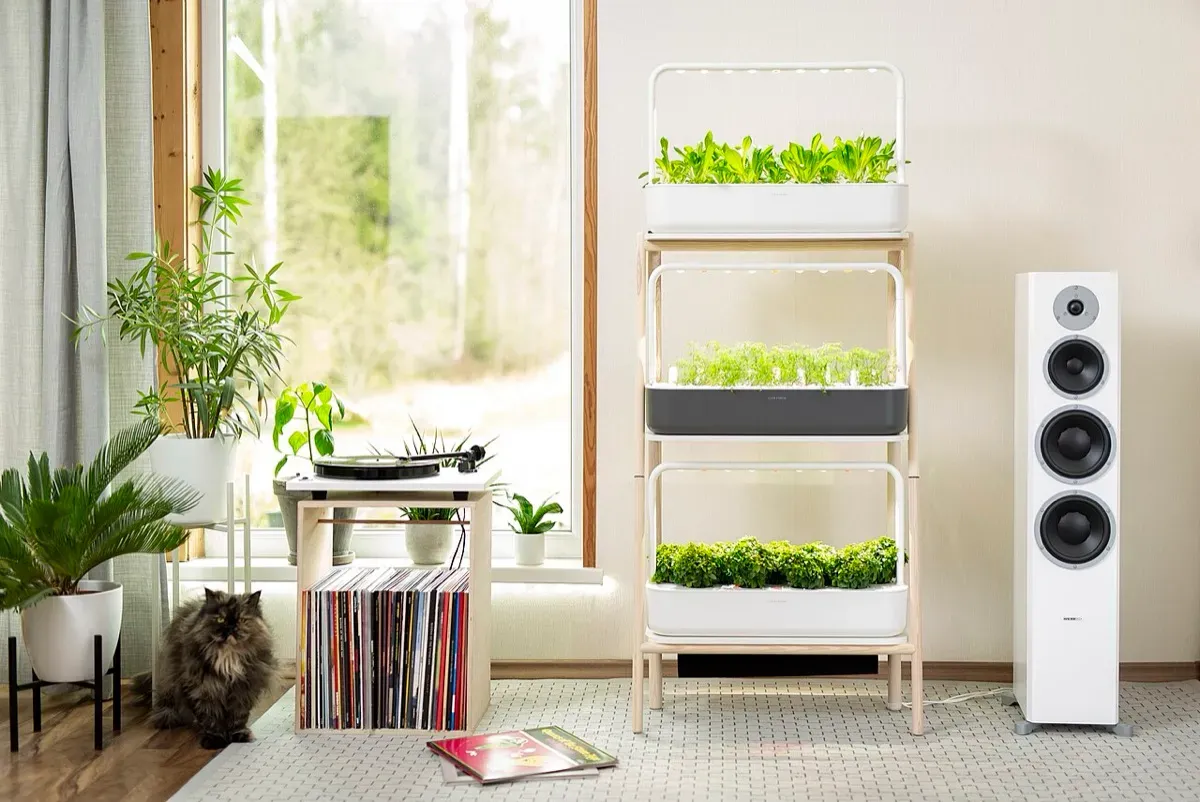
- “Click & Grow Smart Garden 27” by Janar Raidla, licensed under CC BY-SA 4.0 (https://creativecommons.org/licenses/by-sa/4.0), via Wikimedia Commons: https://commons.wikimedia.org/wiki/File:Click_%26_Grow_Smart_Garden_27.jpg