The problem
Europe’s first generation of nuclear sites is being taken apart. Sellafield in Cumbria, where decommissioning is described as the largest environmental restoration project in Europe, holds decades of radioactive waste in old buildings, ponds and silos. Dounreay in Scotland has cells that were sealed for decades. Fukushima Daiichi in Japan still holds melted fuel inside its damaged reactors.
Before anyone can plan to remove that waste, they need to know where the radiation is and how strong it is. Doses can be high enough to harm people or destroy ordinary electronics, access is often limited to small ports or narrow walkways, and conditions inside are frequently unknown.
The product
N-Visage is a gamma camera developed by Createc, founded in 2010 by Matt Mellor. It identifies radiation hot spots, even with complex and distributed sources, by measuring in all directions and mapping the data together in 3D.
According to Createc’s published specifications, the scanner captures a full 360° by 180° gamma image in as little as three hours, with an energy range of 30 keV to 2 MeV and a 12 megapixel camera. A laser point cloud with a range of 20 m builds the 3D model. It tolerates dose rates of up to 1 Sv per hour, fits through 90 mm ports and can work on an umbilical up to 125 m long, so it can be lowered into a contaminated space through existing service openings.
N-Visage Explore is a newer version for robots. Mounted on a four-legged Spot robot from Boston Dynamics, it maps gamma radiation in real time as the robot walks through a facility.
How it works
- Deploy. The scanner goes in through an existing port, or rides on a robot.
- Image. A gamma detector measures radiation arriving from every direction.
- Scan. A laser and camera build a 3D point cloud of the surroundings.
- Fuse. Software maps the gamma data onto the 3D model.
- Locate. Engineers see where the hot spots are and how strong they are.
- Plan. Teams use the map to plan safe entry, retrieval and waste sorting.
Timeline
| Date | Milestone |
|---|---|
| 2010 | Matt Mellor founds Createc |
| 2016 | Createc wins a contract to develop radiation sensors for Fukushima |
| 2020 | Createc starts working with Boston Dynamics |
| 2022 | Sellafield buys a Mk3 N-Visage to replace an obsolete Mk2 unit |
| 2023 | Paper on Createc’s radiation-hardened Fukushima gamma imager |
| 2025 | £3 million Sellafield framework for a quadruped robotic inspection platform; new Cockermouth headquarters |
| Aug 2026 | Createc becomes an authorised Boston Dynamics reseller with global nuclear authorisation |
Impact and numbers
N-Visage has made itself hard to replace at Sellafield. When the site’s Mk2 unit became obsolete, Sellafield directly awarded a contract for a Mk3 system without competition, stating that loss of gamma imaging could seriously affect its site characterisation work and that N-Visage was the only instrument meeting its requirements. The Mk3 supports retrievals, remediation and spent fuel management.
At Fukushima, Createc won a contract in 2016 to develop radiation sensors for Mitsubishi Heavy Industries. The resulting Fuel Finder package, described in a 2023 conference paper, combines a radiation-hardened 3D gamma imager with underwater and above-water 3D mapping to locate fuel debris inside the Unit 2 primary containment vessel. That map helps operators plan retrieval and sort fuel debris from other material.
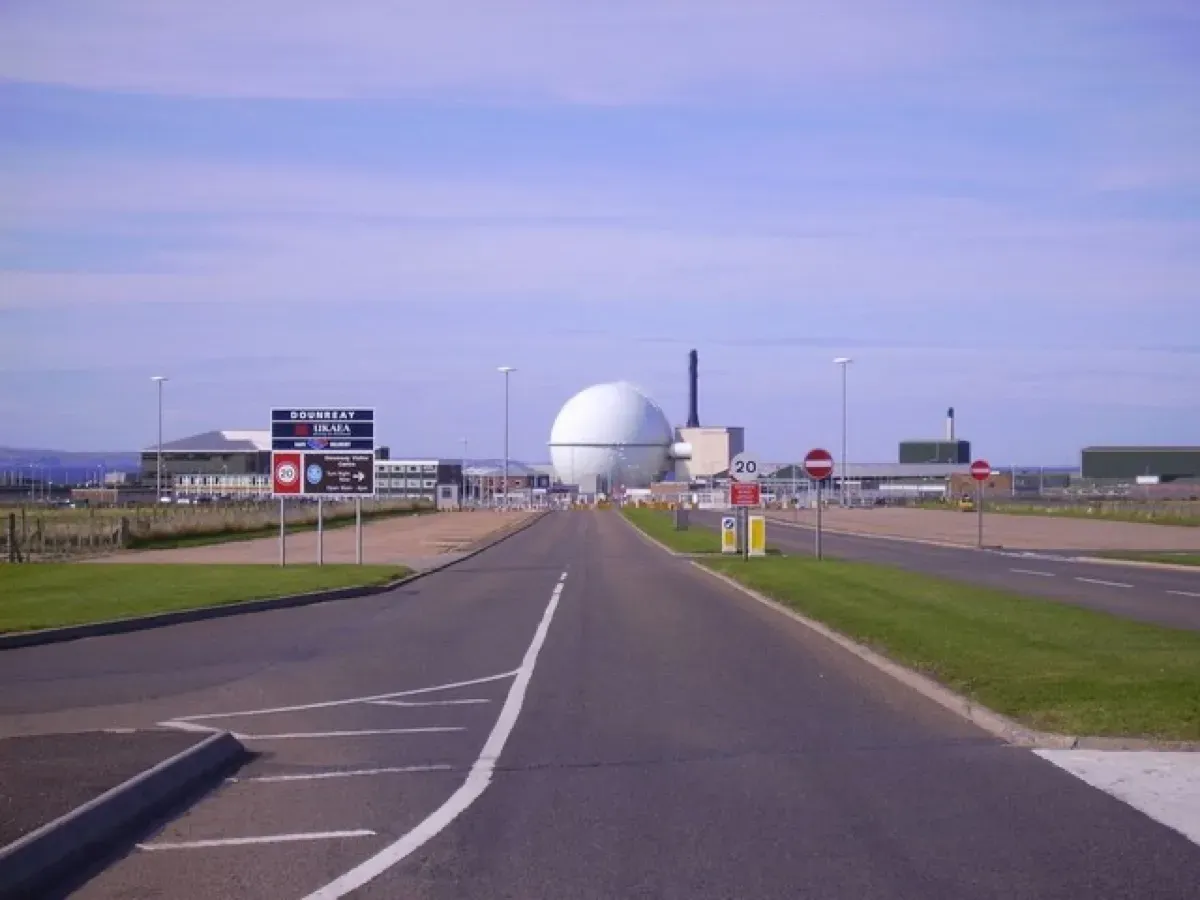
At Dounreay, a multi-floor processing cell had been sealed for over 25 years, and its exact dose rates were unknown. A Spot robot carrying N-Visage Explore climbed stairs across four floors, and Createc’s algorithms produced a 3D reconstruction of the radiation sources and dose planes, which proved valuable for decommissioning planning before people went in. Because concrete walls blocked ordinary radio, the team used a second Spot with an arm to place mesh radio relays, letting operators drive the robots beyond line of sight, collect swab samples and retrieve the relays at the end.
Demand keeps growing. In 2026, Sellafield tendered for a handheld radiation mapping system, a sign that 3D radiation mapping is moving from specialist robots into everyday kit for site workers.
Honest caveats
Small, private company. Createc employs around 70 people and does not publish financial results, so its finances cannot be checked.
Defence work. Createc’s 2026 Boston Dynamics agreement spans nuclear, defence, infrastructure and wider industry. This story covers only its nuclear clean-up work.
Dependence on partners. Much of its robotic work relies on another company’s robot, and its Fukushima work was delivered for a larger Japanese industrial group.
Slow work. A full gamma image can take hours, and decommissioning programmes run for decades, so the benefits of any single tool are spread over a very long time.
Nuclear divides opinion. Some readers see any nuclear work as a problem, but this product reduces risk from waste that already exists.
What’s next
Createc now represents Boston Dynamics across the UK industrial market and leads enterprise asset management work for Spot in the UK and Ireland, combining the robot with its own sensing and software for inspection in hazardous places. Chief executive Will Newsom says that as the industry faces new challenges in decommissioning and the transition to clean energy, there is a huge opportunity for innovation.
Why it matters for Europe and green buyers
For Europe, safe decommissioning is part of dealing honestly with the nuclear legacy, whether a country is phasing nuclear out or building new reactors. Better radiation maps mean fewer worker doses, less guesswork and better sorting of waste, which reduces the volume sent to expensive storage.
For India, which is expanding nuclear power and will one day decommission older plants, remote 3D radiation mapping is a proven tool to adopt early. For the world, Fukushima shows that the clean-up after an accident can take decades, and robots that see radiation make it safer.
Sources & image credits
- Emergency Services Show 2026, “Createc: N-Visage”. https://www.emergencyuk.com/exhibitor-products/createc-n-visage
- Find a Tender, “Mk 3 N-Visage Gamma Imaging system”, Sellafield Ltd, 2022. https://www.find-tender.service.gov.uk/Notice/036538-2022
- INIS (IAEA), “Radiation Hardened 3D Gamma Imager to Detect and Localise Fuel Debris at Unit 2 Fukushima Daiichi NPP”, 2023. https://inis.iaea.org/records/z5wg0-nd221
- GOV.UK, “Cumbria benefits from strong business links with Japan”, 2016. https://www.gov.uk/government/news/cumbria-benefits-from-strong-business-links-with-japan
- Uncrewed Systems, “Mapping a power plant”. https://www.uncrewed-systems.com/mapping-a-power-plant/
- Bdaily, “Createc strengthens nuclear team amid growth”, 28 Sep 2025. https://bdaily.co.uk/articles/2025/09/28/createc-strengthens-nuclear-team-amid-growth
- Bdaily, “Tech firm expands nuclear robotics partnership”, 4 Aug 2026. https://www.bdaily.co.uk/articles/2026/08/04/tech-firm-expands-nuclear-robotics-partnership
- Stotles, “Supply handheld radiation mapping system”, Sellafield Ltd tender, 2026. https://www.stotles.com/tenders/2026/W30/supply-handheld-radiation-mapping-system
- Wikimedia Commons, “Dounreay Fast Reactor”. https://commons.wikimedia.org/wiki/File:Dounreay_Fast_Reactor_-_geograph.org.uk_-_1937595.jpg
Images: “Dounreay Fast Reactor”, Jonathan Russell, 2006, CC BY-SA 2.0, via Wikimedia Commons (Geograph). Illustrative; does not show the product.