The problem
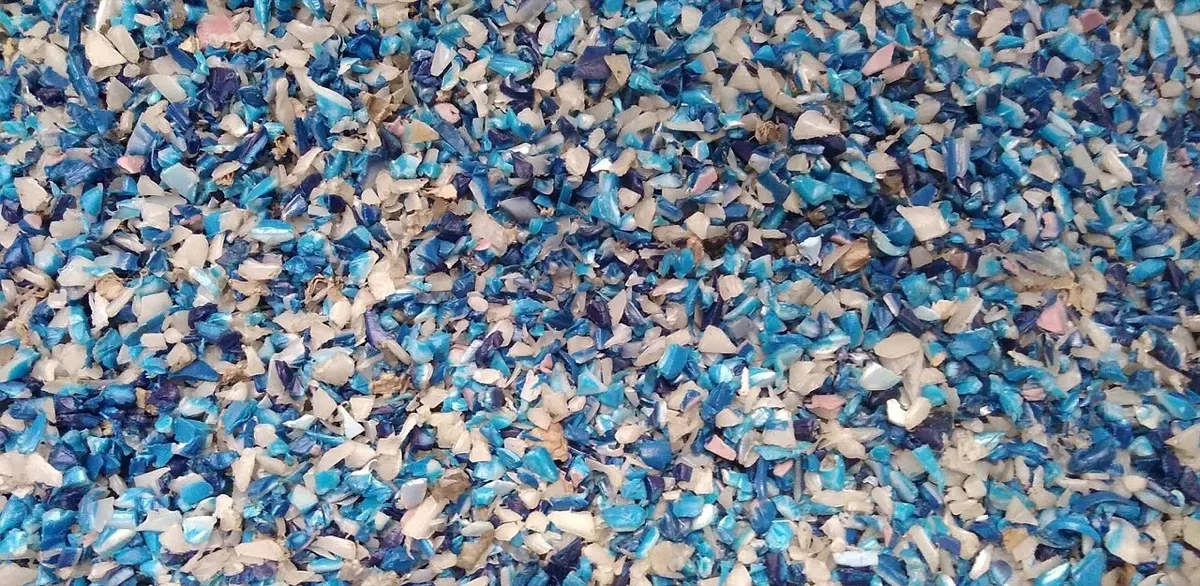
India’s plastic waste is collected mainly by informal waste pickers and scrap dealers, who sell it to small recycling units. Those units usually wash plastic in cold water and cannot remove labels, glue, ink and the smell of shampoo or detergent. The resulting grey or black granules are fine for pipes and buckets but cannot be used in new consumer packaging, so brands keep buying virgin plastic. That is “downcycling”: the material loses value at each step and soon ends in landfill.
India changed the rules in 2022. Under the Extended Producer Responsibility (EPR) guidelines notified on 16 February 2022, producers, importers and brand owners must meet recycling targets and use a rising share of recycled plastic in rigid packaging (PIB). For that, they need recycled plastic that is clean and consistent enough for new bottles.
The product
Banyan Nation sells Better Plastic, recycled high-density and low-density polyethylene granules (rHDPE and rLDPE) made from post-consumer packaging. The company says its 120,000 square foot plant uses a proprietary hot washing and deodorisation process that removes over 98% of contaminants, is water neutral, and holds REACH and CONEG certifications for chemical safety and heavy metals (Banyan Nation).
Its main uses are:
- Bottles: shampoo, detergent and cleaner bottles with 10% to 30% recycled content, for brands including Surf Excel, Comfort, Tresemme, Sunsilk, Harpic and Dettol.
- Tubes, closures and films: recycled LDPE and HDPE for laminated tubes, caps and film packaging.
Banyan says its resins are also used in fabric care and engine oil packs, and an earlier project turned painted car parts into recycled bumpers for Tata Motors. Beyond granules, it sells EPR and plastic credits, advisory services and recyclability assessments, so a brand can buy recycled resin and meet its legal obligations from one supplier. Testimonials on its site come from Reckitt, Marico, Wipro and Tata Motors (Banyan Nation).
How it works
- Collection: more than 10,000 informal waste workers and aggregators sell sorted plastic to Banyan, tracked through its own data intelligence platform across 1,000+ postcodes. Banyan says this gives it a view of informal collection networks in hundreds of Indian cities and towns, and lets it trace material from collection to recycling.
- Sorting: bottles are sorted by polymer and colour.
- Washing: shredded flakes are hot washed and deodorised to remove labels, adhesives, residues and odour.
- Granulating: flakes are melted, filtered and turned into uniform granules, tested batch by batch.
- Closed loop: brands use the granules to blow new bottles, closing the loop from used bottle to new bottle.
Timeline
| Date | Milestone |
|---|---|
| 2013 | Banyan Nation registered in India after incubation at Columbia Business School |
| 2017 | Cleaning breakthrough removes paint from auto parts; Tata Motors bumpers made from recycled plastic |
| 2018 | First Indian company to win at The Circulars (People’s Choice) at the World Economic Forum in Davos |
| 2019 | Multi-year deals with Unilever and Reckitt; Series A for the Hyderabad plant |
| 16 Feb 2022 | India notifies EPR guidelines for plastic packaging |
| 29 Nov 2024 | Plan to invest INR 200 crore in Telangana and triple capacity to 45,000 tonnes |
| 26 Aug 2025 | US DFC foreign-currency loan for a new 12,000-tonne Karnataka plant |
| 27 Jan 2026 | Registered as a Category 2 (flexible) plastic waste processor |
| 2026 | Wins the Plastics Recycling Company category at the PRS India Awards |
Impact and numbers
- Bottles: “3+ billion” bottles recycled, according to the company’s website, up from earlier claims of 1 billion and then 1.5 billion.
- Capacity: the Pasamailaram plant near Patancheru, Telangana, processes about 15,000 tonnes a year; the planned INR 200 crore investment would lift this to 45,000 tonnes and create about 500 jobs. Turnover was about INR 100 crore and the company said it was profitable (The Hans India).
- New plant: the US International Development Finance Corporation (DFC) is lending to build a 12,000-tonne-a-year plant in Karnataka (Bar & Bench).
- Target: 50,000 tonnes a year by 2028 (Banyan Nation).
Honest caveats. Banyan Nation’s figures are mostly self-reported, and its “3 billion bottles” counter is not independently audited. The company earlier aimed for 50,000 tonnes a year by 2025; that has moved to 2028, and actual output is a fraction of India’s plastic waste. Bottle-to-bottle recycling of HDPE in India still means 10% to 30% recycled content, not fully recycled packs. Relying on informal waste pickers raises questions about fair pay and safe working conditions that the company describes but that outsiders cannot easily check. More broadly, India’s EPR market has been hit by fraud: a Centre for Science and Environment report in 2024 found about 700,000 fake EPR certificates and INR 355 crore in fines (Down To Earth), which makes traceable material more valuable but also shows how weak enforcement can be.
What’s next
In January 2026 Banyan registered as a Category 2 processor, which allows it to recycle flexible plastics such as films and pouches as well as rigid bottles (Banyan Nation on LinkedIn). The Karnataka plant and the Telangana expansion are its main growth steps.
Why it matters for Europe / green buyers
Europe’s Packaging and Packaging Waste Regulation sets minimum recycled content for plastic packaging from 2030, and European recyclers already struggle to produce enough food-grade and cosmetic-grade recycled polyolefins. Banyan Nation is an Indian example of what high-quality HDPE recycling can look like when it is linked to informal collection, and global brands with operations in both regions use it. For green buyers, the lesson is to ask suppliers for the source, percentage and certification of recycled content, not just a “recyclable” label.
For India, Banyan matters most at home. Under the EPR rules, rigid plastic packaging must contain at least 30% recycled content from 2025-26, rising to 60% from 2028-29 (Wealthy Waste summary of G.S.R. 133(E)), and recycling targets climb to 60% to 80% from 2027-28 (PIB). Brands will need far more clean recycled HDPE than India produces today.
Sources & image credits
- Banyan Nation, homepage: https://www.banyannation.com/
- Banyan Nation, “About us”: https://www.banyannation.com/about-us/
- Banyan Nation, “Better Plastic granules”: https://www.banyannation.com/plastic-granule/
- Banyan Nation, “Awards and recognitions”: https://www.banyannation.com/awards-recognitions/
- The Hans India, “Banyan Nation to invest Rs 200 cr in TG”, 29 November 2024: https://www.thehansindia.com/telangana/banyan-nation-to-invest-rs-200-cr-in-tg-925505
- Bar & Bench, “TT&A, Wadia Ghandy, US firms act on Banyan Nation securing foreign currency loan from DFC”, 26 August 2025: https://www.barandbench.com/dealstreet/tta-wadia-ghandy-us-firms-act-on-banyan-nation-securing-foreign-currency-loan-from-dfc
- Banyan Nation on LinkedIn, Category 2 registration, January 2026: https://www.linkedin.com/posts/banyan-nation_eprcompliance-sustainability-category2-activity-7421784707077398528-SQhn
- Press Information Bureau, Government of India, EPR guidelines for plastic packaging, 13 February 2023: https://www.pib.gov.in/PressReleaseIframePage.aspx?PRID=1898892&lang=2®=3
- Down To Earth, “7 lakh fake certificates, major polluters missing: CSE report”, 29 October 2024: https://www.downtoearth.org.in/waste/70k-fake-certificates-major-polluters-missing-misuse-of-epr-legislation-worsening-indias-plastic-problem-shows-cse-report
- Wealthy Waste, “Guidelines for the implementation of Extended Producers Responsibility for Plastic Packaging” (summary of G.S.R. 133(E), 16 February 2022), 29 July 2022: https://www.wealthywaste.com/guidelines-for-the-implementation-of-extended-producers-responsibility-for-plastic-packaging
Images:
- “Clean HDPE drum flakes” by Soddaa, 2020, licensed under CC BY-SA 4.0 (https://creativecommons.org/licenses/by-sa/4.0), via Wikimedia Commons: https://commons.wikimedia.org/wiki/File:Clean-HDPE-drum-flakes.jpg