The problem
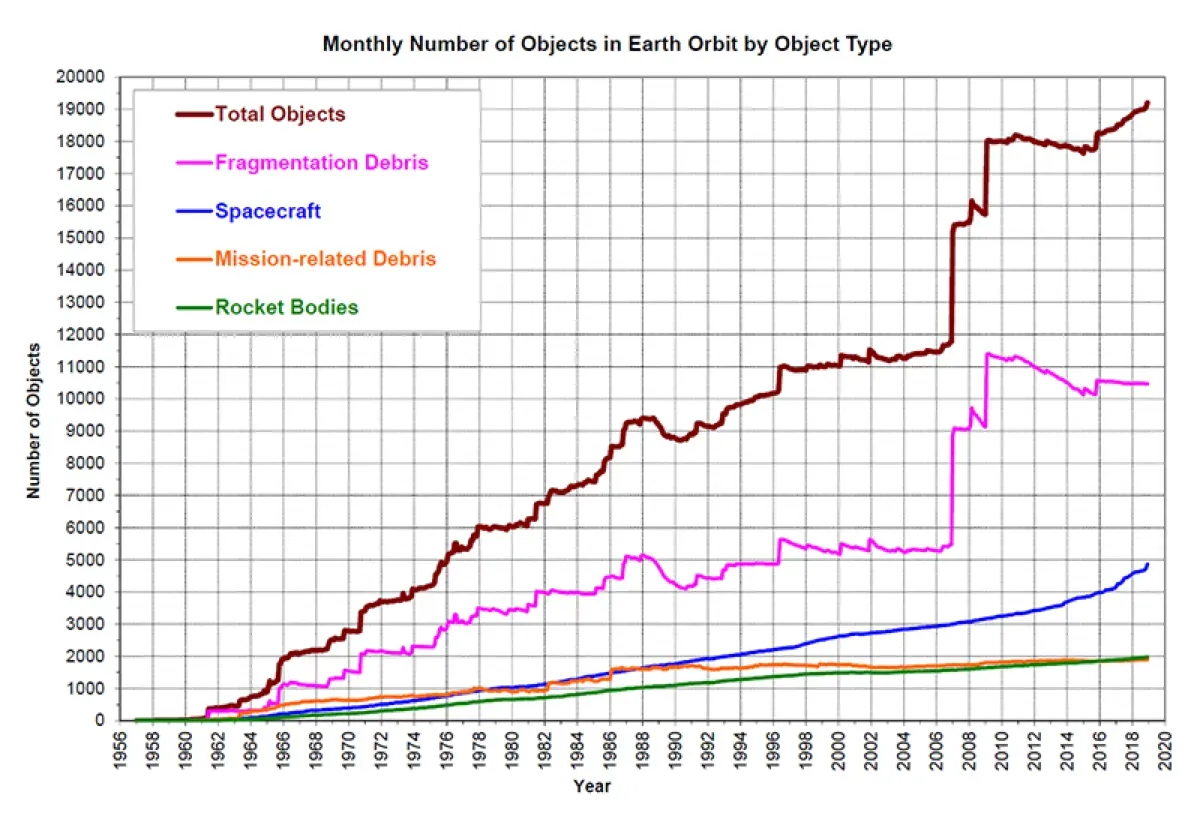
ESA’s 2026 Space Environment Report says the long-term sustainability of space activities got an order of magnitude worse in just one year. More than 300 launches put over 4,000 new payloads into orbit in 2025. ESA concludes that good design and end-of-life disposal remain essential, but that “prevention alone is no longer enough” and active debris removal must become part of the solution soon.
The hardest cases are satellites that fail before they can lower themselves, and old rocket stages left in orbit decades ago. Neither can move. Without removal, ESA warns, collisions will create fragments that cause further collisions.
The product
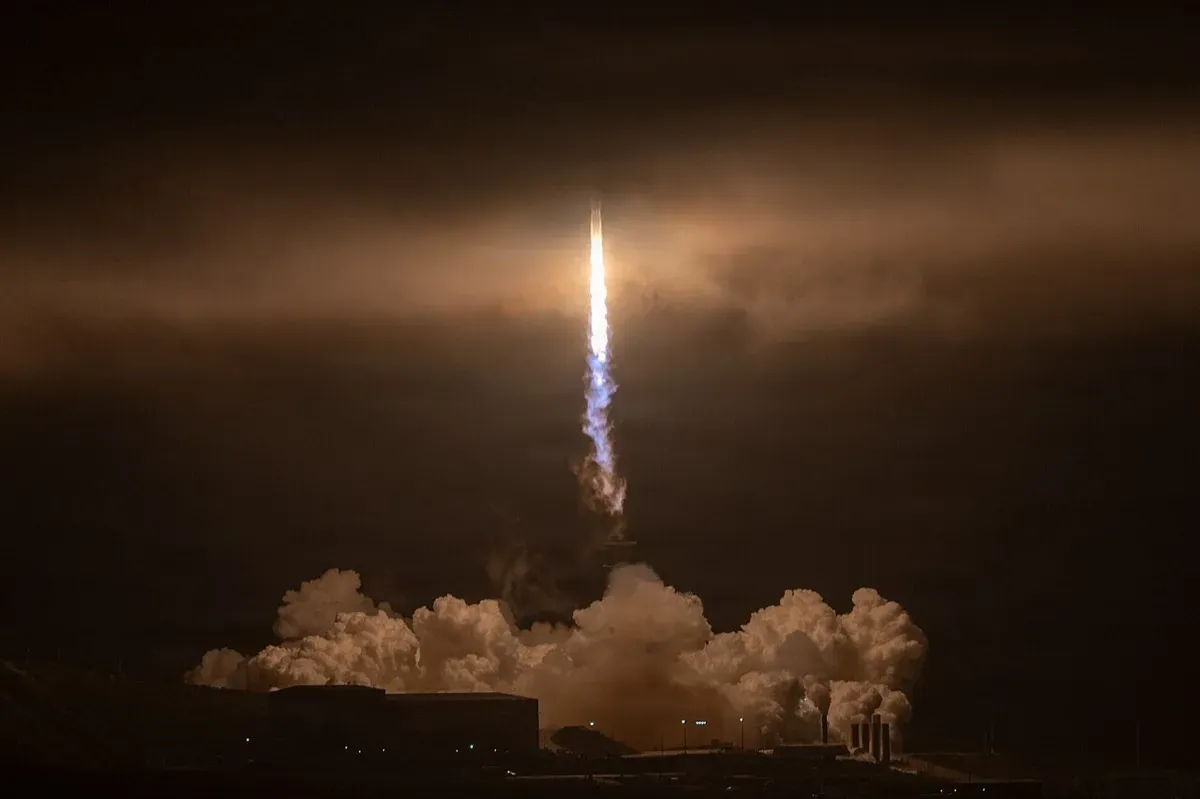
ELSA-d, short for End-of-Life Services by Astroscale demonstration, was the world’s first commercial mission to prove the core technologies for docking with and removing debris, according to Astroscale. It consisted of two spacecraft launched together from Baikonur in Kazakhstan in March 2021: a servicer with rendezvous sensors and a magnetic docking mechanism, and a client acting as replica debris. The UK Space Agency licensed the mission.
In orbit, the servicer released the client and recaptured it magnetically. It went on to track the client from a great distance, navigate from about 1,600 km away to within 160 metres, and switch from GPS-based navigation to its own sensors. After more than two years of operations, the servicer used its remaining thrusters to lower its orbit in a final controlled phase.
ELSA-M is the commercial follow-on. Astroscale’s UK subsidiary will fly a 520 kg servicer to capture and remove an end-of-life Eutelsat OneWeb satellite fitted with a docking plate. On 12 March 2026 it signed a contract with German launcher Isar Aerospace to fly ELSA-M on the Spectrum rocket, in or after the April 2028 period.
How it works
- Prepare. Satellites are fitted before launch with a docking plate for later capture.
- Launch. A servicer is launched towards the orbit of a retired satellite.
- Approach. It navigates using GPS and ground data, then its own sensors.
- Inspect. It holds position nearby, checking the target’s tumble and condition.
- Capture. A magnetic mechanism docks with the target’s plate.
- Remove. The servicer lowers both into a lower orbit so they burn up on re-entry.
Timeline
| Date | Milestone |
|---|---|
| Mar 2021 | ELSA-d servicer and client launched from Baikonur |
| 2021 | Repeated magnetic capture demonstrated |
| 2022 | Autonomous capture attempt halted after anomaly; four of eight thrusters lost |
| 2024 | ADRAS-J inspects a Japanese rocket upper stage at 15 metres |
| Jan 2024 | ELSA-d final de-orbit operations complete |
| 12 Mar 2026 | ELSA-M launch contract signed with Isar Aerospace |
| 1 Sep 2026 | ADRAS-J2 launch contract with Isar, for Japan’s fiscal year 2027 |
| Apr 2028 or later | Planned ELSA-M launch period |
Impact and numbers
ELSA-d’s final orbit shows the principle in action. Astroscale says the servicer, at around 500 km, will re-enter and burn up in about 3.5 years, well within the 25-year guideline then in common use. The client, which cannot manoeuvre, is predicted to de-orbit naturally within five years.
ELSA-M is supported by the UK Space Agency through ESA’s ARTES programme, as part of the Sunrise partnership with Eutelsat, but most of the mission is self-funded by Astroscale. The company’s stock exchange filing puts the ELSA-M Phase 4 contract value at €13.95 million.
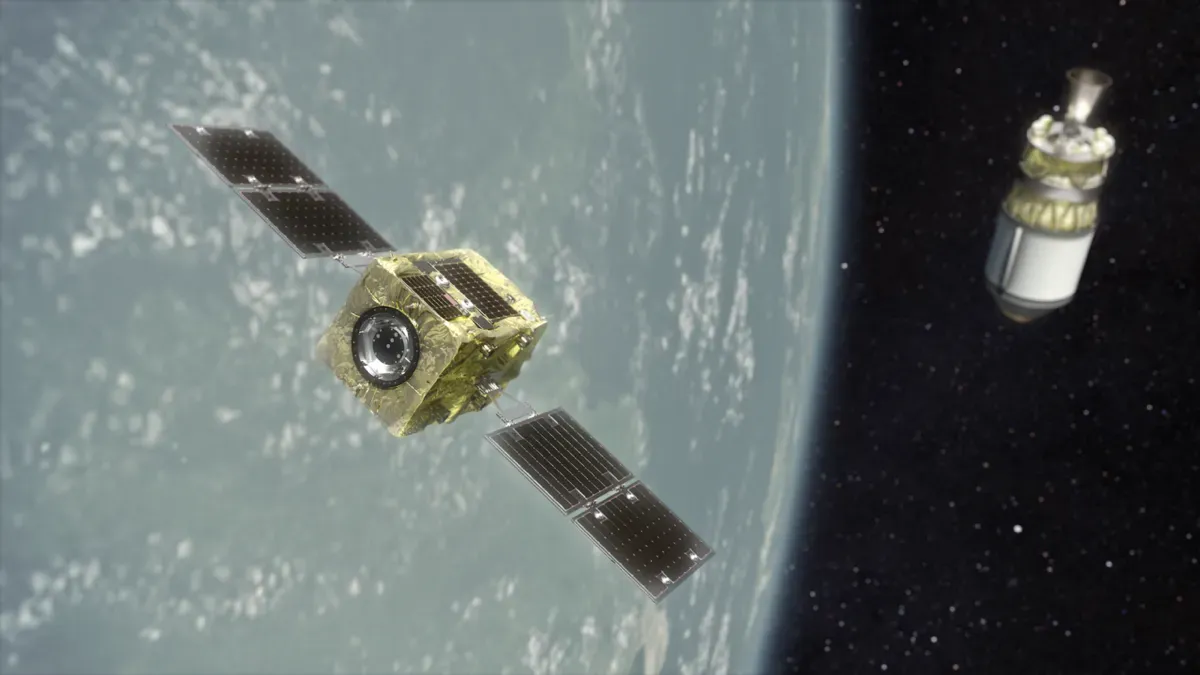
The wider group is scaling. In 2024, its ADRAS-J mission became the first commercial spacecraft to rendezvous with and closely inspect a large piece of existing debris, a Japanese rocket upper stage, flying around it at 50 metres and approaching to 15 metres. Its successor, ADRAS-J2, aims to capture and remove that roughly 3 tonne, 11 metre stage using a robotic arm. TipRanks reported that revenue rose 141.8% to ¥5.94 billion in the year to April 2026.
Honest caveats
Not everything worked. During ELSA-d’s autonomous capture demonstration, the servicer held position for over seven hours, but the team called off the capture after detecting anomalous conditions. The servicer then lost the use of four of its eight thrusters. Astroscale still calls the mission a success, and it did complete further close approaches.
Removal is still a demonstration. No commercial satellite removal has yet been completed. ELSA-M will not launch before the April 2028 period, and it depends on Isar Aerospace’s new Spectrum rocket.
Still loss-making. Astroscale posted a corrected operating loss of ¥9.98 billion and a net loss of ¥7.11 billion for the year to April 2026, after correcting its tax accounting. Its project income includes government subsidies as well as customer revenue.
Removal tools are dual-use. A spacecraft that can approach and grab another satellite could, in principle, be used against one. Clear international rules and transparency are needed.
Launch history. ELSA-d launched in 2021 on a Russian launch service from Baikonur, contracted through Glavkosmos, before Russia’s full-scale invasion of Ukraine reshaped European space cooperation.
What’s next
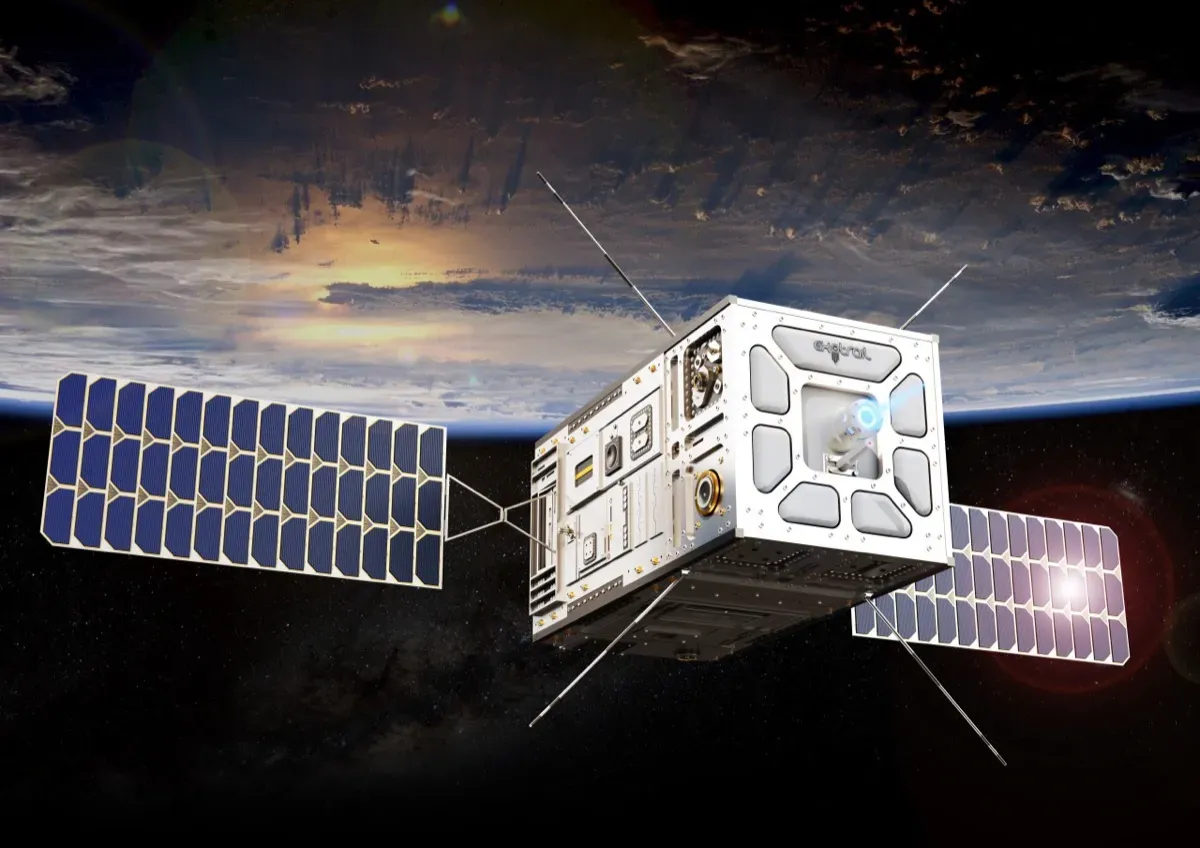
Astroscale UK is preparing ELSA-M for launch from Europe. Astroscale France is working with French start-up Exotrail on a France 2030 de-orbiting demonstration with Eutelsat, with a first mission planned before 2030. In Japan, ADRAS-J2 is in assembly for launch in fiscal year 2027.
Why it matters for Europe and green buyers
For Europe, ELSA-M brings debris removal close to home: a UK-led servicer, backed by ESA and the UK Space Agency, removing a satellite from a European operator and launched by a German rocket. Satellite operators can fit docking plates now so that failed spacecraft can be fetched later, and public buyers can require them.
For India, the lesson is to plan for removal from the start. Astroscale has not announced Indian missions in the sources reviewed, but India’s fast-growing satellite fleet will face the same rules on safe disposal. For the world, removal services turn space sustainability from a promise into an enforceable service.
Sources & image credits
- Astroscale, “ELSA-d Mission”. https://www.astroscale.com/en/missions/elsa-d
- Astroscale, “Astroscale’s ELSA-d Finalizes De-Orbit Operations Marking Successful Mission Conclusion”, Jan 2024. https://www.astroscale.com/en/news/astroscales-elsa-d-finalizes-de-orbit-operations-marking-successful-mission-conclusion
- Astroscale, “Astroscale Selects Isar Aerospace to Launch ELSA-M In-Orbit Demonstration Mission”, Mar 2026. https://www.astroscale.com/en/news/astroscale-selects-isar-aerospace-to-launch-elsa-m-in-orbit-demonstration
- Astroscale Holdings via BigGo Finance, “Announcement Regarding Launch Contract with Isar Aerospace by UK Consolidated Subsidiary”, 12 Mar 2026. https://finance.biggo.com/news/jpx_tdnet_140120260312580942
- Astroscale, “Astroscale Japan Selects Isar Aerospace to Launch ADRAS-J2”, 1 Sep 2026. https://www.astroscale.com/en/news/astroscale-japan-selects-isar-aerospace-to-launch-adras-j2
- TipRanks, “Astroscale Corrects Tax-Related Accounting as Losses Narrow and Equity Improves”, 2026. https://www.tipranks.com/news/company-announcements/astroscale-corrects-tax-related-accounting-as-losses-narrow-and-equity-improves
- ESA, “ESA Space Environment Report 2026”. https://www.esa.int/Space_Safety/Space_Debris/ESA_Space_Environment_Report_2026
- Exotrail, “Exotrail and Astroscale France join forces to build deorbiting capability”, 2026. https://www.exotrail.com/blog/exotrail-and-astroscale-france-join-forces-to-build-deorbiting-capability-aimed-at-satellites-in-low-earth-orbit
- Wikimedia Commons, “ADRAS-J Phase I”. https://commons.wikimedia.org/wiki/File:ADRAS-J_Phase_I.png
Images: “ADRAS-J Phase I”, Astroscale, CC BY-SA 4.0, via Wikimedia Commons. Illustrative artwork of a sister mission, not ELSA-d or ELSA-M.