The problem
Paving a field for homes, roads or a warehouse turns soil that once absorbed rain into hard surfaces that shed it. In heavy storms, the runoff overloads sewers and streams, floods streets and triggers combined sewer overflows, where diluted sewage spills into rivers. Climate change is making short, intense downpours more frequent across Europe.
Planners respond by limiting how fast a new development may discharge rainwater, often to the rate the green field used to release. The extra water has to be stored somewhere on site. On dense plots there is rarely room for a pond or a swale, so engineers put the storage underground.
The product
Wavin Q-Bic Plus Low Carbon is a modular plastic crate system for that underground storage. The units can form an attenuation tank, which holds water and releases it at a controlled rate, or a soakaway, which lets it infiltrate into the ground (Wavin). Key data from the datasheet (Wavin datasheet):
- unit size 1200 x 600 x 600 mm; gross volume 454 litres, or 432 litres without the base;
- void ratio 95 to 96%;
- main unit weight 15.7 kg (Wavin Italia quotes 14 kg for the base unit);
- pipe connections from 160 to 500 mm and shaft connections from 315 to 600 mm;
- cover depth of 0.5 to 4.5 m under a 6-tonne wheel load, calculated to the draft EN 17152-4;
- a 370 mm wide inspection channel, vertical access of 350 x 240 mm and 77% of the tank area reachable for inspection;
- material: recycled polypropylene, in black.
Integrated push-fit connectors replace clips and pins, and tanks can be built in single or multiple layers from 0.6 to 3.6 m high, in rectangular, L or H shapes (Edilportale). A verified Dutch environmental profile for the Low Carbon unit, made at Wavin’s Hardenberg plant, was issued in March 2024 (Wavin environmental profile).
How it works
- Pre-treat: runoff passes through gullies, filters or a sediment separator to remove silt and oil.
- Store: water flows through pipes into the crate tank, wrapped in a geotextile (soakaway) or an impermeable membrane (attenuation).
- Release or infiltrate: a flow control chamber lets water out at the permitted rate, or it seeps into permeable ground.
- Inspect: CCTV cameras and jetting hoses enter through the shafts and internal channels.
- Recover: the tank empties before the next storm, ready to take the next peak.
In July 2026 Wavin added the Certaro Lamella HDS, a sediment separator in a DN1000 manhole that removes up to 80% of suspended solids from catchments up to 6,000 m², to protect tanks like Q-Bic from silting up (Water Magazine).
Timeline
| Date | Milestone |
|---|---|
| 19 Mar 2024 | Verified Dutch environmental profile for Q-Bic Plus LC (Hardenberg) |
| 16 Apr 2025 | Wavin Italia launches Q-Bic Plus LC |
| Jun 2025 | England publishes new, non-statutory national SuDS standards |
| 27 Jul 2026 | Wavin launches the Certaro Lamella HDS sediment separator |
| 31 Dec 2033 | EU deadline for integrated urban wastewater management plans in large cities |
Impact and numbers
- Storage per unit: about 0.43 to 0.45 m³ of water in a block that weighs about 15 kg.
- Logistics: up to about 138 m³ of tank volume per truck, according to the datasheet.
- Carbon: an 80% CO2 reduction compared with traditional attenuation tanks made from virgin fossil plastic, according to Wavin Italia.
- Treatment: up to 80% suspended solids removal by the companion separator.
Honest caveats. The 80% CO2 figure is Wavin’s claim; the basis (which competitor tanks, which life-cycle stages) is not stated in the launch material, and the environmental profile figures were not extracted cleanly here. The datasheet lists certification as “EN17152; Certificates pending”, so buyers should check which approvals apply in their country. Wavin’s own figures differ slightly: 15.7 kg against 14 kg unit weight, and 77% against 70% of the tank reachable for inspection. Recycled plastic is still plastic in the ground, and the long-term creep of recycled PP under load depends on resin quality. Crates do nothing for heat, biodiversity or amenity, so they score poorly on the four pillars of SuDS compared with swales, rain gardens or green roofs. Soakaways only work where soils drain and groundwater is deep enough, and silt can clog tanks if pre-treatment is not maintained.
What’s next
The recast Urban Wastewater Treatment Directive, Directive (EU) 2024/3019, requires integrated urban wastewater management plans for cities of 100,000 population equivalent or more by the end of 2033, and for at-risk towns of 10,000 to 100,000 by the end of 2039. These plans must prioritise green and blue infrastructure and use grey solutions only where needed, with an indicative goal of keeping overflows below 2% of annual dry-weather load (EUR-Lex). Expect underground storage like Q-Bic to be specified alongside, rather than instead of, nature-based measures, and with more emphasis on treatment and smart outlets.
Why it matters for Europe / green buyers
In England, the government updated its national standards for sustainable drainage in June 2025 but still has not made SuDS mandatory by commencing Schedule 3 of the Flood and Water Management Act, which Wales applies; even Wavin called the new standards non-statutory guidance that must not replace legislation (New Civil Engineer). For buyers, the points to check are the soil infiltration test, groundwater level, the design storm and discharge limit, load class, inspection access and recycled content certificates.
In India, Bengaluru’s floods in May 2025, when 105.5 mm of rain fell in one morning, showed what happens when runoff has nowhere to go. The city’s response was a Rs 1,600 crore World Bank loan to link 173.9 km of unconnected stormwater drains (The New Indian Express). Bigger drains move water faster, but on-site storage under plots, campuses and car parks would slow it down at source and, as soakaways, could also recharge the city’s depleted aquifers.
Sources & image credits
- Wavin, “Launch of Wavin Q-Bic Plus Low Carbon”: https://wavin.com/global/en/news-and-cases/Q-Bic_Plus_Low_Carbon
- Wavin, Q-Bic Plus Low Carbon product datasheet: https://mediahub.wavin.com/asset/4a47521a-45be-4349-b5c3-423add2d655d/Wavin_Q-Bic-Plus-LC_datasheet-English.pdf
- Edilportale, “Wavin presenta Q-Bic Plus Low Carbon” (16 Apr 2025): https://www.edilportale.com/news/2025/04/aziende/wavin-presenta-q-bic-plus-low-carbon_104713_5.html
- Wavin, verified environmental profile, Q-Bic Plus LC infiltration unit, Hardenberg (19 Mar 2024): https://mediahub.wavin.com/m/63a7f9dbde92209c/original/Wavin_-_NL_-_Hardenberg_-_Verified-3094653_-_Q-Bic_Plus_LC_Infiltration_Unit_BK-2020-environmental-profile_2024-03-19_1326.pdf
- Water Magazine, “Wavin launches new sediment separator to improve water quality” (27 Jul 2026): https://www.watermagazine.co.uk/2026/07/27/wavin-launches-new-sediment-separator-to-improve-water-quality/
- EUR-Lex, Directive (EU) 2024/3019 concerning urban wastewater treatment (recast): https://eur-lex.europa.eu/eli/dir/2024/3019/oj/eng
- New Civil Engineer, “Experts ‘disappointed’ drainage regulation update still does not make SuDS mandatory” (23 Jun 2025): https://www.newcivilengineer.com/latest/experts-disappointed-drainage-regulation-update-still-does-not-make-suds-mandatory-23-06-2025/
- The New Indian Express, “SWD project: BBMP secures Rs 1,600 crore World Bank loan” (23 May 2025): https://www.newindianexpress.com/cities/bengaluru/2025/May/23/swd-project-bbmp-secures-d1600-crore-world-bank-loan
Images:
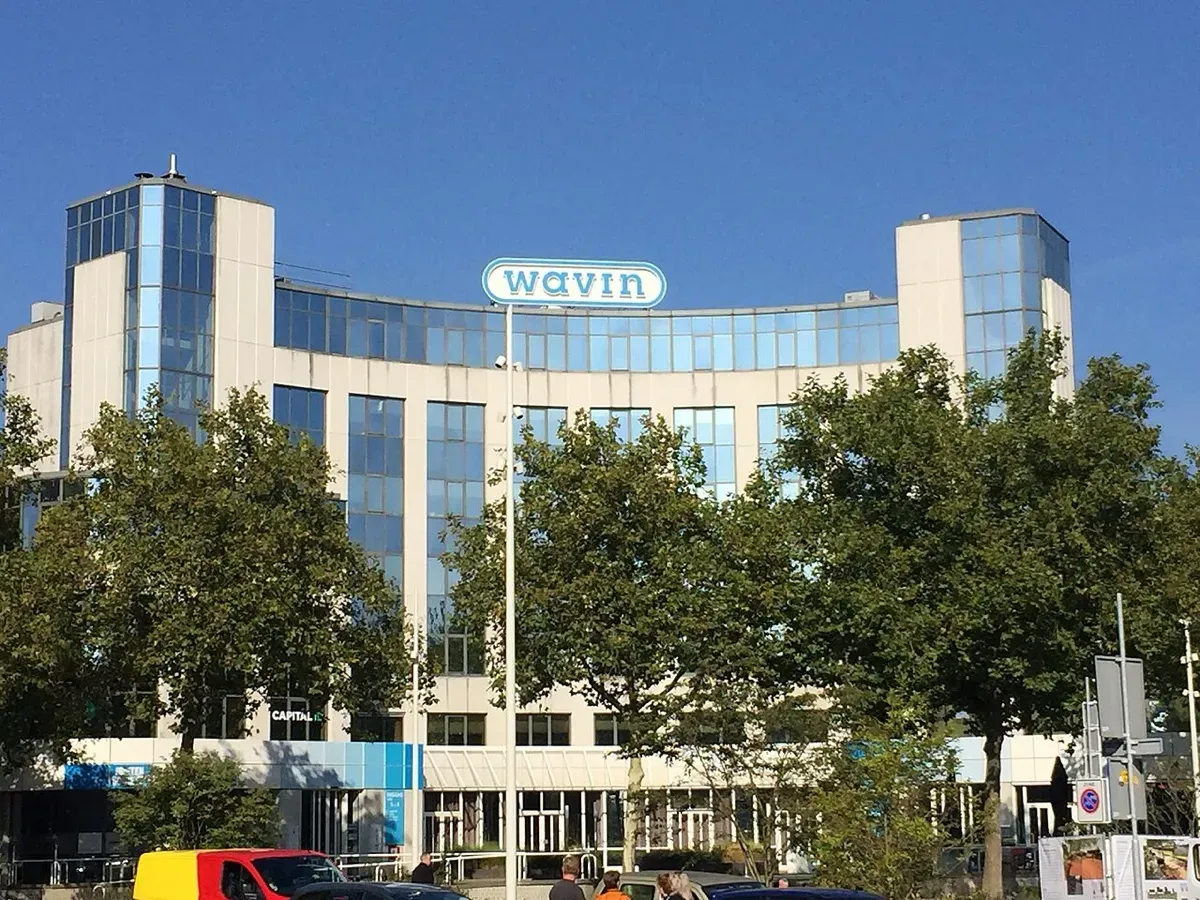
- “WavinZwolle2021” by Vysotsky, licensed under CC BY-SA 4.0 (https://creativecommons.org/licenses/by-sa/4.0), via Wikimedia Commons: https://commons.wikimedia.org/wiki/File:WavinZwolle2021.jpg