The problem
Floors are replaced far more often than walls or structures. Offices, shops, schools and hospitals renew vinyl and carpet every few years, and every installation leaves off-cuts. Most of this material has gone to landfill or incineration, because collecting it from thousands of building sites, separating it by type and cleaning out glue and screed is harder than buying new raw material.
Vinyl adds a chemical complication. Older PVC floors often contain ortho-phthalate plasticisers that are now restricted, so recycling them blindly could carry legacy substances into new products. Carpet tiles mix yarn, backing and adhesives in ways that are hard to separate.
The product
ReStart is Tarkett’s answer: a take-back and recycling service that customers sign up to, launched globally in 2010 after first steps in North America and Sweden (Tarkett sustainability magazine). It is offered in around 30 countries, including most of Europe, the US, Brazil, Australia, Malaysia and India (Tarkett 2025 Sustainability Statement).
The physical system has three parts:
- Collection kit: ReStart big bags for vinyl and linoleum off-cuts and pallets for stacking used carpet tiles. Since 2024, the European bags contain 30% pre-consumer recycled material and carry a QR code with instructions.
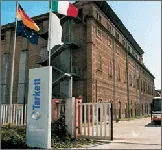
- Recycling centres: eight in-house plants: Ronneby (Sweden), Clervaux (Luxembourg), Waalwijk (Netherlands), Narni (Italy), Jaslo (Poland), Dalton (US), Otradny (Russia) and Jacareí (Brazil). Clervaux and Ronneby hold EuCertPlast certification for recycling post-consumer vinyl flooring.
- Certificates: customers receive documentation of the tonnage they returned, which helps with green building labels and tender requirements (Tarkett UK).
Tarkett has added a reuse option: in France, the Nordics, Benelux and the UK it can clean and resell used carpet tiles that are still in good condition.
How it works
- Enrol: the customer, contractor or flooring dealer signs a ReStart agreement.
- Fill: installers put clean off-cuts into big bags, or stack lifted carpet tiles on pallets.
- Collect: a local waste partner picks up the material when booked.
- Check and sort: material is inspected at the recycling centre. For vinyl, Tarkett currently takes post-consumer homogeneous flooring installed since 2011, to avoid legacy plasticisers.
- Recycle: the material is ground and reprocessed into raw material, such as the recycled backing used on several European vinyl lines.
- Report: Tarkett issues quarterly or project certificates of the returned weight.
Timeline
| Date | Milestone |
|---|---|
| 1990s | First collection of off-cuts in North America and Sweden |
| 2010 | ReStart launched as a global programme |
| 2020 | First take-back of used flooring from an IKEA store (Stockholm) |
| 2022 to 2025 | Yearly collection rises from 3,000 t to 4,100 t, 5,000 t and 5,200 t |
| 2024 | New European cost set-up and QR-coded big bags |
| End 2025 | 129,000 t collected since 2010; programme in around 30 countries |
Impact and numbers
- Volume: over 129,000 tonnes collected from 2010 to 2025, and 5,200 tonnes in 2025 (Tarkett 2025 key figures).
- Recycled content: close to 160,000 tonnes of recycled materials, about 20% of Tarkett’s raw materials in 2025, against a 2030 goal of 30%. This total includes factory scrap and other secondary materials, not only ReStart returns.
- Emissions: Tarkett reports that its scope 1, 2 and 3 emissions were 27% lower in 2025 than in 2019.
- IKEA: more than 250 tonnes (86,000 m²) collected in over 50 take-backs from IKEA stores in 14 European countries since 2020, avoiding about 1,000 tonnes of CO2.
- Nordics: a record 1,071 tonnes collected in 2025, which Tarkett equates to 2,923 tonnes of CO2 saved (Mal Proff).
- Reuse: on one Paris-area office renovation, 7,000 m² of 9,000 m² of old carpet went for resale rather than recycling.
Honest caveats. The carbon savings are Tarkett’s own calculations, compared with an incineration scenario. Figures vary between Tarkett pages: the UK site still cites nine recycling centres and 109,000 tonnes up to 2020, while the 2025 statement lists eight centres; the 2026 magazine says 29 countries and the statement “around 30”. The recycled share of raw materials includes much more than ReStart returns, so it should not be read as the take-back rate. Old vinyl laid before 2011 is excluded, which leaves a large legacy stock with no closed loop. Products labelled phthalate-free contain no added ortho-phthalates in virgin material, but Tarkett notes that recycled content may contain residual amounts. The UK page says Tarkett will take competitors’ carpet, while Tarkett Norway says it will now focus on its own floors because volumes have grown. One recycling centre and a small amount of vinyl production are still in Russia.
What’s next
Tarkett expects post-use vinyl floors, rather than installation off-cuts, to become the largest source of ReStart material within a few years, as floors laid after 2011 reach the end of their life. In France, the 2020 anti-waste law requires building product makers to organise end-of-life collection, which turns take-back from a voluntary service into a compliance tool. Watch for wider reuse of carpet tiles and for more demand for ReStart certificates in public tenders.
Why it matters for Europe / green buyers
The EU Waste Framework Directive set a target of recovering at least 70% by weight of non-hazardous construction and demolition waste by 2020 (EUR-Lex), and contractors increasingly have to show site waste plans in tenders. A manufacturer-run take-back is one of the few routes that returns flooring to the same product rather than downcycling it. For buyers, the practical steps are to sign up before installation, keep off-cuts clean and separated by type, ask for the tonnage certificate, and check whether used carpet tiles can be resold rather than recycled.
ReStart is listed as available in India, where commercial interiors in Bengaluru, Mumbai, Pune and the NCR use large volumes of vinyl and carpet tiles. India’s new Construction and Demolition Waste Management Rules, 2025, in force from 1 April 2026, push bulk waste generators towards recovery and recycled content (MPCB copy of the Gazette notification), but Tarkett has no Indian recycling centre, so collected material would need to travel or be handled by local partners.
Sources & image credits
- Tarkett, 2025 Sustainability Statement (Mar 2026): https://www.tarkett-group.com/app/uploads/2026/03/31230206/tarkett-2025-sustainability-statement-en.pdf
- Tarkett, “Our sustainability progress 2025” key figures: https://www.tarkett-group.com/app/uploads/2026/04/01093944/csr-key-figures-uk-2025.pdf
- Tarkett, sustainability magazine 2026, edition 1: https://www.tarkett-group.com/app/uploads/2026/04/03173417/tarkett-sustainability-magazine-2026-edition-1.pdf
- Tarkett UK, “ReStart recycling and take-back programme”: https://professionals.tarkett.co.uk/en_GB/node/restart-10623
- Mal Proff, “Rekordår for ReStart” (2026): https://www.malproff.no/aktuelt/rekordar-restart
- Tarkett press release, industry-first sustainability statement (Mar 2025): https://www.tarkett-group.com/app/uploads/2025/03/31183437/pr-en-tarkett-sustainability-statement-1.pdf
- EUR-Lex, Directive 2008/98/EC on waste: https://eur-lex.europa.eu/eli/dir/2008/98/oj/eng
- Ministry of Environment, Forest and Climate Change, Environment (Construction and Demolition) Waste Management Rules, 2025 (MPCB copy): https://www.mpcb.gov.in/sites/default/files/construction-demolition-waste/Construction_and_Demolition_waste_Rules_2025.pdf
Images:
- “TarkettSiteNarni” by Mhaggar at English Wikipedia, public domain, via Wikimedia Commons: https://commons.wikimedia.org/wiki/File:TarkettSiteNarni.gif