The problem
Diesel city buses run all day in the densest parts of cities, stopping and starting in front of shops, schools and homes. Even modern Euro VI engines emit CO2 and some nitrogen oxides and particles, and they are noisy. Because buses are bought by public authorities and run on fixed routes from depots, they are also one of the easiest vehicle types to switch to batteries: the operator controls charging, and the routes are known in advance.
The hard parts are range on long or hilly routes, winter heating, charger installation at depots and the higher purchase price. Early electric buses also lost passenger space to batteries and to an engine-style tower at the rear.
The product
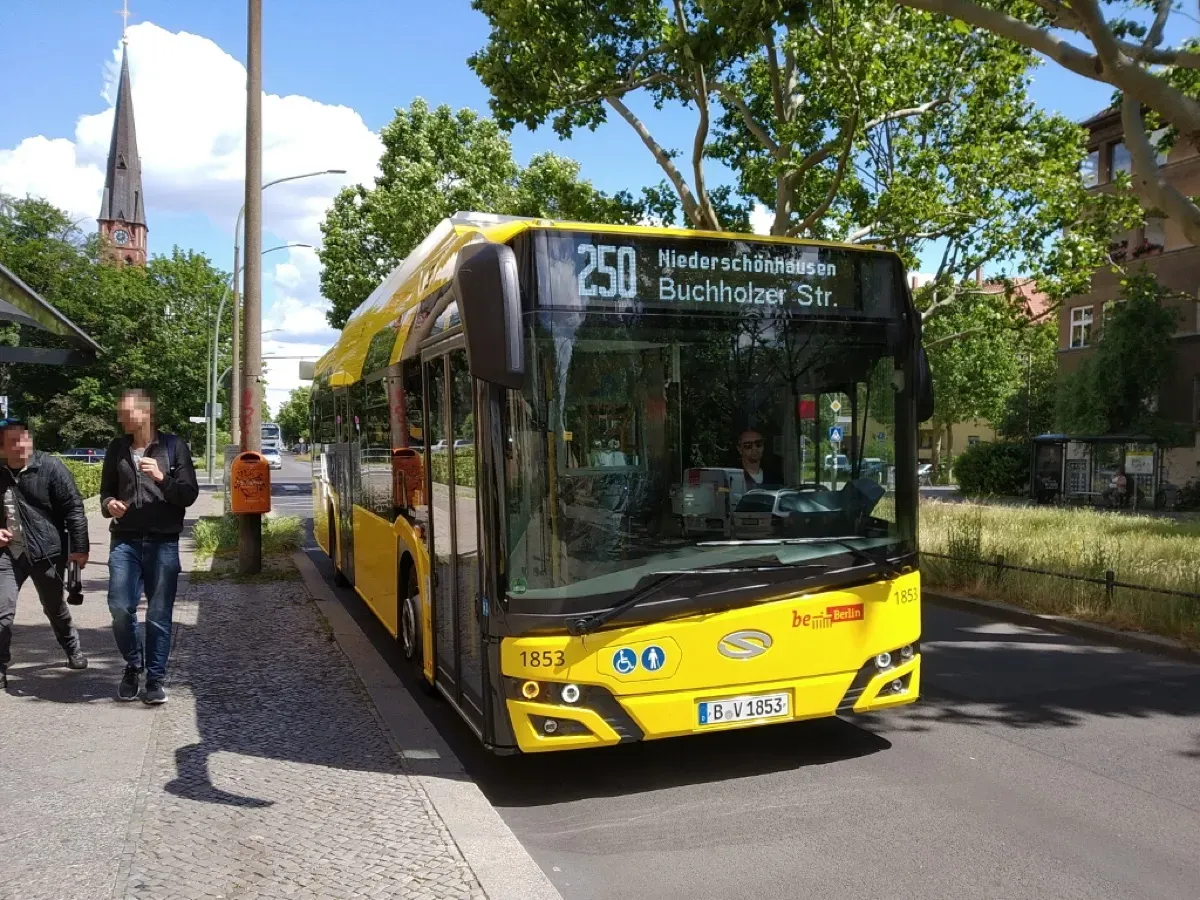
The Urbino 12 electric with modular drive premiered in March 2024 at Mobility Move in Berlin and won the Sustainable Bus Award in the urban category. According to Solaris (Solaris):
- there is no conventional engine compartment; drive components sit on the roof and at the rear;
- this frees space for seven more passengers than the previous version;
- six roof-mounted batteries of a new, higher energy density give over 600 km of range in SORT 2 tests;
- operators can choose plug-in charging at several points, a roof pantograph or an inverted pantograph that lowers from a mast;
- an optional telematics system tracks energy use and allows remote diagnostics.
Toruń’s latest 40 buses also carry General Safety Regulation 2 systems, including a blind spot system that detects cyclists and a moving-off system that warns of pedestrians in front (Bus-News).
The bus builds on a long line. Solaris grew out of Neoplan Polska, built its first bus in Bolechowo in March 1996 and launched the Urbino 12 in 1999. In 2006 it was the first in Europe to market a series-produced hybrid city bus, and in 2017 the Urbino 12 electric became the first electric bus to win the international Bus of the Year title (Wikipedia).
How it works
- Charge overnight: most buses plug in at the depot after the evening peak.
- Top up: on busy routes, a pantograph at a terminus adds energy in minutes during layovers.
- Drive: electric motors at the rear axle drive the bus, with no gearbox noise or exhaust.
- Recover: braking energy is fed back into the batteries in stop-start traffic.
- Heat and cool: electric heating, often with a heat pump, and air conditioning keep passengers comfortable, drawing on the battery.
- Monitor: telematics tell the operator each bus’s state of charge and energy use.
Timeline
| Date | Milestone |
|---|---|
| 22 Mar 1996 | First bus rolls off the line in Bolechowo |
| 1999 | First Solaris Urbino 12 |
| 2017 | Urbino 12 electric wins Bus of the Year |
| Mar 2024 | Modular drive Urbino 12 electric premieres in Berlin |
| 2025 | 916 electric and 306 hydrogen buses delivered; record 2,780 vehicles ordered |
| 10 Jun 2026 | 40 Urbino 12 electric buses handed over in Toruń |
| 2027 to 2028 | Up to 70 Urbino 12 electric due in Ostrava |
Impact and numbers
- Company: in 2025 Solaris delivered 1,631 vehicles to 15 countries, with revenue of EUR 1.183 billion (up 28%). Low- and zero-emission vehicles made up 86% of deliveries, and the order book was worth EUR 2.4 billion at year-end (Solaris).
- Track record: Solaris says it has delivered 3,074 zero-emission buses in Europe, nearly 14% of those on European streets, and more than 5,500 electric, hydrogen and trolley buses to over 200 cities.
- Orders: VR Sverige ordered 101 electric buses for Stockholm, including 47 Urbino 12 electric with modular drive (Solaris); Ostrava signed for up to 70 Urbino 12 electric for 2027 to 2028 (Solaris).
- Market: Europe registered 11,607 electric buses in 2025, up 48%. Yutong led, ahead of MAN, Mercedes and BYD, while Solaris’s registrations rose 92% (Sustainable Bus).
Honest caveats. The 600 km figure comes from SORT 2, a standardised test cycle; in winter, with heating on, real range is lower, and operators still plan around charging. Solaris publishes no life-cycle CO2 figure for the bus, and the climate benefit depends on the electricity mix: in coal-heavy Poland it is smaller than in Sweden or Switzerland, although local air and noise benefits apply everywhere. Competition is fierce: Solaris’s own figures put it third in Europe’s zero-emission city bus segment in 2025, with an 11% share of battery buses, behind rivals that include China’s Yutong. Its claim of a 14% share of all zero-emission buses ever delivered is a long-term, company-calculated figure. Battery buses also cost more to buy than diesel and need depot power upgrades, which is why most orders depend on EU and national funding.
What’s next
Solaris is pushing hydrogen buses for long and demanding routes, where it holds most of the European market, alongside battery buses in five lengths and trolleybuses, including its first Canadian order of 184 trolleybuses for Vancouver. For the Urbino 12 electric, the next test is scale: delivering the 2025 order backlog on time while Chinese makers compete hard on price.
Why it matters for Europe / green buyers
The EU Clean Vehicles Directive (2019/1161) sets minimum shares of clean buses in public procurement, with half of each country’s share required to be zero-emission (EUR-Lex), and the EU’s heavy-duty CO2 rules require 90% of new city buses to be zero-emission from 2030 and 100% from 2035 (EUR-Lex). For cities, the questions now are less about technology than about tenders: whole-life cost, charging strategy, winter range guarantees and European content.
India is buying electric buses at scale through public schemes. Under PM E-DRIVE, ₹4,391 crore has been allocated for 14,028 e-buses, of which 14,000 had been allocated by August 2026 to seven cities including Delhi, Bengaluru, Mumbai and Pune (PIB). Most are made by Indian manufacturers under gross-cost contracts, but the European lessons on depot charging and winter, or in India’s case summer, air-conditioning loads apply directly.
Sources & image credits
- Solaris, “Urbino 12 electric with modular drive”: https://www.solarisbus.com/en/urbino-12-electric-with-modular-drive
- Solaris, “Solaris summarises 2025: sales growth, strong position in e-mobility, and expansion into new markets”: https://www.solarisbus.com/en/press/solaris-summarises-2025-sales-growth-strong-position-in-e-mobility-and-expansion-into-new-markets-2410
- Sustainable Bus, “European electric bus market grew nearly 50% to 11,607 units in 2025”: https://www.sustainable-bus.com/news/electric-bus-market-europe-2025/
- Bus-News, “Poland: Solaris delivers 40 Urbino 12 electric buses to Toruń” (10 Jun 2026): https://bus-news.com/poland-solaris-delivers-40-urbino-12-electric-buses-to-torun/
- Solaris, “Solaris wins a major electric bus tender in the Czech Republic”: https://www.solarisbus.com/en/press/solaris-wins-a-major-electric-bus-tender-in-the-czech-republic-2459
- Solaris, “Impressive order from Sweden: 101 Solaris electric buses for Stockholm”: https://www.solarisbus.com/en/press/impressive-order-from-sweden-101-solaris-electric-buses-for-stockholm-2421
- Wikipedia, “Solaris Bus & Coach”: https://en.wikipedia.org/wiki/Solaris_Bus_%26_Coach
- EUR-Lex, Directive (EU) 2019/1161 (Clean Vehicles Directive): https://eur-lex.europa.eu/eli/dir/2019/1161/oj/eng
- EUR-Lex, Regulation (EU) 2024/1610 on CO2 emission standards for heavy-duty vehicles: https://eur-lex.europa.eu/eli/reg/2024/1610/oj/eng
- PIB, “PM E-DRIVE: a step towards a sustainable future” (1 Oct 2026): https://www.pib.gov.in/PressReleasePage.aspx?PRID=2317890&lang=1®=48
Images:
- “Solaris Urbino 12 electric BVG 1853” by Pedant01, licensed under CC BY-SA 4.0 (https://creativecommons.org/licenses/by-sa/4.0), via Wikimedia Commons: https://commons.wikimedia.org/wiki/File:Solaris_Urbino_12_electric_BVG_1853.jpg