The problem
A modern wind turbine is one of the most recyclable power plants ever built. WindEurope estimates that around 90% of a turbine’s mass, mainly the steel tower, the nacelle and the copper in its generator and cables, can be recycled with established methods. The hard part is the blades. They are made of glass or carbon fibre, balsa wood or foam, and thermoset resin, cured into a single tough structure that is designed never to come apart.
That durability becomes a problem when wind farms are retired. Europe has about 290 GW of wind capacity, and WindEurope says around 80 GW of it reaches the end of its theoretical design life by 2030. It expects decommissioned blade material to grow from about 20,000 tonnes in 2025 to 55,000 tonnes a year by 2030, mostly from older farms in Germany and Spain (WindEurope). The European industry has committed to a self-imposed landfill ban on blades from 1 January 2026. Today most old blades are shredded and burned in cement kilns or ground into filler, which recovers little of the original material value.
The product
The RecyclableBlade was launched on 7 September 2021, when Siemens Gamesa announced that the first six 81 metre blades had been produced at its Aalborg factory (Siemens Gamesa).
The key change is chemical. Siemens Gamesa’s blades are cast in one piece with its IntegralBlade process, and the RecyclableBlade uses the same moulds, fibres and steps. Only the resin is different. Its chemical structure lets it be separated from the other materials in a mild process at end of life, which Siemens Gamesa says protects the properties of the recovered materials.
The technology is available for several blade sizes, including the B81 used on the SG 8.0-167 DD turbine, the 108 metre B108 on the SG 14-222 DD, and the 115 metre B115 on the SG 14-236 DD, the 14 to 15 MW machines now being installed in the North Sea (Siemens Gamesa).
How it works
- Casting: glass fibre, balsa wood and other core materials are laid in a full-length mould and infused with the new resin, exactly as in a standard IntegralBlade.
- Operation: in service the blade behaves like a conventional blade, with the same stiffness, weight and expected 20 to 30 year life.
- Dismantling: at end of life the blade is cut into manageable sections and transported to a treatment site.
- Separation: the sections are immersed in a heated, mildly acidic solution that breaks down the resin, freeing the fibreglass, wood, plastic and metal.
- Reuse: the recovered materials are rinsed, dried and sold into other industries. RWE and Siemens Gamesa cite uses such as vehicle parts, bicycle helmets, suitcases and casings for consumer products.
Timeline
| Date | Milestone |
|---|---|
| 7 Sep 2021 | RecyclableBlade launched; first six 81 m blades made in Aalborg; RWE, EDF Renewables and wpd sign up |
| Jul 2022 | First turbine with RecyclableBlades generates power at RWE’s 342 MW Kaskasi wind farm, Germany |
| Mar 2025 | First turbine installed at RWE’s 1.4 GW Sofia wind farm, UK |
| 10 Nov 2025 | All 150 recyclable blades (50 turbines) installed at Sofia |
| 9 Apr 2026 | First Thor turbine with recyclable blades and a GreenerTower installed off Denmark |
| 10 Jun 2026 | 100th and final turbine installed at Sofia |
| Aug 2026 | Siemens Gamesa posts its first quarterly profit since 2022 |
Impact and numbers
- UK first: at Sofia, 195 km off the north-east coast of England, half of the 100 SG 14-222 DD turbines carry recyclable 108 metre blades made in Hull. RWE called it the first large-scale deployment of the technology at a UK offshore wind farm and expected full commercial operation in the third quarter of 2026 (Sofia Offshore Wind Farm).
- Denmark: at RWE’s 1.1 GW Thor project, 40 of 72 turbines will use a total of 120 recyclable blades, and 36 will have GreenerTower steel towers made with steel that emits at least 63% less CO2. Siemens Gamesa says the tower alone cuts overall turbine emissions by around 20% (RWE).
- Scale: Sofia’s turbines stand 252 metres above the sea and the wind farm can supply the equivalent of about 1.2 million UK homes (offshoreWIND.biz).
- Company health: in the third quarter of fiscal 2026, Siemens Gamesa reported a positive result for the first time since fiscal 2022, with revenue of about EUR 2.7 billion, and Siemens Energy expects it to break even for the full year (Siemens Energy).
Honest caveats. The RecyclableBlade is designed to be recycled, but no large batch has yet reached the end of its life, so the separation process, its energy and chemical use, and the market value of the recovered fibre have only been demonstrated at small scale. The recovered glass fibre is likely to be used in lower-grade products such as casings or car parts rather than in new blades, which is recycling, not a closed loop. So far, deployments depend on a few customers, mainly RWE, and only part of each wind farm uses the recyclable option, which suggests it still carries extra cost or supply limits. Siemens Gamesa is also only one of several players: rivals are developing their own recyclable resins and chemical processes that can break down conventional epoxy blades, which could make a special resin less of an advantage. The wider company has also had a difficult few years: quality problems on its onshore turbines caused heavy losses from 2023, and it only returned to a quarterly profit in 2026.
What’s next
The next milestones are Sofia reaching full commercial operation and Thor completing its 72 turbines by the end of 2026, with full operation in 2027. Siemens Gamesa’s longer-term goal is a fully recyclable turbine by 2040, which also means tackling other hard-to-recycle parts such as permanent magnets. Policy will matter too: WindEurope wants the planned EU Circular Economy Act to create dedicated waste codes for blades and magnets so they can be traced and treated properly.
Why it matters for Europe / green buyers
For European developers and electricity buyers, wind power’s green credentials are increasingly judged over the whole life cycle, not just on the clean electricity a turbine produces. Choosing recyclable blades and lower-carbon towers is one of the few direct levers a wind farm owner has to cut the embodied emissions and future waste of a project, and it can help in auctions and power purchase agreements that score sustainability. Developed in Denmark, built in the UK and first used in Germany, it also supports a European supply chain.
For India and other fast-growing wind markets, the lesson is to plan for end of life now. India is starting to repower its older turbines, and design choices made today will decide how much blade waste it faces in the 2040s.
Sources & image credits
- Siemens Gamesa, “Siemens Gamesa pioneers wind circularity: launch of world’s first recyclable wind turbine blade for commercial use offshore”, 7 September 2021: https://www.siemensgamesa.com/global/en/home/press-releases/launch-world-first-recyclable-wind-turbine-blade.html
- Siemens Gamesa, “Revolutionary RecyclableBlades: Siemens Gamesa technology goes full-circle at RWE’s Kaskasi offshore wind power project”, 1 August 2022: https://www.siemensgamesa.com/global/en/home/press-releases/080122-siemens-gamesa-press-release-recycle-wind-blade-offshore-kaskasi-germany.html
- Siemens Gamesa, “RecyclableBlade” product page: https://www.siemensgamesa.com/global/en/home/explore/journal/recyclable-blade.html
- Sofia Offshore Wind Farm (RWE), “RWE completes installation of all recyclable blades at Sofia Offshore Wind Farm”, 10 November 2025: https://sofiawindfarm.com/latest/press-releases/sofia-completes-installation-of-all-recyclable-turbine-blades/
- offshoreWIND.biz, “All 100 Siemens Gamesa Turbines In Place at RWE’s Sofia Offshore Wind Farm”, 12 June 2026: https://www.offshorewind.biz/2026/06/12/all-100-siemens-gamesa-turbines-in-place-at-rwes-sofia-offshore-wind-farm/
- RWE, “World’s first turbine with CO2-reduced steel tower and recyclable rotor blades installed at Denmark’s largest offshore wind farm”, 9 April 2026: https://www.rwe.com/en/press/rwe-offshore-wind-gmbh/2026-04-09-worlds-first-turbine-with-co2-reduced-steel-tower-and-recyclable-rotor-blades/
- WindEurope, “Where do wind turbine blades go when they are decommissioned?”, 14 November 2025: https://windeurope.org/news/where-do-wind-turbine-blades-go-when-they-are-decommissioned/
- Siemens Energy, “Earnings Release Q3 FY 2026”, 5 August 2026: https://www.siemens-energy.com/global/en/home/press-releases/earnings-release-q3-fy-2026.html
Images:
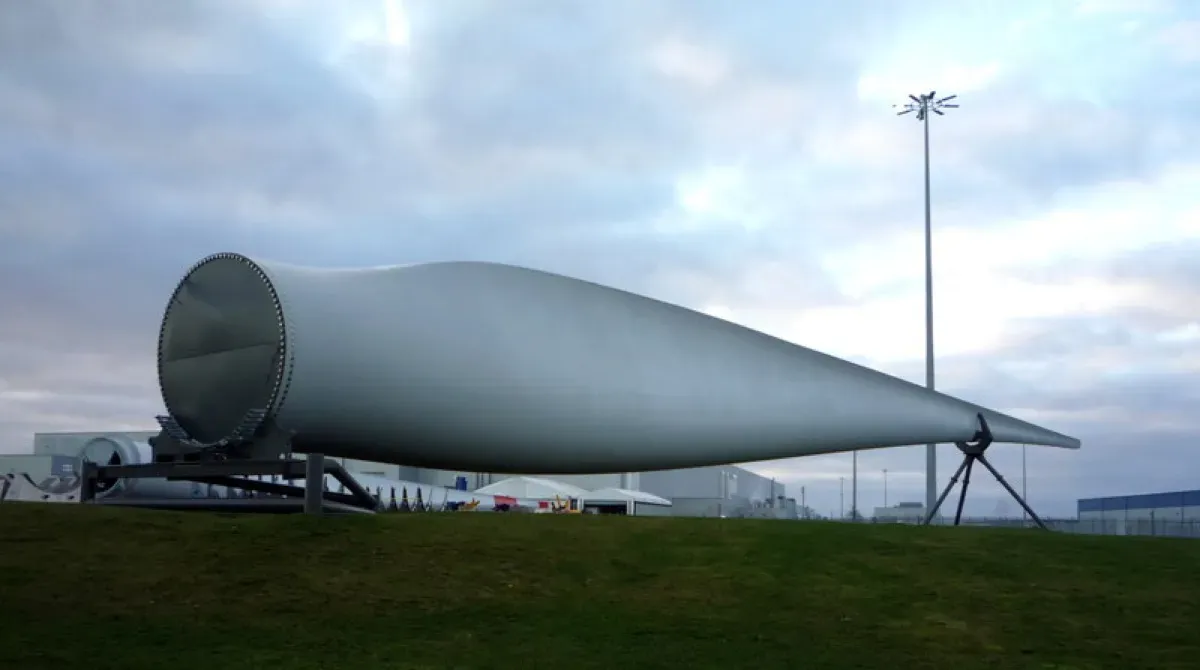
- “Wind turbine blade, Siemens Wind Turbine Factory” by JThomas, geograph.org.uk, licensed under CC BY-SA 2.0 (https://creativecommons.org/licenses/by-sa/2.0), via Wikimedia Commons: https://commons.wikimedia.org/wiki/File:Wind_turbine_blade,_Siemens_Wind_Turbine_Factory_-_geograph.org.uk_-_6341807.jpg