The problem
Dense cities trap heat. Stone, brick, glass and asphalt absorb the sun by day and release it at night. In Amsterdam, research by the AMS Institute finds that the city can be 2 to 3 °C warmer than the surrounding countryside by day and up to 10 °C warmer at night, and that 75% of homes exceed 24 °C on summer nights (AMS Institute).
There is rarely room for more trees at street level. Walls, however, offer a lot of unused surface. Living walls can shade facades, cool air by evaporation, absorb sound and support insects. The challenge has been reliability: early systems often had bare patches for months while plants grew, and many failed when irrigation broke down. Noise is a second, often forgotten problem. Around airports such as Schiphol, building rules limit where new homes can go, while the Netherlands faces a severe housing shortage. Any facade product that makes outdoor spaces quieter as well as cooler could help unlock land for housing.
The product
SemperGreenwall Outdoor is a modular green facade system. Its core is the Flexipanel, a 620 by 520 mm panel with about 25 plants, grown for months at a Sempergreen nursery before it is delivered (SemperGreenwall).
According to Sempergreen:
- panels arrive with at least 90% plant coverage, so the wall looks finished from day one;
- each panel has a waterproof TPO back, a capillary layer that spreads water, a substrate mat and a UV-resistant fleece;
- the system weighs at most about 45 kg/m² when saturated, light enough for many existing walls;
- automatic irrigation uses rainwater first where available, with 24/7 remote monitoring and frost protection;
- the system is Cradle to Cradle certified (Sempergreen).
Plant mixes are chosen for the climate and orientation of each wall, typically evergreen perennials, grasses and small shrubs that stay green in winter.
How it works
- Grow: plants are grown into Flexipanels at the nursery until coverage reaches at least 90%.
- Frame: aluminium profiles are fixed to the building facade, leaving a ventilated gap.
- Hang: panels are clicked onto the profiles, with top, edge and gutter pieces.
- Water: drip lines along the top of each row feed water into the capillary layer, which spreads it through the panel; excess water is collected in a gutter.
- Monitor: sensors and a control box track water flow and moisture and send alarms if something fails.
- Maintain: gardeners prune, replace plants and check irrigation, typically several times a year.
Timeline
| Date | Milestone |
|---|---|
| 1996 | Sempergreen founded in the Netherlands |
| Before 2026 | Two-year test of a 120 m² SemperGreenwall at the Urban Comfort Lab, Hoofddorp |
| 9 Sep 2025 | AMS Institute reports that 10% more greenery can cool an area by 0.6 °C |
| 2026 | Aircraft noise results published by AMS Institute and Sempergreen |
Impact and numbers
- Noise: in the Urban Comfort Lab, a test site of about 120 shipping containers near Schiphol run by AMS Institute with TU Delft and Wageningen University, a 120 m² SemperGreenwall cut aircraft noise by an average of about 3 dB for arriving flights and up to 5 dB for departing flights. A 3 dB drop is roughly half the sound energy (AMS Institute, Sempergreen).
- Heat: Sempergreen reports that in the same lab, greening about 6% of facade surface lowered average air temperature by about 1 °C, and that particulate matter and NOx were 8 to 15% lower near the wall.
- Greenery and cooling: AMS Institute research by Wageningen’s Gert-Jan Steeneveld found that each 10% more greenery in an area cools it by about 0.6 °C.
- Track record: Sempergreen says it has completed more than 2,000 projects and runs nurseries on five continents.
Honest caveats. The Urban Comfort Lab is an experimental courtyard of containers, not a real street, and the temperature and air quality figures above come via Sempergreen’s own summary; the peer-reviewed noise work is led by TU Delft (TU Delft). A 1 °C average cooling is helpful but local; it falls off quickly with distance. Higher claims found in marketing, such as up to 3 °C cooling or a 33% cut in air conditioning, were not checked against independent data. Living walls need water and electricity for pumps and controls, and they fail if maintenance is cut. They cost far more per square metre than climbing plants rooted in the ground, which can also green a wall but take years to grow. Plastic and metal components add embodied carbon. Fire safety on tall buildings must be checked under local rules.
What’s next
Sempergreen and AMS Institute are using the Urban Comfort Lab results to advise planners on designing housing near airports and busy roads, where noise and heat combine. Expect more living walls in projects that need both: schools, hospitals and housing near Schiphol and other European airports. Watch for long-term data on water use and maintenance costs, which will decide whether cities specify living walls at scale.
Why it matters for Europe / green buyers
The EU Nature Restoration Regulation, Regulation (EU) 2024/1991, requires no net loss of urban green space and tree canopy by 2030 compared with 2024, and an increasing trend after that (EUR-Lex). In tight city centres, green facades are one of the few ways to add greenery without space at ground level. For buyers, the main questions are: what irrigation and monitoring is included, who maintains the wall and for how long, how much water it will use per year, and whether a cheaper ground-rooted climbing facade would do the same job.
In India, vertical gardens are already popular on metro pillars, offices and malls in Bengaluru, Delhi, Mumbai and Hyderabad. Most are custom-built with pots or felt pockets and suffer from plant loss in heat and water shortages. A pre-grown, monitored panel system with rainwater use and local plant species could improve reliability, but water supply in the dry season remains the main constraint.
Sources & image credits
- Sempergreen, “SemperGreenwall Outdoor” product page: https://www.sempergreen.com/product/living-walls/sempergreenwall-outdoor/
- SemperGreenwall, “Flexipanel for a modular green wall system”: https://sempergreenwall.com/flexipanel/
- Sempergreen, “Living walls as a quiet force in urban comfort” (research summary): https://www.sempergreen.com/research/living-walls-as-a-quiet-force-in-urban-comfort/
- AMS Institute, “A new way of urban design reduces aircraft noise around buildings and in outdoor spaces”: https://www.ams-institute.org/news/a-new-way-of-urban-design-reduces-aircraft-noise-around-buildings-and-in-outdoor-spaces/
- AMS Institute, “Urban Comfort Lab” (noise programme): https://www.ams-institute.org/urban-challenges/resilient-cities/noise/
- AMS Institute, “A cooler, greener, and healthier city, by design” (9 Sep 2025): https://www.ams-institute.org/news/a-cooler-greener-and-healthier-city-by-design/
- TU Delft Research Portal, “Assessing the influence of street canyon shape on aircraft noise: results from measurements in courtyards near Amsterdam Schiphol Airport”: https://research.tudelft.nl/en/publications/assessing-the-influence-of-street-canyon-shape-on-aircraft-noise--2/
- EUR-Lex, Regulation (EU) 2024/1991 on nature restoration: https://eur-lex.europa.eu/eli/reg/2024/1991/oj/eng
Images:
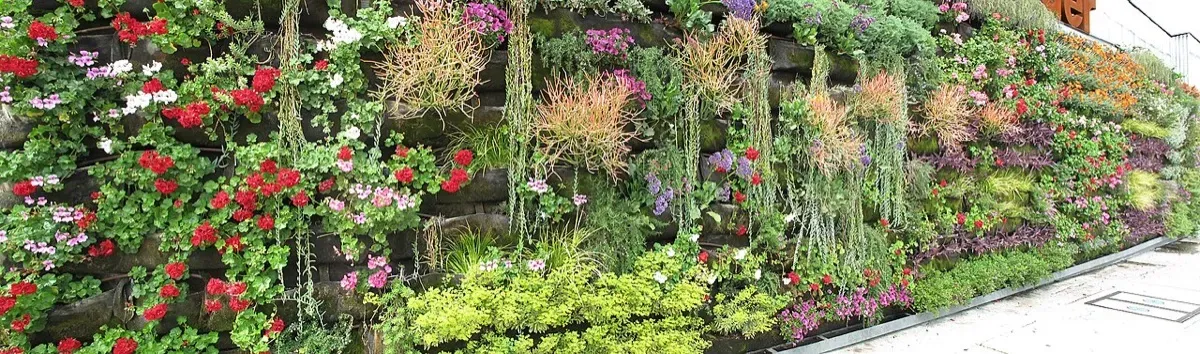
- “Living wall Blackwelder” by Downtowngal, 2020, licensed under CC BY-SA 4.0 (https://creativecommons.org/licenses/by-sa/4.0), via Wikimedia Commons: https://commons.wikimedia.org/wiki/File:Living_wall_Blackwelder.jpg