The problem
European cities face two water problems at once. Cloudbursts dump more rain than sewers can carry, flooding streets and basements. Then heatwaves arrive, and sealed surfaces, roofs and courtyards bake. Optigrün cites a Leipzig courtyard measured on 21 July 2023 where a playground surface exceeded 70 °C.
Green roofs help with both, but a standard extensive green roof has only a thin layer of substrate. After a few dry weeks, the plants stop evaporating water and the roof warms up, so its cooling effect fades exactly when it matters. Meanwhile, the rain that fell weeks earlier has long gone down the drain.
“Sponge city” planning aims to keep rain where it falls, use it to cool the city through evaporation and release the excess slowly. Flat roofs are one of the largest unused spaces for doing this.
The product
Optigrün Retention Roof Flow Control (Retentionsdach Drossel) turns a flat roof into a storage tank with plants on top (Optigrün).
The key parts are:
- Water Retention Boxes (WRB): open plastic elements made from recycled HDPE or PP, in heights of 80, 85, 95 and 170 mm, holding about 72, 80, 90 and 161 l/m² of water. The WRB 85, for example, is about 85 mm thick, weighs about 5.7 kg/m² empty and stores about 80 l/m² (Optigrün WRB 85).
- Capillary bridges or columns: wicks of substrate that draw stored water up to the plant layer.
- Filter and capillary fleece: spreads water evenly across the whole roof.
- Flow control system: a throttle on the roof outlet with a sized opening, so water drains only at a restricted rate; a smart version can be controlled remotely, for example to empty the roof before forecast storms.
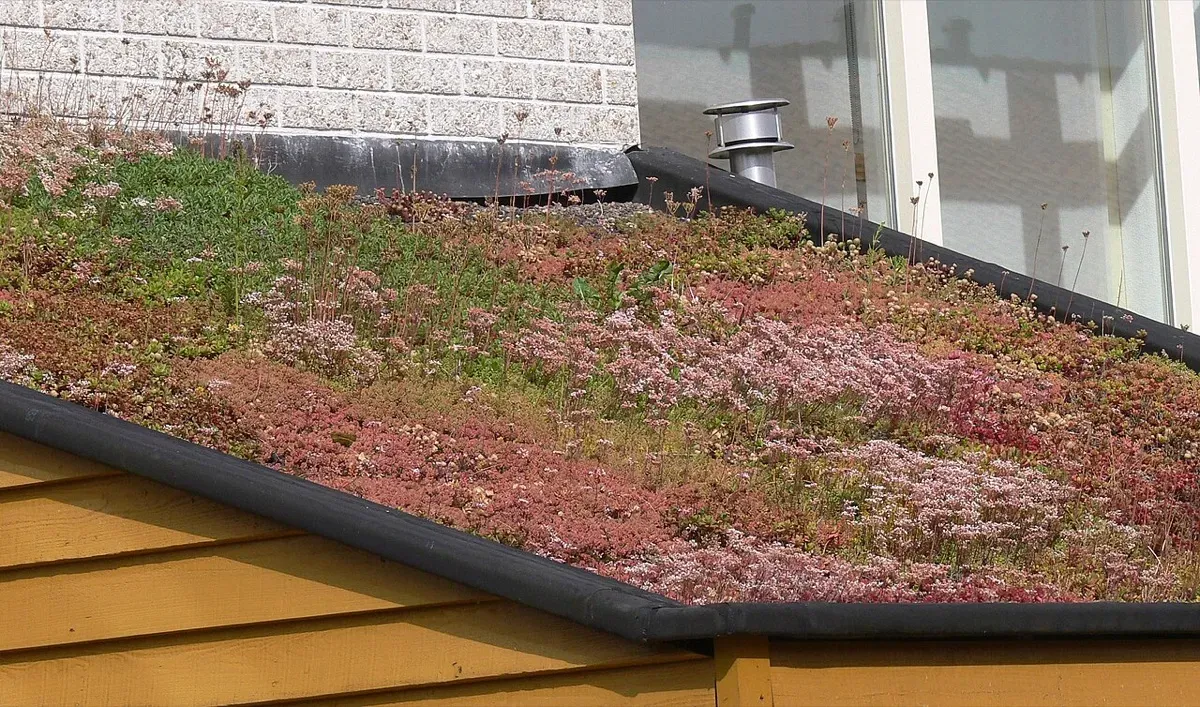
The plant layer above can be extensive (sedum and herbs), simple intensive (grasses and perennials) or a full roof garden.
How it works
- Collect: rain falls on the vegetation and soaks through the substrate into the retention boxes.
- Store: water fills the connected space under the plants, both a temporary storage layer and a permanent reserve below the outlet level.
- Throttle: the flow control releases water slowly to the drain, easing peak loads on sewers in a cloudburst.
- Wick up: in dry weather, capillary bridges carry water from the permanent reserve back up to the roots.
- Evaporate: well-watered plants keep transpiring, and the evaporation cools the roof surface and the air above it (Optigrün).
Timeline
| Date | Milestone |
|---|---|
| Over 50 years ago | Optigrün’s roots in green roofing, according to the company |
| 21 Jul 2023 | Leipzig courtyard measurements: playground surface above 70 °C |
| Phase II | Leipziger BlauGrün II measures a blue-green courtyard over a full year |
| Sep 2025 | Current Optigrün retention roof technical brochure |
Impact and numbers
- Air cooling: in Leipziger BlauGrün II, a project led by the Helmholtz Centre for Environmental Research (UFZ) with federal research funding, air at 1.5 m above the blue-green system was 1.38 °C cooler than above a sealed surface and 1.08 °C cooler than above a traditional green roof (BauNetz Wissen, UFZ).
- Surface cooling: Optigrün reports that capillary-active retention roofs can be up to 30 °C cooler at the surface than sealed surfaces.
- Plant water: in a 24-month trial, substrate moisture was 14% higher thanks to water storage and capillary bridges, according to Optigrün.
- Scale: Optigrün says it supplies or plans green roofs covering around 5 million m² a year across thousands of projects (Optigrün).
Honest caveats. The 30 °C and 14% figures come from Optigrün’s own trials and brochures; the 1.38 °C air cooling comes from the UFZ project, whose handbook gives design guidance for coupled blue-green infrastructure (UFZ handbook). Air cooling of about 1 °C is useful in a courtyard but does not cool a whole district. A full retention roof is heavy: 80 to 160 litres of water add 80 to 160 kg/m² on top of substrate and plants, so many existing roofs need structural checks or reinforcement. Standing water above the waterproofing raises the stakes for leaks, so membranes, inspection and maintenance must be excellent. The boxes are recycled plastic but still plastic. Permanent water storage can attract mosquitoes if not designed properly. And the throttle only helps in a cloudburst if the roof is not already full, which is why the smart control option matters.
What’s next
Optigrün is pushing smart flow control that links retention roofs to weather forecasts and city drainage, so roofs can be emptied before a storm and kept full in a heatwave. German cities increasingly require green or retention roofs in new development plans and charge lower stormwater fees for them. Watch for more “public roof retention” on car parks, schools and supermarkets, and for data from whole neighbourhoods rather than single courtyards. Retrofitting existing flat roofs, rather than only new buildings, will decide how much of a city’s roof area can actually be turned into storage.
Why it matters for Europe / green buyers
The EU Nature Restoration Regulation, Regulation (EU) 2024/1991, requires no net loss of urban green space by 2030 against 2024 and rising urban greenery after that, and it encourages greenery integrated into buildings and infrastructure as part of that effort (EUR-Lex). Retention roofs help cities hit that target while also easing flood risk and heat. For buyers, the key questions are the roof’s load capacity, the waterproofing warranty, the required retention volume and discharge limit set by the local authority, and who will maintain the outlet and plants.
Indian cities suffer both monsoon flooding and extreme pre-monsoon heat, often in the same year, as seen in Mumbai, Chennai and Bengaluru. Flat concrete roofs are almost universal. A blue-green roof that stores monsoon rain and slowly wicks it to plants could cool top-floor flats, which are the hottest homes in Indian cities. However, the long dry season means stored water would run out months before the next rain, so designs would need extra irrigation or greywater, and roofs would need strengthening.
Sources & image credits
- Optigrün, “Retentionsdach Einleitbeschränkung Drossel, extensiv und einfach intensiv”: https://www.optigruen.de/systemloesungen/retentionsdach/uebersicht-retentionsdach/retentionsdach-einleitbeschraenkung-drossel-extensiv-bis-einfach-intensiv
- Optigrün, “WRB 85 Wasser-Retentionsbox für Retentionsdächer”: https://www.optigruen.de/produkte/draenageplatten/wrb-85
- Optigrün, “Hitze und Kapillarität”: https://www.optigruen.de/fachthemen/hitze-und-kapillaritaet
- BauNetz Wissen, “Blaugrüne Quartiere gestalten”: https://www.baunetzwissen.de/stadt--und-dachbegruenung/fachwissen/_retentionsdach/blaugruene-quartiere-gestalten-9884628
- UFZ, “Planung gekoppelter blau-grüner Infrastrukturen” (Leipziger BlauGrün handbook): https://www.ufz.de/export/data/478/301257_LBG_Handbuch%20low.pdf
- UFZ, “Phase II Leipziger BlauGrün”: https://www.ufz.de/leipzigerblaugruen/index.php?de=49849
- Optigrün international AG, company page: https://www.optigruen.com/company
- EUR-Lex, Regulation (EU) 2024/1991 on nature restoration: https://eur-lex.europa.eu/eli/reg/2024/1991/oj/eng
Images:
- “EVA- Lanxmeer Green roof 2009” by Lamiot, licensed under CC BY-SA 4.0 (https://creativecommons.org/licenses/by-sa/4.0), via Wikimedia Commons: https://commons.wikimedia.org/wiki/File:EVA-_Lanxmeer_Green_roof_2009.jpg