The problem
Ionising radiation is indispensable in modern medicine and industry: X-ray imaging, fluoroscopy-guided heart procedures, radiotherapy, nuclear medicine, industrial radiography and nuclear power all depend on it. The people who work with it must be monitored. In Europe, Council Directive 2013/59/Euratom, the Basic Safety Standards Directive, sets occupational limits that member states had to transpose by 6 February 2018 (EU-OSHA). It cut the equivalent dose limit for the lens of the eye to 20 mSv per year, or 100 mSv over five consecutive years with no single year above 50 mSv (EUR-Lex).
Traditional passive dosimeters, such as film, thermoluminescent or optically stimulated luminescence badges, record dose but cannot show it. They are worn for a month or a quarter, collected, posted to a laboratory and read. Results arrive weeks later. A worker who received an unusual dose may not know until well after the event, and radiation safety officers spend hours distributing, chasing and returning badges. Each exchange cycle also means packaging and courier transport for every badge, every period.
The product
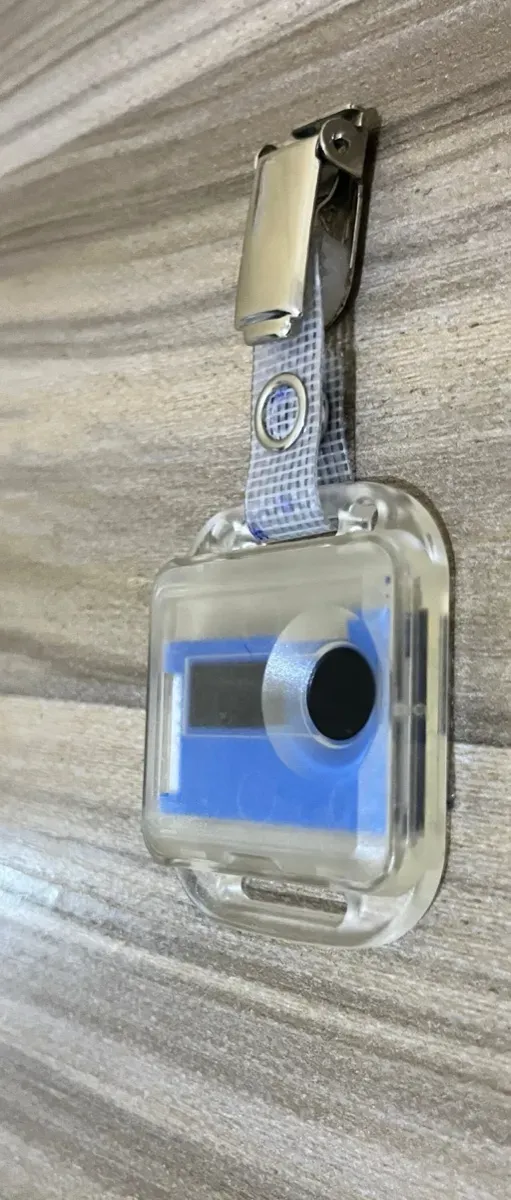
Instadose+ is Mirion’s wireless answer. It is a small badge, a 2.5 cm square top on a 5 cm square body weighing about 20 g, that contains a dose sensor and a Bluetooth Low Energy radio. Data can be sent on demand or automatically on a calendar schedule via the Instadose app on a phone or tablet, a PC, or a fixed InstaLink hotspot (Mirion product page).
Dose readings then appear in an online account. Safety officers can reassign badges instantly and set automatic email alerts when a dose exceeds a chosen level or when a badge has not reported. Mirion notes that no personal information is stored on or transmitted by the device itself.
Mirion presented the product in 2015 as its first completely wireless dosimeter (Instadose blog). It sits in a family: the original Instadose of 2009 read dose through a USB connection to a PC; Instadose 2 added a second detector in 2019 for photon and beta radiation; and Instadose VUE in 2024 added an electronic screen showing badge assignment, wear status and dose communication.
How it works
The core is Direct Ion Storage. A small ionisation chamber sits on top of a non-volatile analogue memory cell, similar to the floating gate in flash memory. Radiation ionises gas in the chamber, and the resulting charge alters the stored charge on the gate in proportion to the dose. Reading the cell does not erase it, so the badge can be read an unlimited number of times and keeps a cumulative record. Mirion combines DIS with what it calls SmartMonitoring, a set of checks for accuracy and sensitivity.
According to the Instadose+ data sheet, the single detector measures deep dose, Hp(10), with a minimum reportable dose of 0.05 mSv (0.03 mSv on request), a useful range from 0.01 mSv to 5 Sv, and a photon energy response from 5 keV to 6 MeV (data sheet). Accreditations listed include NVLAP in the United States (lab code 100555-0) and the Health and Safety Executive in the United Kingdom.
Timeline
| Date | Milestone |
|---|---|
| 2009 | First Instadose USB dosimeter, self-read through an internet-connected PC |
| 2015 | Instadose+ launched as Mirion’s first fully wireless dosimeter |
| February 2018 | Instadose+ promoted in the US trade press for eliminating badge collection |
| 6 February 2018 | Deadline for EU member states to transpose the Basic Safety Standards Directive |
| 2019 | Instadose 2 adds a second detector for photon and beta radiation |
| 2024 | Instadose VUE adds a built-in display |
| 2025 | Mirion reports total revenue of US$925.4 million |
Impact and numbers
- Scale of the company: 2025 revenue of US$925.4 million, of which US$234.8 million came from services, with occupational dosimetry part of the Mirion Medical group (Mirion FY2025 results).
- Time: dose results are available immediately rather than weeks after a wear period, and badge exchange is no longer needed.
- Compliance: automatic, scheduled reads and overdue alerts address one of the commonest failures in dosimetry programmes, badges that are not worn or not returned (ITN, 8 February 2018).
- Footprint: Mirion states that eliminating badge returns saves resources and shipping costs and reduces greenhouse gas emissions.
Honest caveats. Mirion has not published a life-cycle assessment comparing an electronic badge, with its battery and electronics, against reusable passive badges and their courier cycles, so the climate benefit is plausible but unquantified. Wireless reads still need the badge to come within range of a phone or gateway. The basic Instadose+ measures photon deep dose only; extremity and eye-lens monitoring, important for interventional cardiology, need additional dosimeters. Accreditation and regulatory acceptance vary by country, so European buyers must check the national dosimetry service approval that applies to them.
What’s next
The direction of travel is from periodic records to real-time awareness. With the 2024 generation, Mirion says it also improved the robustness of the wireless link and dose transmissions and extended battery life, two practical weak points of earlier electronic badges (Mirion flyer, 2024). Instadose VUE’s screen gives workers direct feedback, and connected badges feed dose data into analytics dashboards that help departments spot high-exposure procedures or staff. As nuclear medicine grows with new radioligand therapies, and as Europe considers new nuclear capacity, the number of monitored workers is likely to rise, which strengthens the case for systems that cut administration per wearer.
Why it matters for Europe / green buyers
Radiation protection is a legal duty under Euratom rules, and dosimetry is a recurring cost for every hospital and nuclear site. Instadose+ shows how a tangible device can improve safety and reduce waste at the same time: fewer parcels, fewer lost badges and faster action when something goes wrong.
When comparing dosimetry services, ask for the national approval status, the dose quantities measured, how often data is transmitted, battery life and end-of-life take-back for electronic badges, and whether the supplier can provide evidence for its environmental claims.
Sources & image credits
- Mirion, Instadose+ Wireless Dosimeter product page: https://www.mirion.com/products/medical/occupational-dosimetry/dosimetry-services/whole-body-area-dosimeters/on-demand-dosimetry-products/instadose-wireless-dosimeter
- Instadose (Mirion), “Last 20 Years of Dosimetry Innovations”: https://www.instadose.com/blog/last-20-years-of-dosimetry-innovations
- Mirion, “Overview of Mirion Dosimetry Services Innovations” flyer, 2024: https://instadoseprodstorage.blob.core.windows.net/prod-20220504/cms4_instadose/files/blog-images/2024-blog-images/mktg-473_overview_of_mirion_dsd_innovations_flyer.pdf
- Mirion, Instadose+ data sheet (SPC-303): https://instadoseprodstorage.blob.core.windows.net/prod-20220504/cms4_instadose/files/pdf/spc-303_instadose__dosimeter.pdf
- Imaging Technology News, “Mirion Technologies Introduces Instadose Radiation Dosimeter”, 8 February 2018: https://www.itnonline.com/content/mirion-technologies-introduces-instadose-radiation-dosimeter
- Mirion, “Fourth Quarter and Full Year 2025 Financial Results”, 10 February 2026: https://ir.mirion.com/_assets/_63d1143208da89d24b428920bec60d94/mirion/news/2026-02-10_Mirion_Announces_Fourth_Quarter_and_Full_Year_174.pdf
- EU-OSHA, Directive 2013/59/Euratom, protection against ionising radiation: https://osha.europa.eu/en/legislation/directives/directive-2013-59-euratom-protection-against-ionising-radiation
- EUR-Lex, Council Directive 2013/59/Euratom, consolidated text: https://eur-lex.europa.eu/legal-content/EN/TXT/HTML/?uri=CELEX%3A02013L0059-20140117
Images:
- “Thermoluminescent Dosimeter Badge” by Erere Onyeugbo (Erereony), licensed CC BY 4.0 (https://creativecommons.org/licenses/by/4.0), via Wikimedia Commons: https://commons.wikimedia.org/wiki/File:Thermoluminescent_Dosimeter_Badge.jpg