The problem
E-commerce has turned packaging into a mass waste stream. When LivingPackets raised money in 2020, Tech.eu reported the company’s estimate that more than 100 billion cardboard boxes are shipped a year in e-commerce alone (Tech.eu). Single-use boxes, labels and filler are made, shipped and discarded at every step.
For businesses that send phones, electronics, luxury goods or spare parts, there is a second cost. A parcel that is lost, opened or stolen means a refund, a replacement and an angry customer, and a cardboard box gives no warning until it is too late. Shops that send devices back for repair or refurbishment face the same problem in reverse.
The product
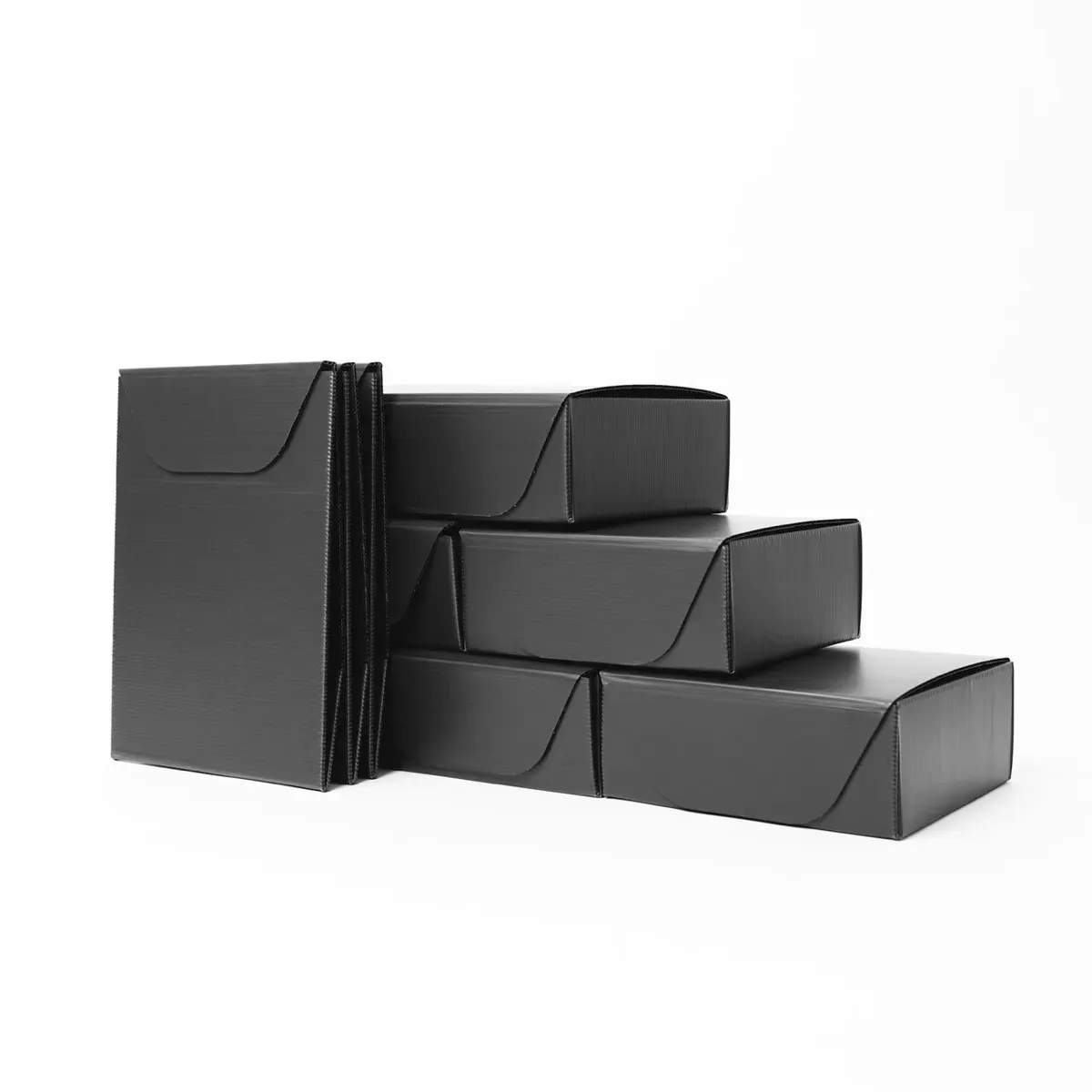
THE BOX is a reusable, robust and foldable parcel. In its early form it measured 44 by 36 by 16 cm, big enough for two pairs of shoes, and could fold flat to send documents or clothes (Ouest-France). Its main features are:
- tracking by 4G, GPS and Wi-Fi throughout the journey;
- security, with an electromechanical lock that opens only for the recipient or someone holding a secure code, and alerts if someone tries to force it;
- sensors for opening and closing, shocks, temperature and humidity, with an embedded camera in the early versions (E-commerce Mag);
- an e-ink screen on which the address label is loaded digitally, with no paper, glue or single-use plastic;
- return labels preloaded in the system, so the same box goes straight back.
LivingPackets also sells THE BOX Pro and THE TABLET, its embedded electronics, and has built an automated shipping station that can generate hundreds of digital labels a day at a logistics provider’s site (Emballage Digest). The company says THE BOX is covered by more than 42 patents, some granted and some pending (LivingPackets).
How it works
- Load: the sender puts goods in the box, closes it and loads a digital label.
- Ship: any carrier picks it up as a normal parcel.
- Watch: sender and recipient follow the parcel in one interface and receive alerts for shocks, temperature or tampering.
- Open: the recipient unlocks the box on arrival.
- Return: a preloaded return label sends the box back, empty or carrying a return or repair item, ready for its next trip.
Timeline
| Date | Milestone |
|---|---|
| Dec 2016 | LivingPackets starts as a small research team in Nantes |
| Oct 2019 | Cdiscount tests 400 boxes on deliveries around Bordeaux |
| Jan 2020 | THE BOX named the product with the greatest potential to change the world at CES 2020, the company says |
| Feb 2020 | Joins Cdiscount’s incubator |
| Apr 2020 | About EUR 5 million raised through crowdfunding |
| Jan to Mar 2024 | SFR pilot, then national launch with 220 boxes |
| 2024 | FCC (US) and ISED (Canada) certifications |
| Apr 2026 | Taiwan NCC certification; SFR fleet at 1,300 boxes |
Impact and numbers
- SFR at scale: after a pilot in January 2024 and a national launch in March 2024 with 220 boxes, SFR now uses 1,300 units, with 1,600 planned by the end of 2026, to serve almost 130 shops, about 25% of its network, and some 30,000 deliveries a year. Shops use the preloaded return labels to send products to refurbishment partners (Supply Chain Magazine).
- Reuse in practice: several boxes have made more than 100 trips each in the SFR network since January 2024, almost five a month on average, and SFR reports that 100% of thefts and losses of traceability are now avoided or resolved (Emballage Digest).
- Growth: LivingPackets says the distance travelled by its parcels grew sixfold in 2025, and its Taiwan certification, issued through SGS, lets it sell THE BOX, THE BOX Pro and THE TABLET there (J’aime les startups).
- Funding model: the 2020 crowdfunding drew more than EUR 6 million from individuals giving between EUR 50 and EUR 20,000, and half of future profits were earmarked to repay these backers several times over (TechCrunch).
Honest caveats. LivingPackets has not published a life-cycle assessment in the sources used here, and a box full of electronics, a battery and a lock carries a much bigger footprint than one cardboard box; the benefit depends on how many trips it really makes and how empty returns are handled. TechCrunch suggested the box pays for itself after the first hundred or so uses, so short-lived or lost boxes can be worse than cardboard. In 2019 the company aimed to produce 1 million boxes in 2020 and 4 million in 2021 (Ouest-France); today’s best-documented fleet is in the low thousands. Sources also disagree on its base: TechCrunch called it Berlin-based in 2020, while the company now describes Nantes and Paris. The SFR results are reported by LivingPackets and its customer, not audited.
What’s next
LivingPackets is growing in Europe, pitching THE BOX to senders of high-value goods, where theft and failed deliveries cost the most, and using its Taiwan certification as a first step into Asia. The SFR fleet is due to reach 1,600 boxes by the end of 2026.
Why it matters for Europe / green buyers
The EU’s Packaging and Packaging Waste Regulation, Regulation (EU) 2025/40, applies from 12 August 2026. From 1 January 2030, companies using transport packaging, including for e-commerce, will have to make at least 40% of it reusable within a re-use system, rising to an aim of 70% from 2040. Deliveries within the same company or the same Member State face stricter re-use duties, although cardboard boxes are exempt (EUR-Lex). A reusable parcel with built-in tracking and returns is one ready-made way for European retailers and repair networks to build such a system.
India’s e-commerce and quick-commerce boom is producing the same mountain of single-use packaging. Under the Plastic Waste Management (Amendment) Rules 2022, India’s Extended Producer Responsibility guidelines set targets for recycling plastic packaging and for reusing rigid plastic packaging (PIB). For Indian electronics and telecom retailers that ship valuable devices between stores, repair hubs and customers, a lockable, trackable, reusable box could cut both theft and waste.
Sources & image credits
- LivingPackets, “Get to know us”: https://livingpackets.com/about-us
- Tech.eu, “Sustainable logistics startup LivingPackets raises EUR 5 million for shipping box that can be used 1,000 times” (14 Apr 2020): https://tech.eu/2020/04/14/livingpackets-crowdfund/
- TechCrunch, “LivingPackets hopes to nurture a circular economy with its smart parcels” (7 Aug 2020): https://techcrunch.com/2020/08/07/livingpackets-hopes-to-nurture-a-circular-economy-with-its-smart-parcels/
- E-commerce Mag, “LivingPackets rejoint l’incubateur de Cdiscount” (13 Feb 2020): https://www.ecommercemag.fr/Thematique/logistique-1222/Breves/LivingPackets-rejoint-incubateur-Cdiscount-346919.htm
- Agence API / Ouest-France, “Emballage. LivingPackets intègre l’incubateur de Cdiscount” (Feb 2020): https://agence-api.ouest-france.fr/pays-de-la-loire/loire-atlantique/emballage-livingpackets-integre-lincubateur-de-cdiscount-11cfc25c-b5c7-44c8-bf51-f1ef176980f3
- Supply Chain Magazine, “SFR passe à l’échelle nationale avec LivingPackets” (13 Mar 2026): https://supplychainmagazine.fr/nl/2026/sfr-passe-a-lechelle-nationale-avec-livingpackets/
- Emballage Digest, “LivingPackets accélère sa collaboration avec SFR” (26 Apr 2026): https://www.emballagedigest.fr/en/livingpackets-accelere-sa-collaboration-avec-sfr/
- J’aime les startups, “LivingPackets s’implante sur le marché taïwanais avec la certification NCC” (8 Apr 2026): https://www.jaimelesstartups.fr/news/livingpackets-simplante-sur-le-marche-taiwanais-avec-la-certification-ncc/
- Regulation (EU) 2025/40 on packaging and packaging waste (PPWR), EUR-Lex: https://eur-lex.europa.eu/eli/reg/2025/40/oj
- Press Information Bureau, Government of India, “Extended Producer Responsibility guidelines mandate sustainable plastic packaging to reduce plastic foot print” (2023): https://www.pib.gov.in/Pressreleaseshare.aspx?PRID=1909909
Images:
- “Reusable shipping box by rhinopaq” by rhinopaq, released under CC BY-SA 4.0 (https://creativecommons.org/licenses/by-sa/4.0), via Wikimedia Commons: https://commons.wikimedia.org/wiki/File:Reusable_shipping_box_by_rhinopaq.jpg