The problem
Drones are now used to inspect pipelines and power lines, map land, deliver medical supplies and support emergency services. Most run on lithium-ion batteries, which typically give 20 to 30 minutes of flight, take one to four hours to recharge and lose performance in the cold (Intelligent Energy). Small petrol engines fly longer but are noisy, vibrate, need constant maintenance and emit CO2.
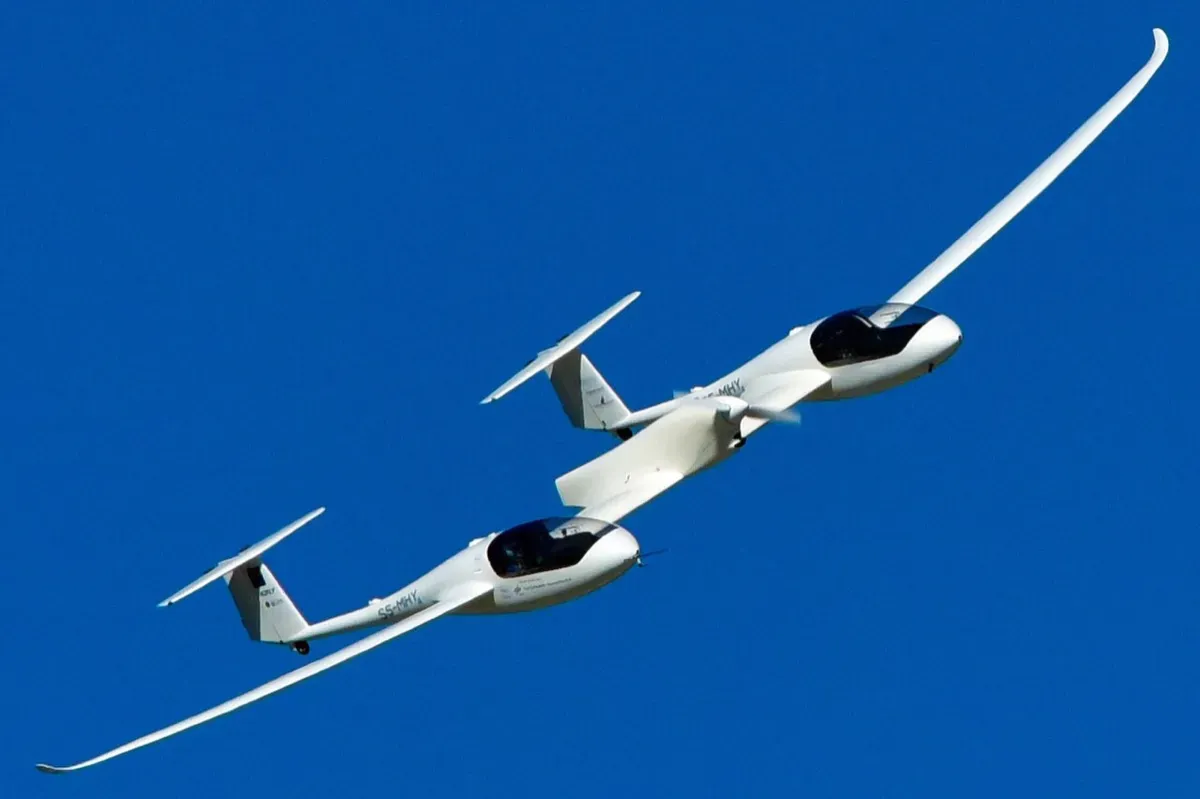
For crewed aircraft the same trade-off is sharper. Batteries are too heavy for most useful ranges. Hydrogen fuel cells promise more energy per kilogram and emissions of only water, but they produce a lot of low-grade heat, and the radiators needed to remove it add weight and drag.
The product
Intelligent Energy makes proton exchange membrane (PEM) fuel cells for aerospace, drones, data centres and other markets, with a product range from 1 kW to 1 MW (Intelligent Energy). Its flight products are:
- IE-SOAR: lightweight modules for fixed-wing, rotary and VTOL drones, from 800 W to 2.4 kW, that replace the battery and follow load demand in the same way. Modules can be combined for systems of 800 W to 24 kW, and are designed to be tolerant of a single point of failure. The company says flight times of more than three times those of batteries have been achieved.
- IE-FLIGHT 120: a 120 kW system launched in July 2026 for long-range fixed-wing drones carrying 150 to 750 kg of payload for surveillance, defence and logistics.
- IE-FLIGHT 300: a 300 kW modular platform for eVTOL aircraft and commuter planes of up to 19 seats, being developed under the UK’s HEIGHTS programme (Intelligent Energy).
How it works
- Fill: a lightweight cylinder on the drone or aircraft is filled with compressed hydrogen in minutes.
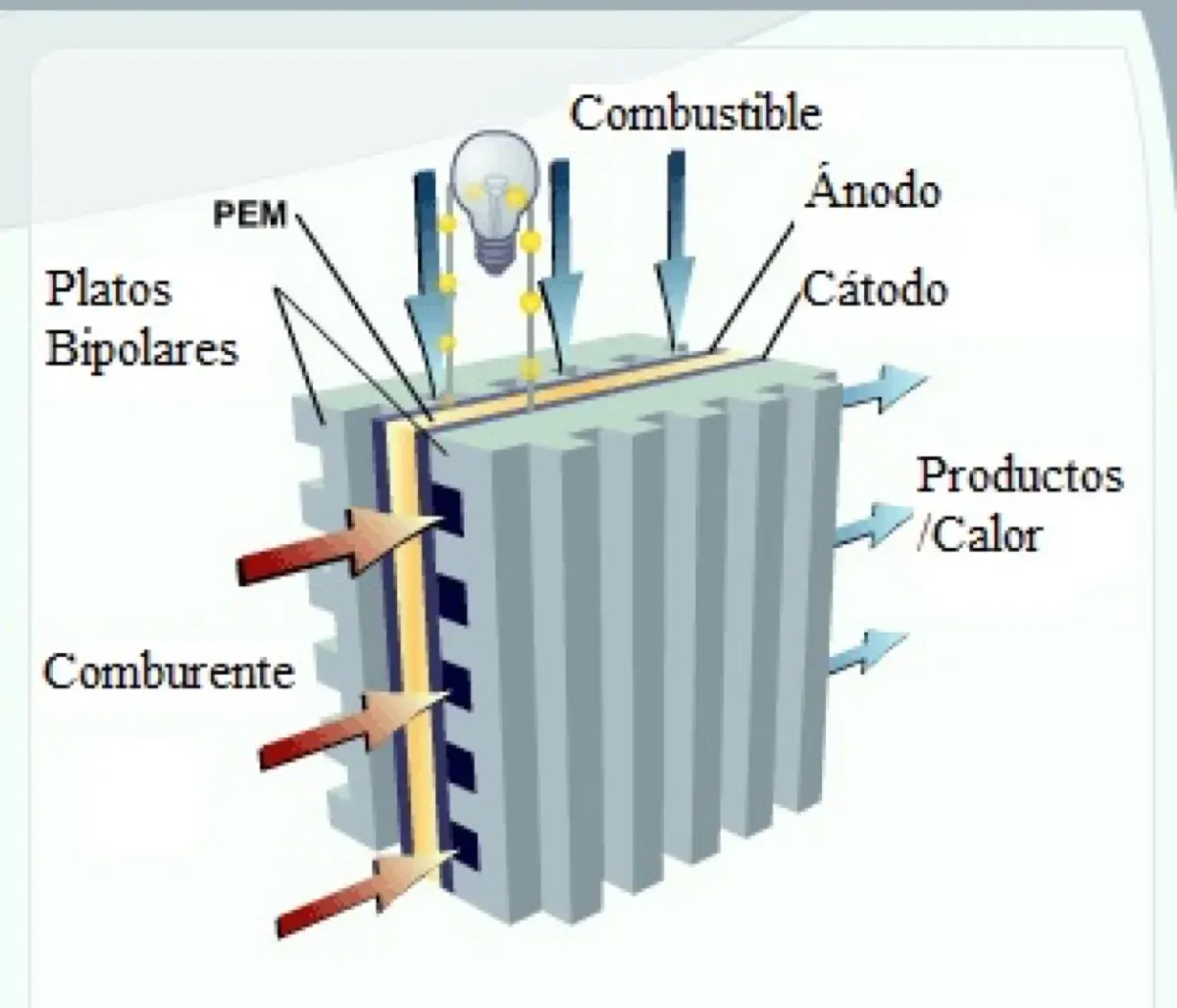
- Feed: hydrogen flows to the fuel cell stack, while fans or the airflow supply oxygen from ambient air.
- React: the PEM cells combine hydrogen and oxygen to make DC electricity, water and heat.
- Cool: Intelligent Energy’s patented direct water-injection cooling uses air-cooled condensers that are smaller at the front than conventional glycol radiators, cutting drag.
- Power: the electricity drives the motors, with a small battery for peaks where needed.
- Emit: the only exhaust is water vapour, with low noise, little vibration and a third of the heat signature of a combustion engine.
Timeline
| Date | Milestone |
|---|---|
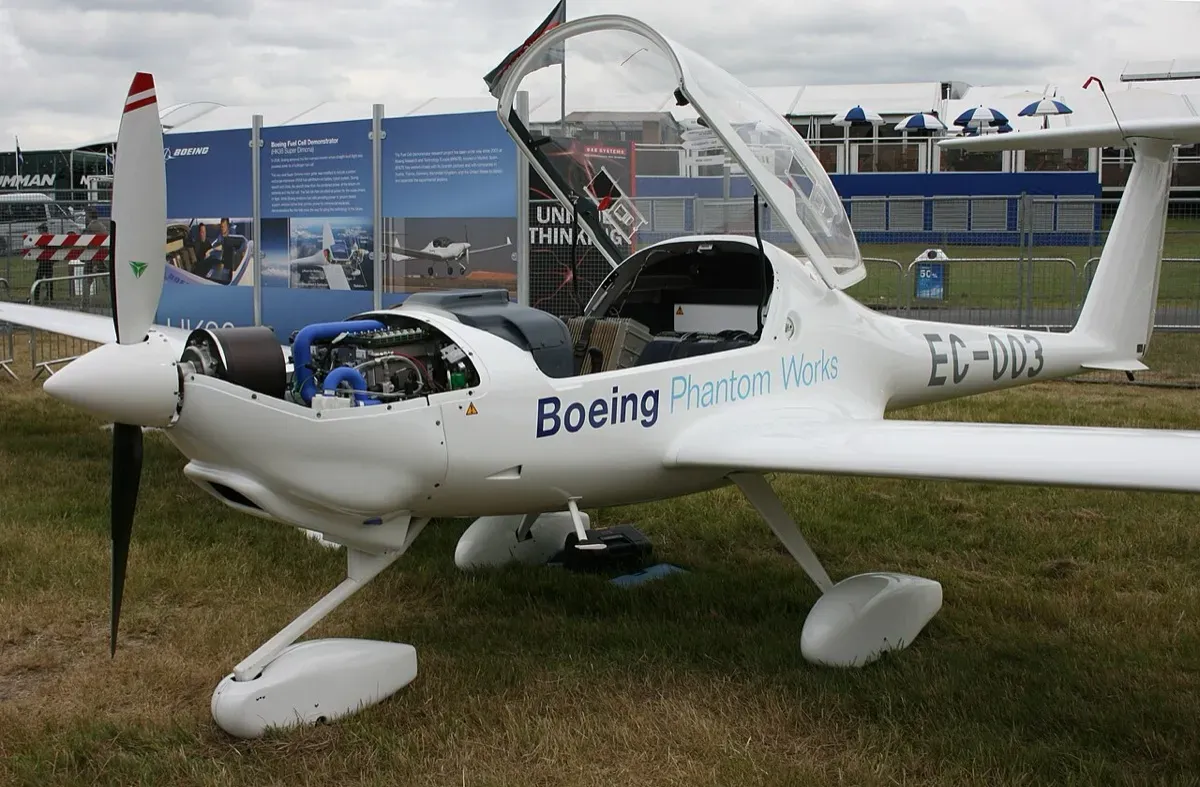
| Feb to Mar 2008 | Boeing’s demonstrator makes three manned flights in Spain on an Intelligent Energy fuel cell system |
| Oct 2022 | Shell uses IE-SOAR on drones to patrol a US pipeline |
| 17 Jun 2025 | GBP 17 million HEIGHTS programme awarded to develop IE-FLIGHT 300 |
| 25 Nov 2025 | IE-SOAR powers the UK’s first hydrogen drone flight beyond visual line of sight |
| 23 Jun 2026 | Five-year H2GEAR research programme completed |
| Jul 2026 | IE-FLIGHT 120 launched; record IE-SOAR order; 150 kW module shown at Farnborough |
Impact and numbers
- First crewed fuel cell flights: in February and March 2008, Boeing’s two-seat demonstrator made three short flights at Ocaña, south of Madrid, using a hybrid battery and fuel cell system developed by Intelligent Energy. Batteries helped on take-off, but in cruise the aircraft relied entirely on the fuel cells (BBC News).
- Commercial drone work: Shell chose IE-SOAR on a Harris Aerial H6 drone for safety patrols of its Falcon pipeline in the north-eastern United States, after comparing it with a combustion hybrid. Shell’s pipeline aviation manager praised the low noise and zero emissions (Intelligent Energy).
- Long-range trial: a 25 kg hexacopter powered by IE-SOAR took off from Llanbedr in Wales and flew deep into Eryri National Park and up to 10 km offshore, beyond the pilot’s line of sight, with flight times of up to three hours and support from uAvionix and operator Skyfarer (Intelligent Energy).
- Aviation research: over five years, the H2GEAR programme led by GKN Aerospace helped Intelligent Energy improve power density, drag and dynamic response, and supported a 1.3 MW test facility in Northamptonshire running on green hydrogen from on-site renewables (Intelligent Energy).
- Hardware shown: at Farnborough in July 2026 the company showed a 150 kW aerospace fuel cell module from H2GEAR with a carbon-fibre enclosure and water recycling, which had exceeded 150 kW in testing (Jumpseat Aerospace News).
- Climate potential: the company estimates that fuel cells across eVTOL, regional aircraft and auxiliary power units could cut CO2 by up to 25.6 million tonnes a year.
Honest caveats. The drone modules are real products with paying customers, but the company does not publish sales volumes, and “largest order to date” is not quantified. The aviation products are at a much earlier stage: IE-FLIGHT 300 is a three-year development programme, aimed at early service in 19-seat aircraft by the end of the decade, and the 150 kW module has been tested on the ground, not flown. The 2008 Boeing flights lasted about 20 minutes each, and Boeing itself said then that fuel cells were unlikely to be the main power source for large passenger aircraft. The CO2 and market figures are company estimates. Most hydrogen today is made from natural gas, so the climate benefit depends on green supply, which Intelligent Energy is testing at its renewables-powered site but which is scarce at airfields.
What’s next
HEIGHTS runs for three years from 2025, with the aim of a ready-to-integrate IE-FLIGHT 300 system for eVTOL and commuter aircraft, followed by scale-up for larger regional aircraft in the 2030s. In drones, the company expects demand to shift towards larger, heavier fixed-wing aircraft, which is the market IE-FLIGHT 120 targets.
Why it matters for Europe / green buyers
The EU’s drone rules, Implementing Regulation (EU) 2019/947, set out how operators can fly in the “specific” category, which covers most beyond-line-of-sight work such as long pipeline or rail patrols, after a risk assessment (EUR-Lex). As those operations become routine, endurance becomes the limiting factor, and hydrogen modules that can be bought off the shelf give European inspection, energy and emergency service operators a quiet, zero-emission option. For aircraft makers, a European supplier of certifiable fuel cell systems matters as eVTOL and commuter programmes look for powertrains.
India is building a domestic drone industry. A production-linked incentive scheme worth Rs 120 crore was notified on 30 September 2021 to reward Indian manufacturers of drones and drone components for value added in India (PIB). Long-endurance hydrogen drones would suit India’s long pipelines, power lines and border and disaster-relief work, and Indian drone makers integrating fuel cell modules could use such incentives.
Sources & image credits
- Intelligent Energy, “IE-SOAR 2.4 hydrogen fuel cell” product page: https://www.intelligent-energy.com/our-products/ie-soar-fuel-cells-for-uavs/ie-soar-2-4/
- Intelligent Energy, “Shell choose fuel cells for pipeline inspection” (19 Oct 2022): https://www.intelligent-energy.com/news/shell-chooses-fuel-cells-for-pipeline-inspection/
- Intelligent Energy, “Intelligent Energy powers UK’s first long-range hydrogen drone trial” (25 Nov 2025): https://www.intelligent-energy.com/news/intelligent-energy-powers-uks-%EF%AC%81rst-long-range-hydrogen-drone-trial/
- Intelligent Energy, “Heavy-lift drone powertrain debuts as hydrogen UAV orders hit record high” (15 Jul 2026): https://www.intelligent-energy.com/news/heavy-lift-drone-powertrain-debuts-as-hydrogen-uav-orders-hit-record-high/
- Intelligent Energy, “Hydrogen lift-off: Intelligent Energy secures £17m programme to power zero-emission flight” (17 Jun 2025): https://www.intelligent-energy.com/news/hydrogen-lift-off-intelligent-energy-secures-17m-to-power-zero-emission-flight/
- Intelligent Energy, “Intelligent Energy advances commercial hydrogen aviation with completion of ATI-backed H2GEAR project” (23 Jun 2026): https://www.intelligent-energy.com/news/intelligent-energy-advances-commercial-hydrogen-aviation-with-completion-of-ati-backed-h2gear-project/
- Jumpseat Aerospace News, “Intelligent Energy unveils 150kW aerospace fuel cell” (Jul 2026): https://jumpseataerospacenews.com/2026/07/intelligent-energy-unveils-150kw-aerospace-fuel-cell/
- BBC News, “Hydrogen-powered plane takes off” (3 Apr 2008): http://news.bbc.co.uk/2/hi/7330311.stm
- EUR-Lex, Commission Implementing Regulation (EU) 2019/947 on the rules and procedures for the operation of unmanned aircraft: https://eur-lex.europa.eu/eli/reg_impl/2019/947/oj/eng
- Press Information Bureau, Government of India, “Incentive of Rs. 120 crore has been provided for Indian manufacturers of drone and drone components under PLI Scheme”: https://www.pib.gov.in/Pressreleaseshare.aspx?PRID=1779782
Images:
- “Boeing Fuel Cell Demonstrator AB1” by Adambro, licensed under CC BY-SA 3.0 (https://creativecommons.org/licenses/by-sa/3.0), via Wikimedia Commons: https://commons.wikimedia.org/wiki/File:Boeing_Fuel_Cell_Demonstrator_AB1.JPG