The problem
Making cement means heating limestone (calcium carbonate) to about 1,450°C to produce clinker. Burning fuel for that heat emits CO2, but around 60% of a cement kiln’s emissions come from the limestone itself as it breaks down into lime and CO2. Switching to renewable fuels or electric heating cannot remove these process emissions. Lower-clinker cements and new binders help, but to reach near zero, most roadmaps assume some carbon capture and storage (CCS) for cement.
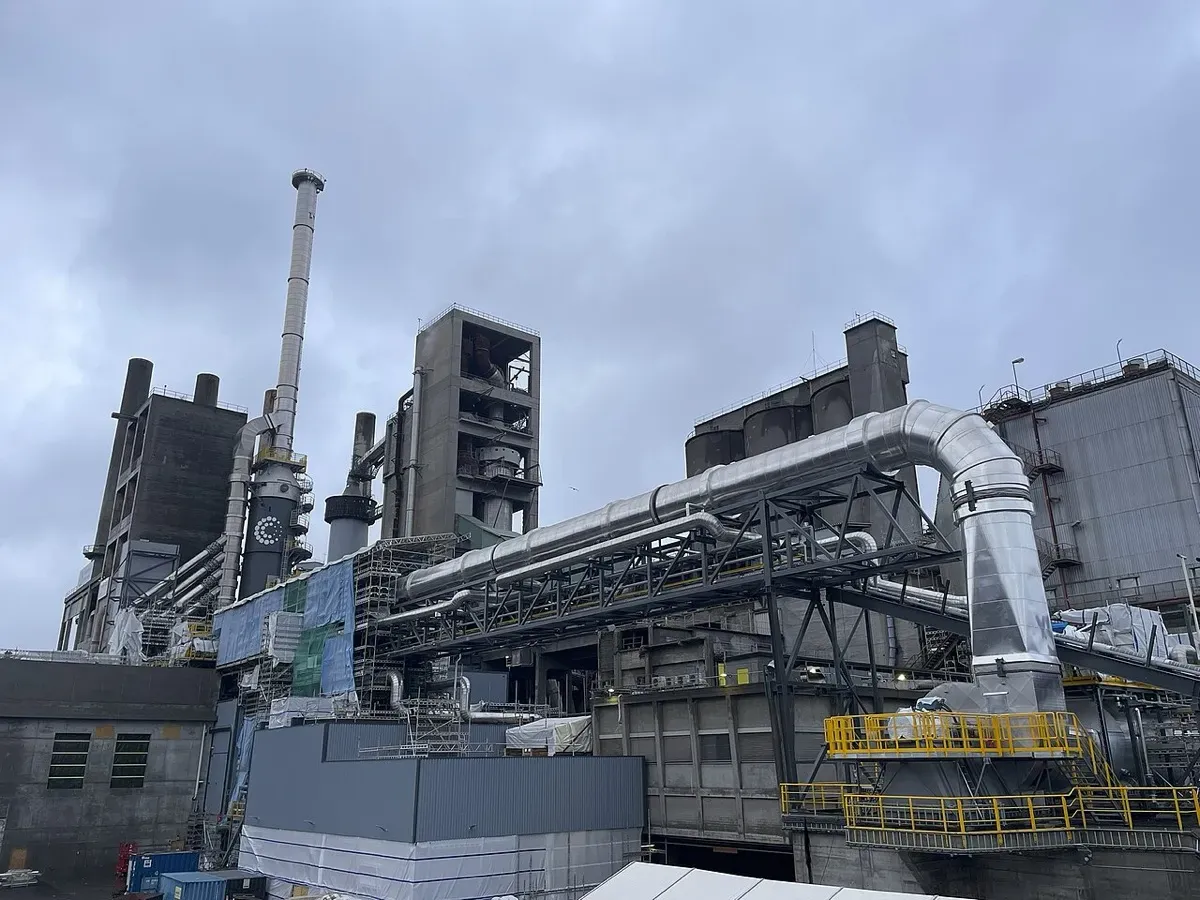
The Brevik works emits about 800,000 tonnes of CO2 a year, roughly 2% of Norway’s total (Carbon Commentary). Europe’s carbon price, and from 2026 the definitive phase of the Carbon Border Adjustment Mechanism for imported cement, make the cost of those emissions increasingly visible.
The product
evoZero is cement, physically the same as the grades builders already use, sold with a near-zero carbon footprint backed by CO2 captured and stored from Brevik. Heidelberg offers two versions (evoZero):
- evoZero Carbon Captured Brevik, produced in and delivered from Brevik.
- evoZero Carbon Captured, delivered from a Heidelberg plant near the customer’s project anywhere in Europe, with the carbon reduction realised at Brevik allocated to it.
Heidelberg states that the near-zero footprint is achieved by applying “chain of custody models”, and that each tonne of captured CO2 is only counted once. DNV Business Assurance Germany provides third-party assurance of clinker produced under capture conditions and of permanently stored CO2, and all volumes are recorded in Heidelberg’s Carbon Bank (Heidelberg Materials, 17 October 2025; DNV assurance statement).
Deliveries began on 17 October 2025. Among the first projects were Skanska’s new Skøyen Station in Oslo, 45 metres underground, and DREIHAUS, three 3D-printed homes in Heidelberg.
How it works
- Flue gas capture: exhaust gas from the cement kiln passes through an absorber where a liquid amine solvent binds the CO2.
- Regeneration: the solvent is heated to release a concentrated CO2 stream and is then reused. SLB Capturi’s design recovers waste heat from the cement plant and the compression system to power this step (SLB Capturi).
- Liquefaction and intermediate storage: the CO2 is compressed, liquefied and stored in tanks on the quay.
- Shipping and injection: ships carry the liquid CO2 to the Northern Lights terminal at Øygarden near Bergen, from where it is piped about 100 km offshore and injected 2,600 metres below the seabed.
- Allocation: captured tonnes are verified and turned into product claims for evoZero deliveries.
Because available waste heat limits the capture plant, the design target was always half of the plant’s emissions, not all of them (Brevik CCS facts).
Timeline
| Date | Milestone |
|---|---|
| 2005 | Heidelberg begins CCS research at Brevik |
| 2020 | Norwegian government approves Longship, including Brevik CCS |
| Dec 2024 | Mechanical completion of the capture plant |
| May 2025 | First 1,000 tonnes of CO2 captured, liquefied and stored on site |
| 18 Jun 2025 | Brevik CCS officially opened by Crown Prince Haakon |
| Aug 2025 | First CO2 injected under the North Sea |
| 17 Oct 2025 | First evoZero deliveries to customers |
| Jun 2026 | Independent analysis questions how much CO2 has actually been stored |
Impact and numbers
- Design capacity: 400,000 tonnes of CO2 a year, about 50% of the plant’s emissions (Heidelberg Materials, 18 June 2025).
- Public support: the plant cost roughly €400 million; the Norwegian state paid about 80% of the capital cost and also covers about 80% of operating costs, according to Carbon Commentary.
- Stored to date: Norwegian Offshore Directorate figures for the Northern Lights well, whose main supplier so far is Brevik, show about 39,500 tonnes injected in 2025 and about 145,500 tonnes from January to August 2026, roughly 185,000 tonnes in total (Sodir factpages).
- Pipeline: Heidelberg is developing further CCS projects, including Slite in Sweden (up to 1.8 million tonnes a year from 2030) and Padeswood in the UK.
Honest caveats. In June 2026, analyst Chris Goodall reported that only about 105,000 tonnes had been injected between August 2025 and the end of May 2026, well below Heidelberg’s promise of 360,000 tonnes in the first year. Heidelberg confirmed the figures to journalists but said it was still in a ramp-up phase that is normal for a project of this scale and had recently reached the promised performance. Monthly injection data have since improved but remain uneven. Separately, buyers should understand that most evoZero is not physically made at Brevik; its footprint is an allocated claim under a chain-of-custody model, so total emissions fall only as fast as Brevik actually stores CO2.
What’s next
The key test for evoZero is simple: sustained injection at or near 400,000 tonnes a year. If Brevik gets there, the volume of near-zero cement Heidelberg can sell grows with it, and the lessons feed into Slite, Padeswood and other projects. The company’s own engineers have written that the project started as a low-cost “proof of concept”, which may explain some teething problems.
The economics are moving in its favour. Under the EU Emissions Trading System, CO2 that is captured and permanently stored does not count as emitted, so every tonne Brevik stores avoids buying an allowance. Free allowances for cement are being phased out between 2026 and 2034 as CBAM takes over, which raises the cost of unabated clinker year by year. That gives captured-carbon cement a growing price advantage, but also puts pressure on Heidelberg to prove that its stored volumes match its marketing.
Why it matters for Europe / green buyers
For contractors, developers and public clients, evoZero is one of the few ways to buy cement with a verified near-zero claim today, which helps with whole-life carbon reporting under the recast EU buildings directive. The best practice is to ask for the DNV assurance, check whether the cement comes from Brevik or uses allocated attributes, and pair it with lower-clinker mixes and efficient design that cut emissions directly.
India is the world’s second-largest cement producer, and its industry is testing carbon capture pilots alongside blended cements and alternative fuels. Indian cement plants also fall under the country’s Carbon Credit Trading Scheme, which sets emission-intensity targets for the sector. Brevik offers a real-world benchmark, including the costs, the public support needed and the ramp-up risks.
Sources & image credits
- Heidelberg Materials, press release on the opening of Brevik CCS, 18 June 2025: https://www.heidelbergmaterials.com/system/files/2025-06/HM_EN_20250618.pdf
- Heidelberg Materials, “evoZero hits the market: world’s first carbon captured cement delivered to customers across Europe”, 17 October 2025: https://www.heidelbergmaterials.com/en/pr-2025-10-17
- evoZero, product website: https://www.evozero.com/
- DNV Business Assurance, assurance statement on evoZero environmental attribute certificates: https://www.evozero.com/system/files/2026-05/DNVs_Assurance_Statement_HM_evoZero_EACs_2025_04_Nov-11_Nov.pdf
- Brevik CCS, “Facts and FAQ”: https://www.brevikccs.com/en/facts-and-faq
- SLB Capturi, “Brevik CCS”: https://capturi.slb.com/projects/brevik-ccs
- Chris Goodall, “The hidden failure of the world’s most important carbon capture site”, Carbon Commentary, 16 June 2026: https://www.carboncommentary.com/blog/2026/6/16/the-hidden-failure-of-the-worlds-most-important-carbon-capture-site
- Norwegian Offshore Directorate, CO2 storage injection table: https://factpages.sodir.no/en/storage/tableview/injection
Images:
- “Heidelberg Brevik Carbon Capture” by PutTheKettleOn, licensed CC BY 4.0 (https://creativecommons.org/licenses/by/4.0), via Wikimedia Commons: https://commons.wikimedia.org/wiki/File:Heidelberg_Brevik_Carbon_Capture.jpg