The problem
Cutting emissions is the main job of climate policy, but it is no longer enough on its own. Almost every pathway that keeps warming well below 2°C also needs carbon dioxide to be taken back out of the atmosphere, to balance emissions that are very hard to stop, such as some from aviation, agriculture and cement, and later to bring concentrations down.
Trees and soils can store carbon, but that carbon can be lost again in fires, droughts or changes in land use. Engineers have therefore looked for removal methods that are measurable and permanent. Direct air capture, or DAC, is the most literal answer: a machine that filters CO2 from ordinary air. The challenge is that CO2 makes up only about 0.04% of the air, so capturing it takes a lot of energy, equipment and money.
The product
Climeworks was founded in 2009 at ETH Zurich by Christoph Gebald and Jan Wurzbacher. It built the first commercial DAC plant in Switzerland and then Orca in Iceland, which captured CO2 and sent it for underground storage.
Mammoth, at Hellisheiði near Reykjavík, is its second Icelandic plant and about ten times the size of Orca. Climeworks broke ground in June 2022 and started operations in May 2024, with 12 of 72 collector containers installed at first. When complete, it is designed for a nameplate capacity of up to 36,000 tonnes of CO2 a year.
The plant runs on renewable geothermal energy. The captured CO2 goes to Climeworks’ storage partner, which dissolves it in water and injects it into basalt rock, where it reacts and forms carbonate minerals. Climeworks sells the resulting tonnes as verified carbon removal credits.
How it works
- Draw in air. Fans pull air through collector containers lined with a solid filter material, called a sorbent.
- Bind CO2. The sorbent chemically binds CO2 molecules as the air passes through.
- Release with heat. When the sorbent is full, the collector is closed and heated, using energy from the nearby geothermal plant, so it releases concentrated CO2.
- Hand over for storage. The CO2 is mixed with water and pumped deep into the basalt bedrock.
- Turn to stone. Over about two years, the CO2 reacts with the rock and becomes solid carbonate minerals.
- Measure and certify. Net removal is calculated after deducting emissions from building and running the plant, then verified for customers.
Timeline
| Date | Milestone |
|---|---|
| 2009 | Climeworks founded at ETH Zurich |
| 2021 | Orca starts operating in Iceland |
| Jun 2022 | Ground broken on Mammoth |
| May 2024 | Mammoth starts operations with 12 of 72 collector containers |
| May 2025 | Climeworks announces 106 job cuts out of 498 |
| H1 2026 | Mammoth produces 675 tonnes of net carbon removal |
| End 2026 | Upgrades planned for all 12 containers in one module |
| Early 2027 | Next-generation DAC technology to be tested at Mammoth |
Impact and numbers
The headline figures have changed a lot in two years. Icelandic investigative outlet Heimildin reported in 2025 that, according to data from the verifier Puro.Earth, Mammoth captured only 105 tonnes of CO2 in its first ten months. Climeworks itself has put the figure at 750 tonnes for the same period. Either way, it was a tiny share of the 36,000 tonne goal, and Heimildin also reported that Climeworks’ total captures in Iceland since 2021 were around 2,400 tonnes.
In a 2026 performance update, co-founder Jan Wurzbacher said 18 months of operating Mammoth had led to new sorbent formulations and mechanical upgrades. Two collector containers running the upgrades for more than six months now reach the design run rate of 1.37 tonnes of CO2 per container per day, double the original units. Their capacity factor, which accounts for maintenance, weather and the plant’s own emissions, is around 40 to 50%.
Net carbon removal, the tonnes actually delivered to customers, rose to 675 tonnes in the first half of 2026 from 119 tonnes in the first half of 2025, a more than five-fold increase. Climeworks says operating cost per tonne fell by more than 50% over the past year, and lab tests have shown a tenfold improvement in sorbent lifetime.
Honest caveats
Still far from nameplate. Even after the gains, half a year of output is under 2% of the plant’s annual design capacity. Most containers have not yet been upgraded.
Disputed early numbers. The gap between Puro.Earth’s 105 tonnes and the company’s 750 tonnes for the first ten months shows how much depends on what is counted and when.
Energy hungry. Heimildin quotes Wurzbacher saying Mammoth would need 5,000 to 6,000 kWh per tonne captured, and that the first plant was not designed for energy efficiency. That only makes sense where clean power is plentiful, as in Iceland.
Money and politics. Climeworks cut 106 of 498 jobs in 2025, citing economic uncertainty and slower momentum for climate tech. Its planned US plant in Louisiana, part of the Project Cypress hub, has faced long delays tied to federal funding uncertainty, although the US Department of Energy confirmed in April 2026 that the hub survived its review.
Removal is not a substitute. Every tonne removed by DAC is expensive. Using credits to justify continued emissions would undercut the point.
What’s next
By the end of 2026, Climeworks plans to bring its new sorbent and mechanical upgrades to all 12 collector containers in one module at Mammoth. From early 2027, it will test its next-generation DAC technology at the plant, which the company says uses a denser process that needs fewer containers for the same output. If those results hold, Mammoth becomes the proving ground for cheaper plants elsewhere, including Louisiana.
Why it matters for Europe and green buyers
For Europe, Mammoth is the continent’s flagship test of engineered carbon removal at industrial scale. The EU is building a certification framework for permanent removals and debating their role in the EU Emissions Trading System. Buyers such as airlines and tech firms that want durable removal credits will look at whether Mammoth’s upgraded containers can keep their design rates, because that decides whether DAC prices ever fall to a level that can be used widely.
For India, DAC at this cost is not a near-term priority, and the country’s own pathways lean on cheaper tools such as renewables, efficiency and nature-based storage. But Mammoth’s lessons about sorbents, energy use and honest reporting are useful to Indian research groups working on capture technologies, and to Indian companies with net zero targets deciding which removal credits to trust.
Sources & image credits
- Climeworks, “Climeworks switches on world’s largest direct air capture plant”, May 2024. https://climeworks.com/press-release/climeworks-switches-on-worlds-largest-direct-air-capture-plant-mammoth
- Climeworks, Jan Wurzbacher, “How Mammoth is unlocking a step change in performance and reducing costs”, 2026. https://climeworks.com/blog/mammoth-direct-air-capture-performance-update
- SWI swissinfo.ch, “Why Swiss carbon removal start-up Climeworks faces serious headwinds”, 2025. https://www.swissinfo.ch/eng/climate-solutions/why-swiss-carbon-removal-start-up-climeworks-faces-serious-headwinds/89386618
- Heimildin, “Climeworks capture fails to cover its own emissions”, 2025. https://heimildin.is/grein/24581/climeworks-capture-fails-to-cover-its-own-emissions/
- The Guardian, “Swiss firm that captures carbon from air to cut workforce by more than 10%”, 17 May 2025. https://www.theguardian.com/environment/2025/may/17/swiss-firm-that-captures-carbon-from-air-to-cut-workforce-by-more-than-10
- Trellis, “U.S. carbon removal industry in turmoil as federal support remains uncertain”, 7 May 2025. https://trellis.net/article/carbon-removal-industry-setbacks-federal-support-uncertain/
- Red River Parish Journal (The Center Square), Project Cypress survives DOE review, 22 April 2026. https://www.redriverparishjournal.com/2026/04/22/
- Wikimedia Commons, “Climeworks-Anlage.jpg”. https://commons.wikimedia.org/wiki/File:Climeworks-Anlage.jpg
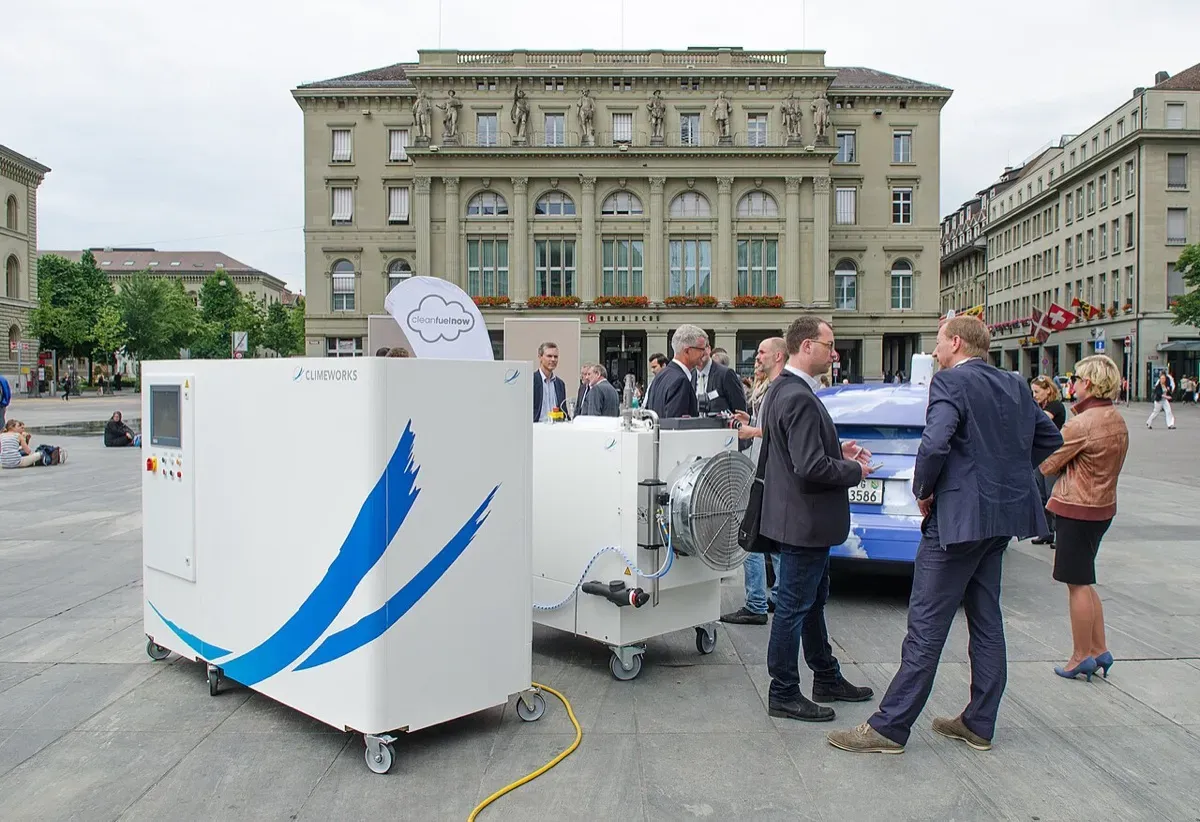
Images: “Climeworks-Anlage”, TRx340, Bundesplatz, Bern, Switzerland, 18 June 2015, CC BY-SA 4.0, via Wikimedia Commons. Illustrative: shows an early Climeworks DAC unit, not Mammoth.