
The problem
A crewed trip around the Moon needs more than a capsule. Astronauts need an engine to leave Earth orbit, electricity, temperature control and a steady supply of oxygen, nitrogen and water for days in deep space, where help is days away.
Europe had no crew vehicle of its own. Yet ESA wanted European hardware and European astronauts at the heart of the next era of lunar exploration, rather than buying seats. The answer was to build the part of Orion that keeps everything running.
The product
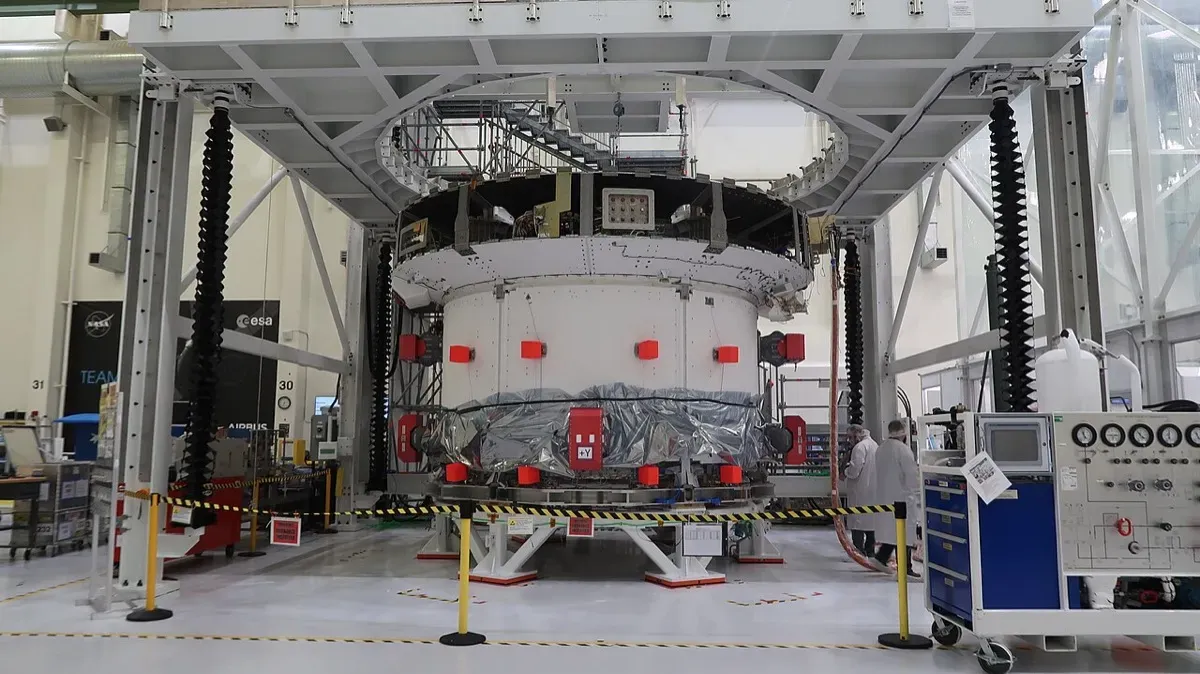
The European Service Module is a cylinder about four metres high and wide that sits beneath Orion’s crew capsule. ESA describes it as providing electricity, water, oxygen and nitrogen, and keeping the spacecraft at the right temperature and on course. Its four solar array wings unfold to span 19 metres and, ESA says, generate enough energy to power two households. It evolved from ESA’s Automated Transfer Vehicle, which made five supply runs to the International Space Station between 2008 and 2014.
According to Airbus, the module has 33 engines: one main engine, a repurposed Space Shuttle orbital manoeuvring engine, eight auxiliary engines and 24 smaller thrusters for attitude control. ESA says the main body carries 8.6 tonnes of propellant. Airbus is the prime contractor, with final assembly in Bremen and components from companies across Europe.
Artemis I proved the structure on an uncrewed flight in 2022. Artemis II was the first time the module’s life support had to keep people alive. The module also supplied stable power for Orion’s new laser communications system, which Airbus says can send data to Earth at up to 260 megabits per second, enough to stream high-definition video of the Moon.
How it works
- Launch. The ESM rides under Orion on NASA’s Space Launch System rocket.
- Unfold. Once in space, four solar wings deploy to generate power.
- Supply. Tanks feed oxygen, nitrogen and water to the crew cabin.
- Regulate. Radiators and heat exchangers manage extreme temperature swings.
- Propel. The main engine fires for the push from Earth orbit to the Moon.
- Steer. Smaller engines and thrusters make course corrections and turns.
- Separate. Shortly before re-entry, the module is jettisoned and burns up.
Timeline
| Date | Milestone |
|---|---|
| 2008 to 2014 | Five Airbus-built Automated Transfer Vehicles supply the ISS |
| 2022 | Artemis I flies ESM-1 around the Moon without crew |
| Late 2025 | ESM-4 delivered to Kennedy Space Center |
| 31 Mar 2026 | ESM-2 declared fully integrated, fuelled and ready |
| 1 Apr 2026 | Artemis II launches from Kennedy Space Center (6:35 p.m. EDT) |
| 6 Apr 2026 | Lunar flyby; crew breaks Apollo 13 distance record |
| 10 Apr 2026 | Splashdown off San Diego; ESM burns up on re-entry as designed |
| 2027 / 2028 | ESM-5 and ESM-6 scheduled for delivery |
Impact and numbers
Artemis II carried NASA astronauts Reid Wiseman, Victor Glover and Christina Koch and Canadian astronaut Jeremy Hansen. NASA says they flew 695,081 miles in total and reached 252,756 miles from Earth, farther than the Apollo 13 crew in 1970. The service module fired its main engine on the second day to send the crew towards the Moon, bringing them to 4,067 miles above the lunar surface at closest approach.
Airbus’s industrial manager for the programme, Siân Cleaver, told Payload that “the service module has worked almost flawlessly”. Ars Technica reported that Orion’s trajectory was so close to predictions that NASA cancelled some course correction burns, and that with nearly 80% of the mission complete the spacecraft had used just 40% of its fuel.
For Europe, the module is also currency. ESA described its six-module contract with Airbus as “guaranteeing seats for ESA astronauts”, with hardware built by companies from ten European countries. After the flight, the four astronauts visited Airbus in Bremen to meet the employees who designed and assembled their service module.
Honest caveats
A valve problem to fix. During Artemis II, an internal helium leak in the oxidiser pressurisation system rose after the main engine burn. NASA’s Amit Kshatriya said the in-flight leak rate was an order of magnitude higher than on the ground, still acceptable for a free-return flyby, but likely to need “an extensive redesign” before Artemis IV goes into lunar orbit. A helium leak was also seen on Artemis I.
Single use and toxic propellants. Each module is discarded and burns up before re-entry. It runs on hydrazine fuel and nitrogen tetroxide, both hazardous chemicals.
Political uncertainty. NASA paused the lunar Gateway station in 2026. ESA’s Josef Aschbacher said Europe must now negotiate how astronaut seats earmarked for Gateway can be used for surface missions. Airbus says its own contract is with ESA and largely unaffected.
Defence context. Airbus Defence and Space also builds military systems. This story covers only its civil exploration hardware.
Climate relevance is indirect. Crewed exploration does not cut emissions. Its value is in technology, skills, science and international cooperation.
What’s next
Under NASA’s revised plan, Artemis III in 2027 will test rendezvous and docking with commercial lunar landers closer to Earth, using ESM-3. Artemis IV in 2028 is planned to land astronauts on the Moon, with ESM-4 already at Kennedy Space Center. ESM-5 and ESM-6 are in production in Bremen.
Why it matters for Europe and green buyers
For Europe, the ESM shows that the continent can build and qualify life-critical deep space hardware, and that this buys a seat at the table: ESA astronauts on future lunar missions. It also sustains high-skill jobs across ten countries. ESA’s head says the long-term goal is more European autonomy in human spaceflight.
For India, which is developing its own crewed spaceflight capability, the ESM is a model of how a partner can contribute a whole subsystem to a larger mission and gain access in return. For the world, Artemis II shows that complex international hardware can work together safely, a lesson that matters for science and for space sustainability alike.
Sources & image credits
- Airbus, “Heart of the mission: Airbus-built ESM to power historic Artemis II crew to the Moon”, 31 Mar 2026. https://www.airbus.com/en/newsroom/press-releases/2026-03-heart-of-the-mission-airbus-built-esm-to-power-historic-artemis-ii-crew-to-the-moon
- Airbus, “Artemis II: A historic lunar mission with Airbus”. https://www.airbus.com/en/space/orion-european-service-module/artemis-ii-mission
- ESA, “European Service Module”. https://www.esa.int/Science_Exploration/Human_and_Robotic_Exploration/Orion/European_Service_Module
- ESA, “Three more service modules for Artemis to be built in Europe”. https://www.esa.int/Science_Exploration/Human_and_Robotic_Exploration/Orion/Three_more_service_modules_for_Artemis_to_be_built_in_Europe
- NASA, “NASA Welcomes Record-Setting Artemis II Moonfarers Back to Earth”, Apr 2026 (updated 7 May 2026). https://www.nasa.gov/news-release/nasa-welcomes-record-setting-artemis-ii-moonfarers-back-to-earth/
- Payload, “Artemis II Gives Airbus Hope For European Spaceflight”, Apr 2026. https://payloadspace.com/artemis-ii-gives-airbus-hope-for-european-spaceflight/
- Ars Technica, “Orion helium leak no threat to Artemis II reentry but will require redesign”, Apr 2026. https://arstechnica.com/space/2026/04/nasa-homes-in-on-likely-redesign-to-fix-orion-spacecrafts-leaky-valves/
- Phys.org / AFP, “Europe to negotiate with NASA on lunar missions: ESA”, 2 Apr 2026. https://phys.org/news/2026-04-europe-nasa-lunar-missions-esa.html
- Wikimedia Commons, “Artemis II European Service Module (KSC-20230113-PH-NAS01 0001)”. https://commons.wikimedia.org/wiki/File:Artemis_II_European_Service_Module_(KSC-20230113-PH-NAS01_0001).jpeg
Images: “Artemis II European Service Module (KSC-20230113-PH-NAS01 0001)”, NASA Kennedy Space Center, 13 Jan 2023, public domain, via Wikimedia Commons. Shows the flight module ESM-2.
.jpeg)