The problem
Around 2.1 billion people worldwide cook on open fires or simple stoves burning wood, dung, crop waste, kerosene or coal. The World Health Organization estimates that the resulting household air pollution caused about 2.9 million premature deaths in 2021, and that women and young children, who spend the most time near the fire, are most exposed (WHO fact sheet). Collecting fuel also takes hours each week, time that could go to school, paid work or rest.
India’s LPG programme has transformed access, with about 10.58 crore connections under the Pradhan Mantri Ujjwala Yojana by July 2026. But many households still “stack” fuels: they use gas for some meals and the chulha for others, because refills are expensive. Ujjwala beneficiaries averaged 4.71 refills a year in 2025-26, and in July 2026 the government confirmed that the number of refills eligible for its targeted ₹300 subsidy had been cut from nine to four a year (Lok Sabha answer, 23 July 2026). For millions of families, biomass will remain part of the kitchen for years.
The product
Greenway’s founders set out to design a better biomass stove rather than ask families to abandon free local fuel. They spent about a year and a half visiting villages and testing prototypes with users before launching the Smart Stove (Economic Times, 4 November 2025). The company’s own history dates the collaboration to 2010 and the formal co-founding to 2011 (Greenway, About us).
The Smart Stove is a single-burner, portable stove made of stainless steel and aluminium with bakelite handles. It measures about 10 by 10 by 11 inches, can carry pots weighing up to 40 kg, and sells for ₹2,399 including GST. Greenway says it uses 65% less fuel and produces 70% less smoke than a traditional mud stove, and that replacing a chulha avoids one to two tonnes of CO2 a year (Greenway Smart Stove). Ash stays inside the stove and is tipped out after cooking. The Jumbo Stove, Greenway’s flagship, serves larger families and bulk cooking and retails for ₹3,499, a price the company says it has not raised in more than five years thanks to vertically integrated manufacturing in Vadodara.
How it works
A traditional chulha wastes fuel because air reaches the fire unevenly, so much of the wood smoulders rather than burns. The Smart Stove improves combustion through design:
- Combustion chamber: fuel such as wood, crop residue or dung cakes is fed into an enclosed metal chamber that keeps the fire hot and concentrated under the pot.
- Air regulation: a patented air-flow system, with no moving parts, draws air in and directs it to where combustion happens, so more of the gases released from the fuel burn instead of escaping as smoke.
- Heat transfer: the pot sits close to the flame, so more of the heat goes into the food.
- Ash handling: ash collects inside the body rather than spilling onto the floor.
The result is less fuel for the same meal and visibly less smoke. Because the stove still burns solid biomass, it reduces exposure rather than eliminating it.
Timeline
| Date | Milestone |
|---|---|
| 2010 | Founders begin collaborating on a rural cookstove |
| 2011 | Greenway co-founded; Smart Stove developed after extensive field research |
| 2013 | Founders named Echoing Green Fellows |
| Mid-2019 | Carbon-finance-backed subsidies begin to support stove sales |
| 2024 | Expansion into rooftop solar and energy management |
| Nov 2025 | Company reports more than 3 million stoves sold; expansion in Tanzania and Zambia |
| Jan 2026 | Planned launch of tabletop water purifiers |
Impact and numbers
- Scale: more than 3 million cookstoves sold over the past decade, through over 300 partners including community groups, NGOs, banks and microfinance lenders (Greenway). Media reports put the figure at about 3.1 million homes (The Better India).
- Affordability: stoves are financed through public sector banks, regional rural banks, NBFC-MFIs and NGO lenders, so families can pay in instalments; CSR programmes cover households new to credit.
- Measured outcomes: in its climate finance projects, Greenway tracks time saved collecting fuel, time saved cooking, money saved each month and self-reported reductions in coughing, breathlessness and itchy eyes.
- Beyond stoves: the company has sold more than 250,000 LED inverter bulbs and is developing induction stoves and solar-powered institutional cooking systems.
- Sector profile: Greenway is listed in the Clean Cooking Alliance sector directory (Clean Cooking Alliance).
Honest caveats. The 65% fuel and 70% smoke figures are company claims compared with traditional chulhas; real-world savings depend on fuel, cooking habits and whether families keep using the old stove too. The WHO counts biomass stoves as clean only if they meet its emission targets, which most improved biomass stoves, including fan-less designs like this one, are not designed to guarantee, so health benefits may be smaller than the fuel savings suggest. Carbon credits from cookstove projects have been heavily criticised: a 2024 study in Nature Sustainability found a sample of 51 projects was over-credited by about 9.2 times on average (Gill-Wiehl, Kammen and Haya, 2024). Any buyer of cookstove credits should demand metered usage data.
What’s next
Greenway sees the cookstove as an entry point to a wider rural energy business: LED inverter bulbs, rooftop solar, water purifiers and, as electricity access becomes universal, induction cooking. Its distribution model, built on local field officers drawn from the communities they serve, is being replicated in Tanzania and Zambia. The 2026 LPG price shock and the cut in subsidised refills make an efficient biomass stove more relevant, not less, for poorer households.
Why it matters for Europe / green buyers
For European companies and foundations funding clean cooking through CSR or carbon finance, Greenway shows what a locally designed, locally made product can achieve at scale. The lesson is to fund outcomes, not units: insist on usage monitoring, conservative crediting and a pathway towards fully clean fuels such as biogas, LPG or electric cooking. Within Europe, wood stoves are also a major source of fine particle pollution, a reminder that combustion quality matters everywhere.
Sources & image credits
- Greenway, “About us”: https://www.greenwayappliances.com/about-us
- Greenway, “Greenway Smart Stove” product page: https://www.greenwayappliances.com/greenway-smart-stove
- The Economic Times, “Fuelling change: a cookstove revolution for rural India is transforming into a scalable clean energy business”, 4 November 2025: https://economictimes.indiatimes.com/small-biz/sustainability/fuelling-change-how-greenways-cookstove-revolution-for-rural-india-is-transforming-to-scalable-clean-energy-business/articleshow/125075167.cms
- The Better India, “Startup’s smart stove reduces indoor smoke by 70%, saving lives in 3 million rural homes”: https://thebetterindia.com/342452/traditional-chulha-smoke-while-cooking-greenway-grameen-ankit-mathur-neha-juneja-smart-stove/
- World Health Organization, “Household air pollution” fact sheet: https://www.who.int/news-room/fact-sheets/detail/household-air-pollution-and-health/
- Gill-Wiehl, A., Kammen, D. M. and Haya, B. K., “Pervasive over-crediting from cookstove offset methodologies”, Nature Sustainability, 2024: https://www.nature.com/articles/s41893-023-01259-6
- Lok Sabha, Unstarred Question No. 734, “Implementation of PMUY”, answered 23 July 2026: https://sansad.in/getFile/lsapps/loksabhaquestions/annex/188/AU734_YoIA4C.pdf
- Clean Cooking Alliance, sector directory entry for Greenway Grameen Infra: https://cleancooking.org/sector-directory/greenway-grameen-infra-pvt-ltd/
Images:
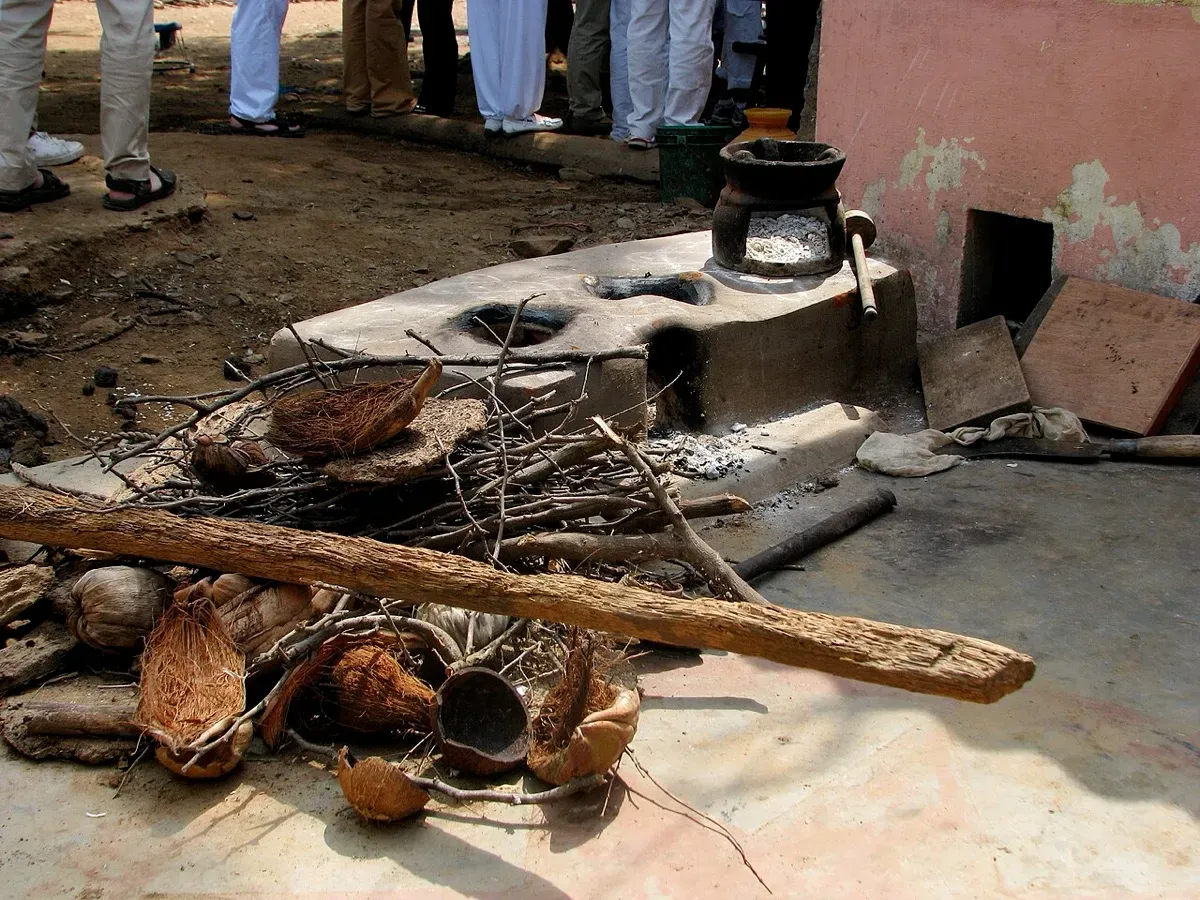
- “Chulla cookstove tamil nadu india” by mckaysavage, licensed CC BY 2.0 (https://creativecommons.org/licenses/by/2.0), via Wikimedia Commons: https://commons.wikimedia.org/wiki/File:Chulla_cookstove_tamil_nadu_india.jpg